Quick answer
Adjust the Beast Harness by loosening all straps first, then tightening the chest band before the shoulder straps. Aim for a snug fit that lets you slide one finger under each strap—any looser and the harness will shift during wear.
Why strap order matters on a leather chest harness
The Beast Harness uses multiple adjustment points, and tightening them in the wrong order can leave the chest band loose even when the shoulder straps feel tight. Start with the chest band because it carries most of the harness's weight and sets the baseline for everything else. If you tighten the shoulders first, the chest band may ride up or sit unevenly.
Leather also has less stretch than elastic or nylon harnesses, so small adjustments make a bigger difference. Tighten in half-inch increments and check the fit after each change rather than cranking every strap down at once.
Signs your harness is too loose or too tight
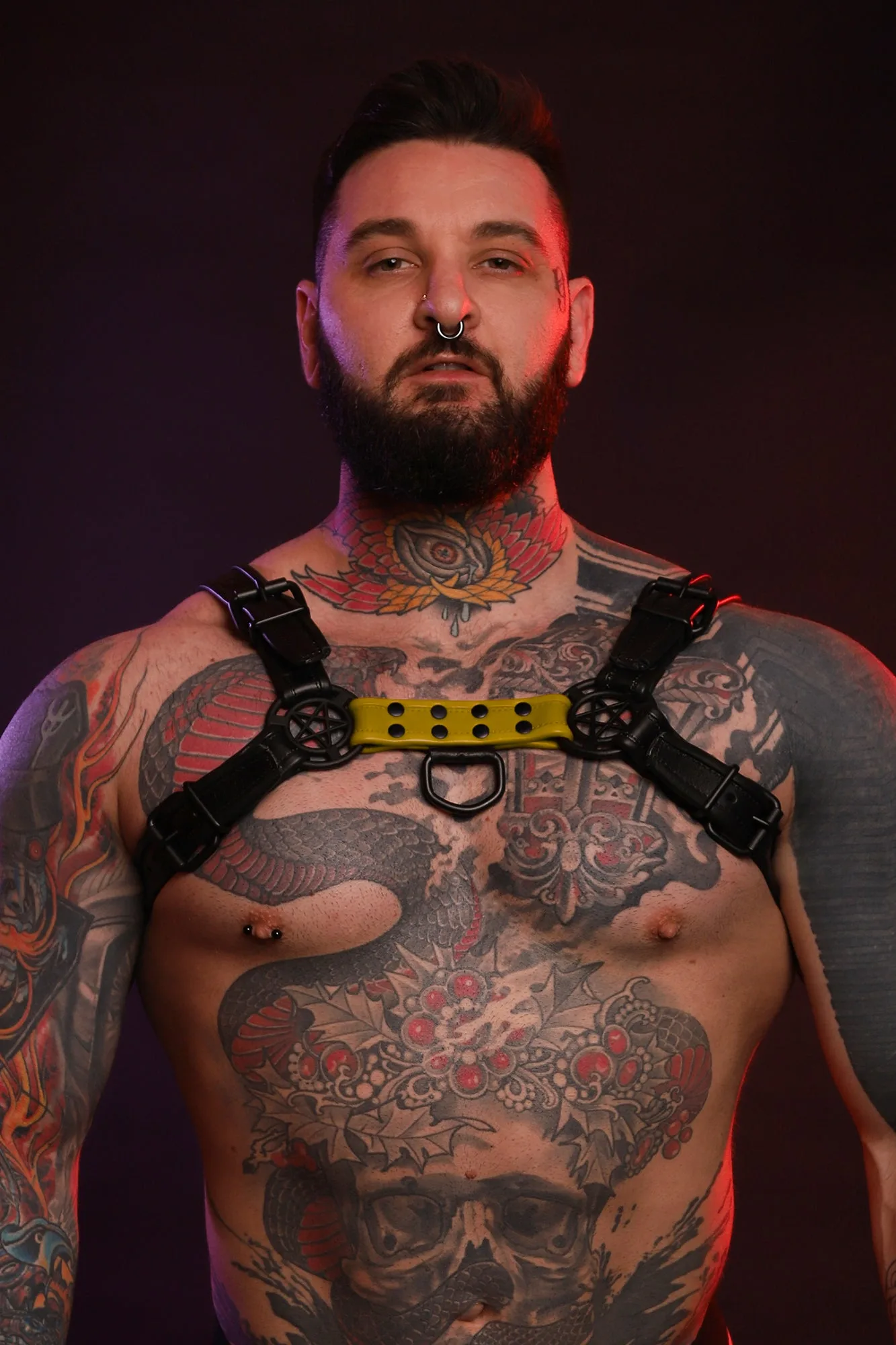
A harness that is too loose will slide down when you raise your arms or twist your torso, and the pentagram O-rings may sit off-center. A harness that is too tight leaves red marks within minutes, restricts breathing, and can dig into the shoulders. The sweet spot is snug enough that the harness stays put but loose enough that you forget you're wearing it.
Check the fit by doing a few slow shoulder rolls and a gentle twist. If the chest band moves more than an inch, tighten it. If you feel pressure points at the collarbone or underarms, loosen the nearest strap.
Step-by-step Beast Harness adjustment
- Loosen all straps before putting it on: Fully open the chest band and shoulder straps so the harness slides over your head and shoulders without twisting. Common mistake: trying to wiggle into a pre-tightened harness, which strains the leather and makes it hard to tell where the pressure points are. A harness that goes on easily is easier to adjust accurately.
- Center the chest band and pentagram O-rings: Position the chest band so the pentagram O-rings sit evenly across your chest, then tighten the chest strap until it feels snug but not restrictive. Check that the band is level—not riding up at the front or dipping at the back. If the O-rings are off-center, loosen and reposition before tightening further.
- Tighten the shoulder straps evenly: Adjust each shoulder strap in small increments, alternating sides, until the harness feels stable when you move. Common mistake: tightening one side all the way before the other, which pulls the chest band crooked. Compare strap lengths by feel—both shoulders should carry equal tension.
- Do a movement test: Raise your arms overhead, twist your torso, and bend forward. The harness should stay in place without shifting more than an inch. If it slides, tighten the chest band first, then the shoulders. If it digs in, loosen the nearest strap half an inch. Adjust while standing—sitting changes how the straps sit.
- Fine-tune for comfort over time: Wear the harness for a few minutes before your final adjustment. Leather warms and softens slightly with body heat, so a fit that felt perfect immediately may need a small tweak. Common mistake: over-tightening at first because leather feels stiff—give it time to settle. Recheck the fit after 10 minutes of wear and adjust as needed.
Product facts
-
Beast Harness: The Beast Harness is made of premium leather with custom pentagram O-rings and black hardware. Leather holds its shape and provides firm support, so each strap adjustment stays where you set it—no constant retightening mid-wear.
Beast Harness