Quick answer
Break in a new Baronfig notebook by opening it in small sections from the center outward, pressing each section flat with a clean weight, and leaving it closed under weight overnight before writing. Skip the common mistake of forcing the spine flat on day one and avoid writing on page one until the binding has relaxed.
Why a new notebook needs a slow opening
A fresh binding is stiff because the glue and paper sections have not yet learned how far they can flex. If you crack it open to the center immediately, you stress the hinge and can loosen pages near the front. Working from the middle outward distributes that stress evenly, which is why the technique below starts at the center rather than page one.
What to have on hand before you start
You do not need special tools. A clean, flat surface, a couple of hardcover books or a small weighted object, and a sheet of scrap paper are enough. The scrap paper matters because it protects the first page from oils and pressure marks while you flatten sections.
How to choose what goes on page one
The baronfig notebook first page is the hardest to write on later if you change your mind, so decide its job before you commit. Many people use it as an index, a title page, or a simple-358900">simple-358888">simple start date. If you are unsure, leave it blank for a week and use a sticky note-358708">note as a placeholder. That way you are not stuck with a heading you regret.
Signs you are pushing too hard
Stop if you hear a sharp crack, feel the spine resist at the hinge, or see pages buckle near the center. A little resistance is normal; a sudden give is not. If the notebook will not lie flat after two gentle passes, close it, weight it, and try again the next day. Patience here protects the binding for the whole life of the notebook.
Step-by-step: breaking in your Baronfig notebook
- 1. Open from the center, not the front: Hold the closed notebook upright and let it fall open to the middle. Press the center section gently with a clean hand, then work outward in small groups of pages toward the front and back covers. Checkpoint: the spine should flex slightly, not crack. If it resists, stop and go to step 2.
- 2. Flatten each section with a weight: Lay the notebook flat and place a sheet of scrap paper over the open pages. Set a hardcover book or small weight on top for a few minutes per section. Repeat for the front, middle, and back thirds. Mistake to avoid: pressing only the middle. Uneven pressure leaves the front and back sections stiff.
- 3. Rest it closed under weight overnight: Close the notebook, align the covers, and place it under a stack of books or a flat weight until morning. This trains the spine to stay flat without forcing it. Checkpoint: the notebook should open more easily the next day. If not, repeat step 2 once.
- 4. Set up page one once the binding relaxes: After the notebook has rested, write your title, index, or start date on the first page. Use a pencil if you are unsure, or leave it blank and start on page two. Mistake to avoid: writing page one while the binding is still tight, which can smudge or dent the paper.
- 5. Write the first entry and check lay-flat: Open to your chosen page and write a short entry. Notice whether the notebook stays open on its own. If it closes, close the book and repeat the overnight weight step. Next step: once it lies flat, keep a light hand for the first week and avoid forcing the spine past its natural opening.
Papier designs that make a new notebook feel personal
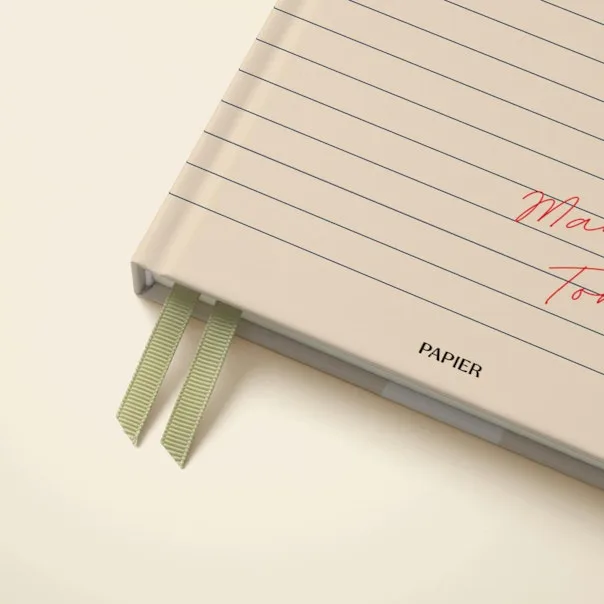
- Playful Cats: Playful Cats is a Papier design with a whimsical feline motif intended to add personality to everyday notes and lists. If you want page one to feel less formal, a playful cover or insert design gives the notebook a clear identity from the start.
- Rise and Shine: Rise and Shine is a Papier stationery item with a simple, clean design that fits a variety of everyday uses. A clean design is a good match when you plan to use page one as a plain index or date page rather than a decorative title.
- Joy: Joy is a Papier product with a customizable title option. A customizable title lets you label the notebook before you write in it, which can settle the page-one decision early.