Quick Answer
For long-range shooting up to 600 yards, a 6-24x50 rifle scope with an adjustable objective, mil-dot reticle, and exposed tactical turrets offers the best balance of precision and value.
Why Magnification and Objective Size Matter
A 6-24x magnification range gives you the flexibility to shoot at both medium and long distances. At 6x, you can acquire targets quickly, while 24x lets you see fine details at extended ranges. The 50mm objective lens gathers more light, which helps during dawn and dusk shooting sessions.
However, higher magnification and a larger objective lens increase the scope's weight and size. If you plan to carry your rifle for long distances, consider whether the added bulk is worth the optical performance.
Parallax Adjustment: Fixed vs. Adjustable Objective
Parallax error occurs when the target image and the reticle are not on the same focal plane, causing the point of aim to shift as your eye moves. A scope with a fixed parallax is typically set for a specific distance, often 100 yards, which can cause inaccuracy at other ranges.
An adjustable objective (AO) scope lets you fine-tune the parallax for the exact distance you are shooting. This is especially important for long-range shooting, where small parallax errors can lead to missed shots. The Sniper 6-24x50mm Scope features a front AO adjustment, allowing you to sharpen the target image and eliminate parallax at various distances.
Reticle Options: Mil-Dot vs. Other Styles
The reticle is your aiming reference, and different styles serve different purposes. A mil-dot reticle has dots spaced at milliradian intervals, which you can use for holdover, windage correction, and ranging targets. This makes it a favorite among long-range shooters who prefer to estimate adjustments without turning turrets.
Illuminated reticles, such as red, green, or blue, improve visibility in low-light conditions or when aiming at dark targets. However, they consume battery and may add a bit of weight. Decide whether you need illumination based on your typical shooting environment.
Turret Design: Exposed vs. Capped
Turrets are how you adjust windage and elevation. Capped turrets are less likely to be bumped out of zero, making them good for hunting. Exposed tactical turrets allow quick adjustments in the field, which is essential for long-range shooting where you often need to dial for different distances.
Look for turrets with clear, repeatable clicks. A 1/4 MOA per click adjustment is common and provides fine control. Also, consider whether the turrets can be reset to zero after sighting in, which simplifies making future adjustments.
Build Quality and Mounting Considerations
A rifle scope must withstand recoil and rough handling. Look for a body made from aircraft-grade aluminum, such as 6061 T6, which offers strength without excessive weight. Tube diameter affects mounting compatibility: a 1-inch tube is standard and fits many mounts, while 30mm tubes allow more elevation travel but require specific rings.
Check what accessories are included. Some scopes come with rings, lens covers, and batteries, which can save you money and hassle. For example, the Sniper 6-24x50mm Scope package includes scope rings that fit Picatinny rails, flip-up lens covers, and a CR2032 battery.
Decision Rules for Choosing a 6-24x50 Scope
- Magnification Range: Choose 6-24x if you need to shoot from 100 to 600+ yards. If you never shoot past 300 yards, a lower magnification like 4-16x may be lighter and easier to use. Match magnification to your typical shooting distances.
- Parallax Adjustment: Select a scope with an adjustable objective or side focus if you shoot at varying distances. Fixed parallax scopes are acceptable only if you always shoot at the preset distance. AO is essential for precision at multiple ranges.
- Reticle Type: Use a mil-dot reticle if you plan to use holdover or range targets. Choose a simple duplex if you only need a basic crosshair. Illumination is a bonus for low light. Mil-dot offers more versatility for long-range.
- Turret Style: Pick exposed tactical turrets for quick field adjustments. Capped turrets are better if you worry about accidental bumps and prefer a set-and-forget setup. Exposed turrets are a priority for dialing in the field.
- Build and Mounting: Ensure the tube diameter matches your existing rings. A 1-inch tube is common, but 30mm tubes offer more travel. Check that the scope includes all necessary accessories. Verify compatibility before purchase.
Product Facts
-
Sniper 6-24x50mm Scope W Front AO Adjustment. Red/Blue/Green mil-dot Reticle: This scope has a front adjustable objective (AO) for parallax adjustment. You can fine-tune the image at different distances, which is critical for long-range accuracy.
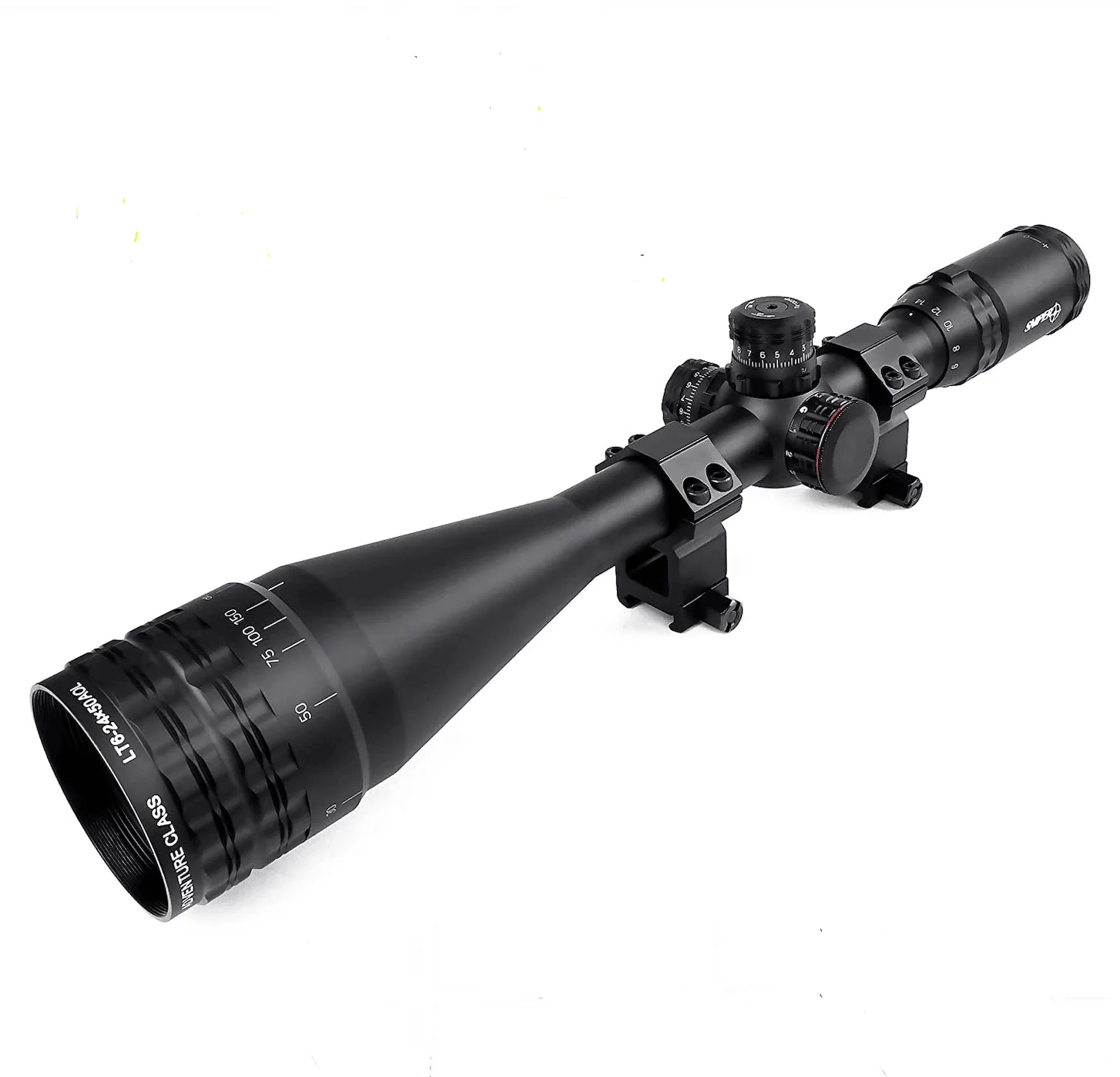
Sniper 6-24x50mm Scope W Front AO Adjustment. Red/Blue/Green mil-dot Reticle
-
Sniper 6-24x50mm Scope W Front AO Adjustment. Red/Blue/Green mil-dot Reticle: It features a red, green, and blue illuminated mil-dot reticle. The illuminated mil-dot reticle helps with holdover and low-light shooting, and the color options let you match your target background.
-
Sniper 6-24x50mm Scope W Front AO Adjustment. Red/Blue/Green mil-dot Reticle: The turrets are quick tactical zero locking/resetting with 1/4 MOA per click adjustments. You can dial windage and elevation quickly and return to zero after sight-in, making field adjustments easier.
-
Sniper 6-24x50mm Scope W Front AO Adjustment. Red/Blue/Green mil-dot Reticle: The body is 6061 T6 aircraft-grade aluminum with a 1-inch tube. It is durable yet not overly heavy, and the 1-inch tube fits a wide range of standard mounts.
Who Should Buy This Type of Scope
Best for
- Long-range shooters who need parallax adjustment at various distances
- Hunters who shoot in low light and want an illuminated reticle
- Tactical shooters who prefer exposed turrets for quick adjustments
Not for
- Shooters who only shoot at fixed short ranges and don't need parallax adjustment
- Those who prefer a lightweight, compact scope for close-quarters use