Quick answer
Choose a comb with rounded teeth and the right tooth spacing for your boy's hair type—fine hair needs a fine-tooth comb, while thick or curly hair benefits from a wide-tooth version.
Tooth spacing matters more than you think
The distance between teeth determines how the comb interacts with different hair textures. Fine-tooth combs (closely spaced teeth) are ideal for smooth, thin hair because they distribute product evenly and help create neat parts. Wide-tooth combs (with more space between teeth) are better for thick, wavy, or curly hair because they detangle without pulling or breaking strands.
For boys with very short hair, a comb with medium spacing is versatile enough for everyday styling and product application. If your child has sensitive scalp or tangles easily, a wide-tooth comb is usually the gentler option.
Material and teeth shape affect comfort
Combs come in plastic, metal, wood, and cellulose acetate. Metal combs can be sturdy but may feel cold and are less forgiving on the scalp. Wooden combs are eco-friendly but can absorb moisture and may rough if not finished well. Cellulose acetate is a plant-based plastic that is durable, smooth, and gentle on the scalp—a good balance for kids.
Rounded teeth are essential for children. They prevent scratching and poking, making combing a more pleasant experience. Always check that the teeth are smooth and free of sharp edges, especially if your child has a sensitive scalp.
Size and handle design
A comb that's too large can be awkward for small hands. Look for a compact size that fits comfortably in your hand and is easy to maneuver around the head. A handle with a non-slip grip can also help if your child is learning to comb his own hair.
Some combs have a pointed tail for sectioning, but that can be unsafe for young children. For everyday use, a simple comb with a rounded handle is safer and just as effective.
Decision rules for choosing a comb
- Hair type: fine or thin: Choose a fine-tooth comb (closely spaced teeth) to smooth and style without adding bulk. It also helps distribute styling products evenly. If your boy has fine hair, avoid wide-tooth combs as they may not provide enough control.
- Hair type: thick, wavy, or curly: Opt for a wide-tooth comb to detangle gently and reduce breakage. Wide spacing allows the comb to glide through without pulling. Wide-tooth combs are also useful for applying leave-in conditioners to curly hair.
- Sensitive scalp or tangles easily: Select a comb with rounded teeth and a smooth material like cellulose acetate. Rounded teeth prevent scratching and make combing more comfortable. Check that the teeth are uniformly shaped and free of sharp edges before purchase.
- Age and hand size: For toddlers and younger boys, choose a compact comb that is easy to grip. A handle with a non-slip surface can help if the child is learning to comb his own hair. Avoid combs with sharp tail ends; a rounded handle is safer for young children.
Product to consider
-
Boy's Hair Comb: The Boy's Hair Comb is crafted from rugged and durable cellulose acetate with 40 uniform teeth and soft, rounded teeth. This comb is built to handle daily use by young boys while being gentle on the scalp, making it a solid choice for detangling and styling without irritation.
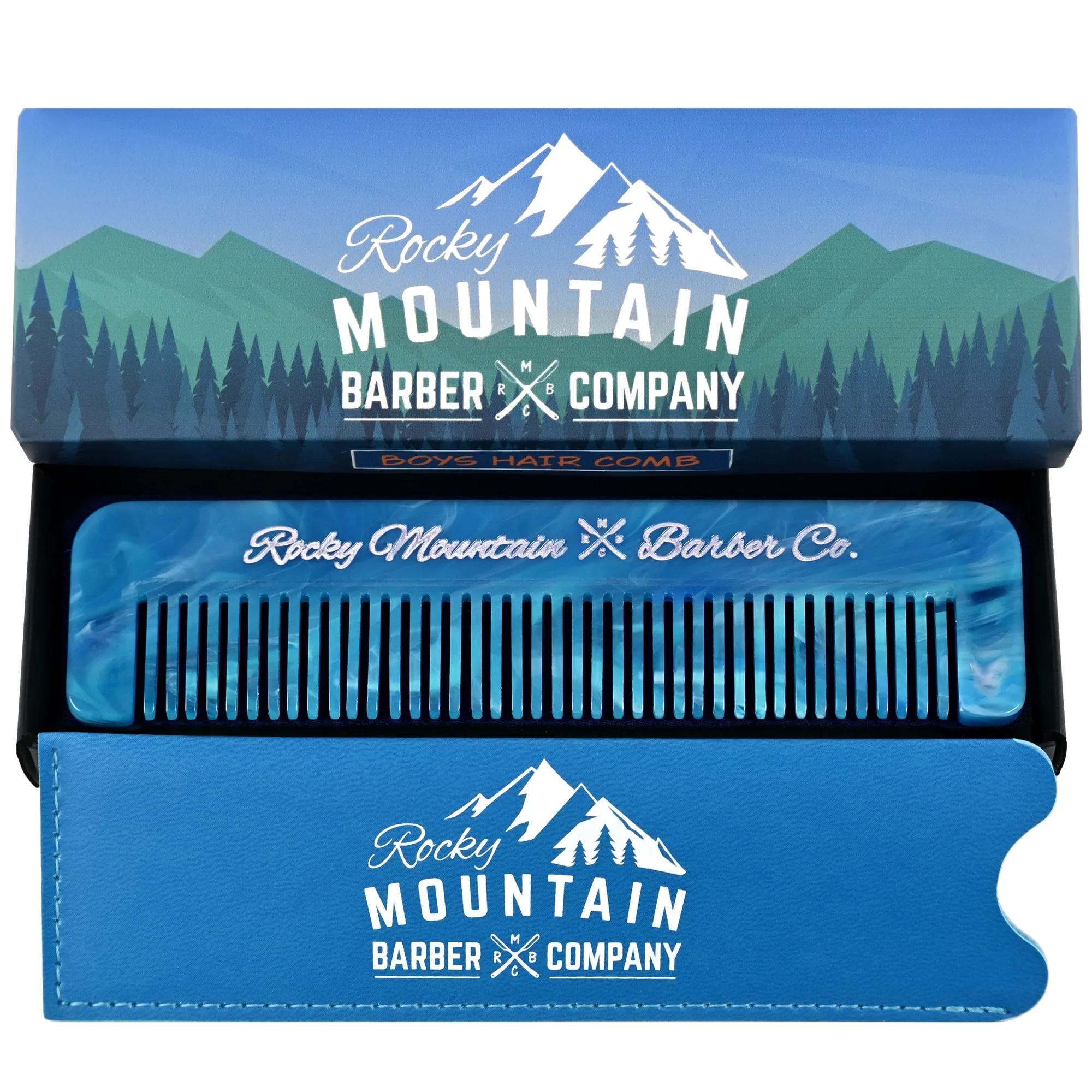
Boy's Hair Comb
Which comb should you pick?
Best for
- Boys with fine or thin hair who need precise styling and even product distribution
- Boys with sensitive scalps who need a gentle, scratch-free combing experience
Not for
- Boys with very thick, curly hair that requires a wide-tooth comb for detangling without breakage