Quick answer
For general-purpose hobby and repair work, a metal film resistor kit with 1% tolerance and a wide range of values—like the 600pcs 1/4W assortment—gives you the best balance of accuracy, stability, and cost. Focus on the resistor type, tolerance, and value coverage rather than just the piece count.
Metal film vs carbon film: which matters more
Metal film resistors offer lower noise and better temperature stability than carbon film types, making them the preferred choice for analog circuits, audio projects, and precision measurements. Carbon film resistors are cheaper but drift more with temperature and have higher noise—fine for simple digital or power circuits where exact values aren't critical.
If you build mostly Arduino or microcontroller projects, metal film is still a good baseline because you often need consistent values for voltage dividers or current-limiting resistors. The price difference per resistor is small, so starting with a metal film kit avoids upgrading later.
Value coverage: don't just count pieces
A 600-piece kit with 30 different values gives you 20 of each resistor. That's enough to build several prototypes without running out of common values like 220Ω, 1kΩ, or 10kΩ. Kits that pack many pieces into only 10–15 values leave you short on variety, forcing extra orders for uncommon values.
Look for a kit that includes values from 10Ω up to 1MΩ, covering the E12 or E24 series. The 600pcs metal film resistor kit covers 30 values across that range, which suits most breadboard experiments, sensor circuits, and basic amplifier builds.
Tolerance: 1% vs 5% and when it matters
1% tolerance resistors are standard for metal film kits and give you predictable performance in voltage dividers, op-amp circuits, and timing applications. 5% tolerance (common in carbon film kits) can cause noticeable errors in precision circuits, but it's acceptable for pull-up resistors or LED current limiting where a 5% variation won't change behavior.
If you're just starting out, a 1% kit removes one variable when debugging a circuit. The cost difference between 1% and 5% kits is minimal, so there's little reason to choose the looser tolerance unless you're buying in bulk for a specific non-critical application.
How to choose your resistor kit: decision rules
- Check the resistor type: Prefer metal film for lower noise and stable performance. Carbon film is only worth it if you need a very low price per resistor and can tolerate higher drift.
- Match tolerance to your circuit: Use 1% tolerance for analog, audio, or precision circuits. 5% is fine for digital logic pull-ups and LED current limiting. If you're unsure, go with 1% – it covers more use cases.
- Assess value variety, not just count: Aim for at least 20–30 different values spanning 10Ω to 1MΩ. Fewer values mean you'll likely need to buy separate resistors for uncommon values.
- Consider wattage for your projects: 1/4W (0.25W) resistors suit most low-power signal and logic circuits. For power supplies or motor drivers, you may need 1/2W or higher. Check your circuit's maximum current and voltage to confirm wattage.
Product spotlight
-
600pcs Metal Film Resistors 1/4watt 1% Tolerance 30 Values: 600pcs Metal Film Resistors 1/4watt 1% Tolerance 30 Values, each value 20 pieces, covering 10Ω to 1MΩ. This kit gives you a broad value range and enough duplicates per value for prototyping multiple circuits without running out of common resistors.
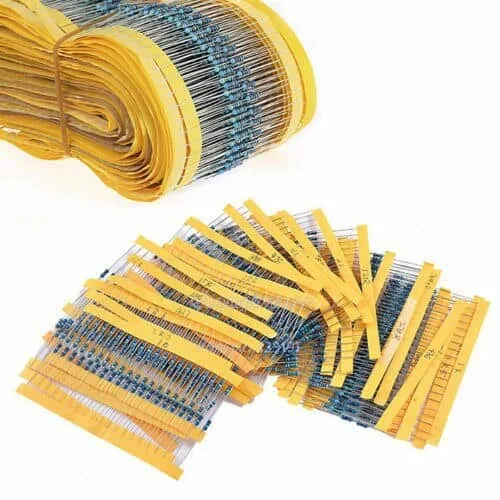
600pcs Metal Film Resistors 1/4watt 1% Tolerance 30 Values
Who this kit fits best
Best for
- Hobbyists and students prototyping on breadboards with Arduino, Raspberry Pi, or analog circuits
- Repair technicians who need a broad value range for fixing consumer electronics
Not ideal for
- High-power circuits (e.g., power supplies, motor drivers) that require 1W or larger resistors
- Surface-mount (SMD) projects – this kit contains only through-hole resistors