Why most baby booties end up lost
The main reason booties go missing is not that babies kick harder than expected. It is that many designs rely on a simple slip-on shape that loosens as a baby moves. A bootie that stays on usually has a closure or a cuff that holds it in place, and it fits the foot closely without being tight.
When you shop, look for a bootie that states how it stays on, not just how it looks. A roll-down sock top, for example, is a design feature that can help the bootie stay put. If a listing does not explain the closure or fit, treat that as a gap you will need to check before buying.
Start with the size range on the label, not the age
Baby booties are often sold in broad age ranges, and those ranges are a starting point, not a guarantee. The Cozy Booties are listed in sizes 0-12 months, which is a wide window. That means the same bootie is meant to cover a lot of growth, so the fit at the beginning of the range will feel different from the fit near the end.
For newborn booties fit, check the smallest end of the range against your baby's actual foot. If your baby is at the very start of the range, a bootie designed for 0-12 months may have extra room. If your baby is closer to the top of the range, the same bootie may fit more snugly. The catalog does not provide foot-length measurements, so use the listed size range and your own check at home rather than assuming a precise age fit.
What the Cozy Booties actually list
-
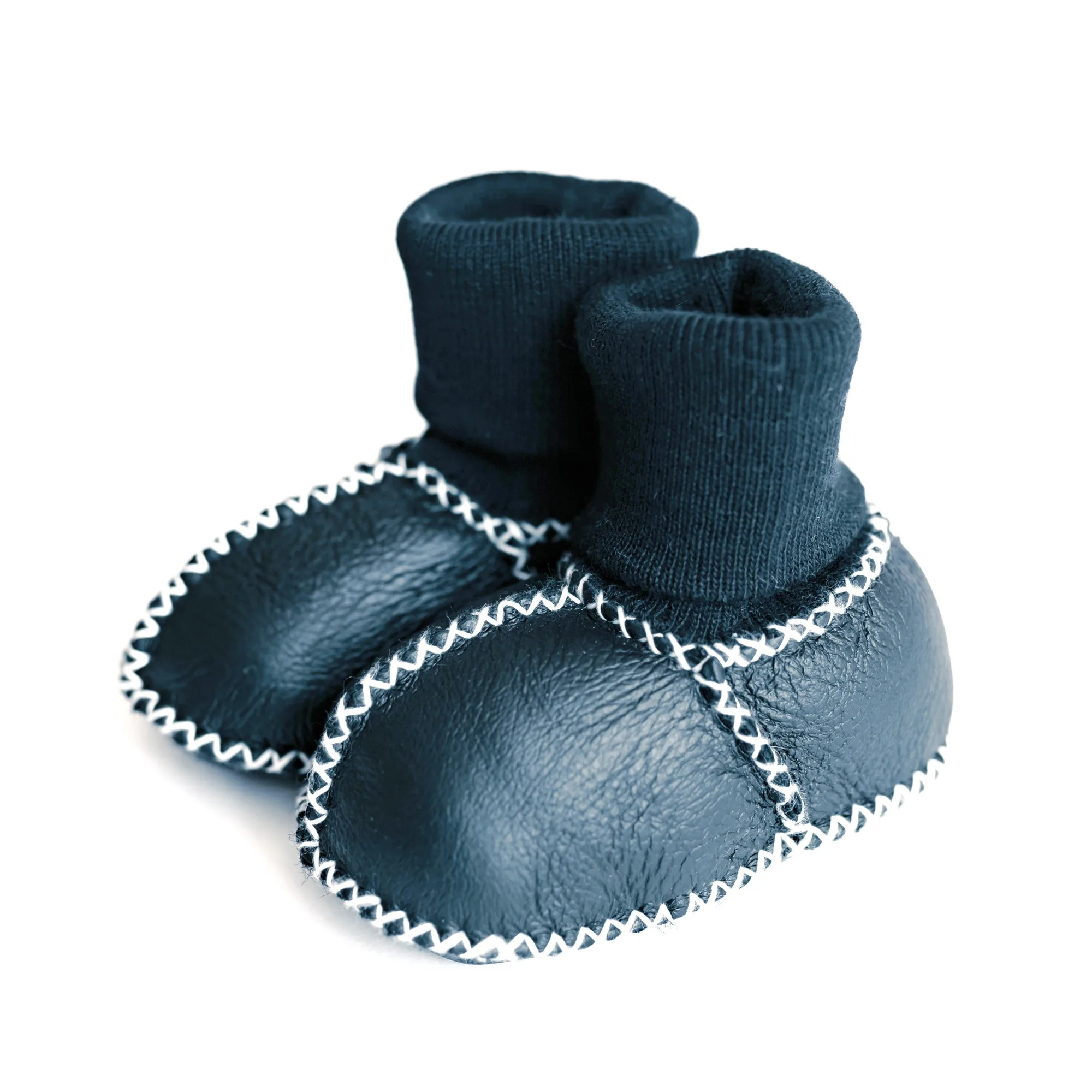
cozy booties: Sizes: 0-12 months This is the only size range given, so it is the number to match against your baby's current stage rather than a specific month.
cozy booties
-
cozy booties: Made of real sheepskin Material matters for warmth and for how the bootie feels against delicate feet; sheepskin is the stated material here.
-
cozy booties: Roll-down sock top This is the feature the listing says helps the booties stay on and avoid getting lost when you are out.
-
cozy booties: Buy two pairs (any color) for $54 A two-pair offer is useful if you want a backup pair or a gift, but only if the size range works for your baby.
Match the material to the season and the outing
For baby booties for winter, warmth is the priority, but so is breathability and comfort. The Cozy Booties use real sheepskin, which the listing describes as keeping baby's delicate feet warm all season long. That makes them a cold-weather option rather than a year-round staple.
Consider how you will use them. If you need a bootie for quick trips in a stroller or carrier, a warm sheepskin design with a roll-down top is a sensible choice. If you need something for indoor wear only, a lighter bootie may be more comfortable. The catalog does not state a temperature rating or waterproofing, so do not assume these booties are designed for wet or extreme conditions.
Check the closure and the cuff before you buy
A bootie stays on when the opening grips the ankle without pinching. The Cozy Booties use a roll-down sock top, which the listing says keeps them from falling off or getting lost. That is a specific design choice worth comparing with other booties that use ties, snaps, or elastic.
If you are shopping for a baby who pulls at socks and shoes, a roll-down top can be harder for small hands to remove than a simple slip-on. Still, no bootie is completely escape-proof. The honest trade-off is that a snug cuff may take a little more effort to put on, especially on a wiggly baby.
Color and gifting: practical notes
The Cozy Booties are described as gender-neutral and a good holiday gift. Available colors include Navy and Red, both in the 0-12 month size. If you are buying as a gift, the two-pair offer for $54 can work well for a holiday present, but confirm the size range fits the recipient's baby.
For baby accessories for cold weather, a bootie that is easy to spot in a diaper bag or stroller basket is a small but real advantage. Navy and Red are both distinct enough to find quickly. The listing does not include care instructions, so ask the seller or check the packaging before washing.
A simple fit check when the booties arrive
- Try them on with the socks you plan to use: A bootie that fits over a bare foot may feel tight over a thick sock. Test the combination you will actually use.
- Check the heel and toe: The bootie should cover the foot without bunching at the toe or slipping off the heel. If the roll-down top covers the ankle, make sure it is not so tight that it leaves marks.
- Do a short wear test indoors: Let your baby wear them for a short time while you watch. If they twist or come off easily, the fit or closure is not right for your baby's foot shape.
- Recheck as your baby grows: Because the listed range is 0-12 months, the fit will change over time. Check the booties regularly rather than assuming they will fit for the whole range.
What the catalog does not settle
The supplied information does not include foot-length measurements, care instructions, or safety testing details for the Cozy Booties. It also does not state whether they are suitable for sleep or for use in a car seat. Do not assume those uses. If you need a bootie for a specific situation like overnight sleep, check with the manufacturer or choose a product that explicitly states that use.
Use the listed size range, material, and closure as your main decision points. If those match your needs, the Cozy Booties are a reasonable cold-weather choice. If you need a precise fit or a specific safety certification, ask before you buy.