Quick Answer
Choose modular knife storage that fits your drawer dimensions, knife count, and daily reach—prioritizing blade protection and easy access over extra capacity.
Why modular beats a fixed block
A fixed knife block takes up counter space and often forces you to store knives you rarely use. Modular storage lets you scale the layout to your actual knife collection and adapt as it grows, without committing to a one-size-fits-all block.
Because modular pieces sit flat in a drawer, they also reduce the risk of accidental cuts when reaching for a knife—something a countertop block can’t always prevent.
Drawer fit is the first filter
Before comparing materials or capacity, measure your drawer’s interior width, depth, and height. Modular systems are flexible, but only if the base unit fits. A system that’s too tall for a shallow drawer or too wide for a narrow one will force you to leave it on the counter, defeating the purpose.
Check whether the modular pieces can be arranged in a single row or stacked, and confirm the drawer can close without catching on handles or blade tips.
Blade protection vs. quick access
The main job of any knife storage is to keep edges from banging against other metal or hard surfaces. Slotted inserts hold each blade separately, which is great for protection but can slow you down if you grab knives often. Open trays are faster but offer less separation.
Think about how you cook: if you reach for the same chef’s knife all day, a dedicated slot near the front matters more than storing all five knives in a neat row.
Decision Rules for Modular Knife Storage
- Measure first: Measure your drawer’s interior width, depth, and height. Choose a modular system that fits within those dimensions with at least 1 cm of clearance on all sides. Write down your measurements before shopping; they’ll rule out most options instantly.
- Count your daily knives: List the knives you use at least once a week. Choose a modular system with that many dedicated slots or trays—not the total number of knives you own. If you only use three knives regularly, don’t buy a system sized for eight.
- Prioritize blade isolation: Look for individual slots or dividers that keep blades from touching each other. If you often grab knives quickly, position the most-used slot at the front of the drawer. Test the layout in your drawer before committing; rearrange pieces to match your workflow.
- Check material and cleaning: Choose a material that can be wiped clean and won’t absorb moisture or odors. Avoid systems with crevices that trap food particles, especially if you store knives after washing. Make sure the system is dishwasher-safe or easy to hand-wash; otherwise, it may become a hygiene issue.
- Scale for future growth: If you plan to add knives later, pick a modular system that offers add-on pieces or adjustable compartments. This avoids buying a whole new system when your collection grows. Check whether the brand sells individual modules or expansion kits before you buy.
Product Insight
-
Modular Knife Storage: Turn your knife drawer into something you can actually use: no clattering, no dulling, no dangerous digging around for the knife you need. This modular system directly addresses the two biggest knife storage problems—edge dulling and cut risk—by keeping blades separated and accessible in a drawer.
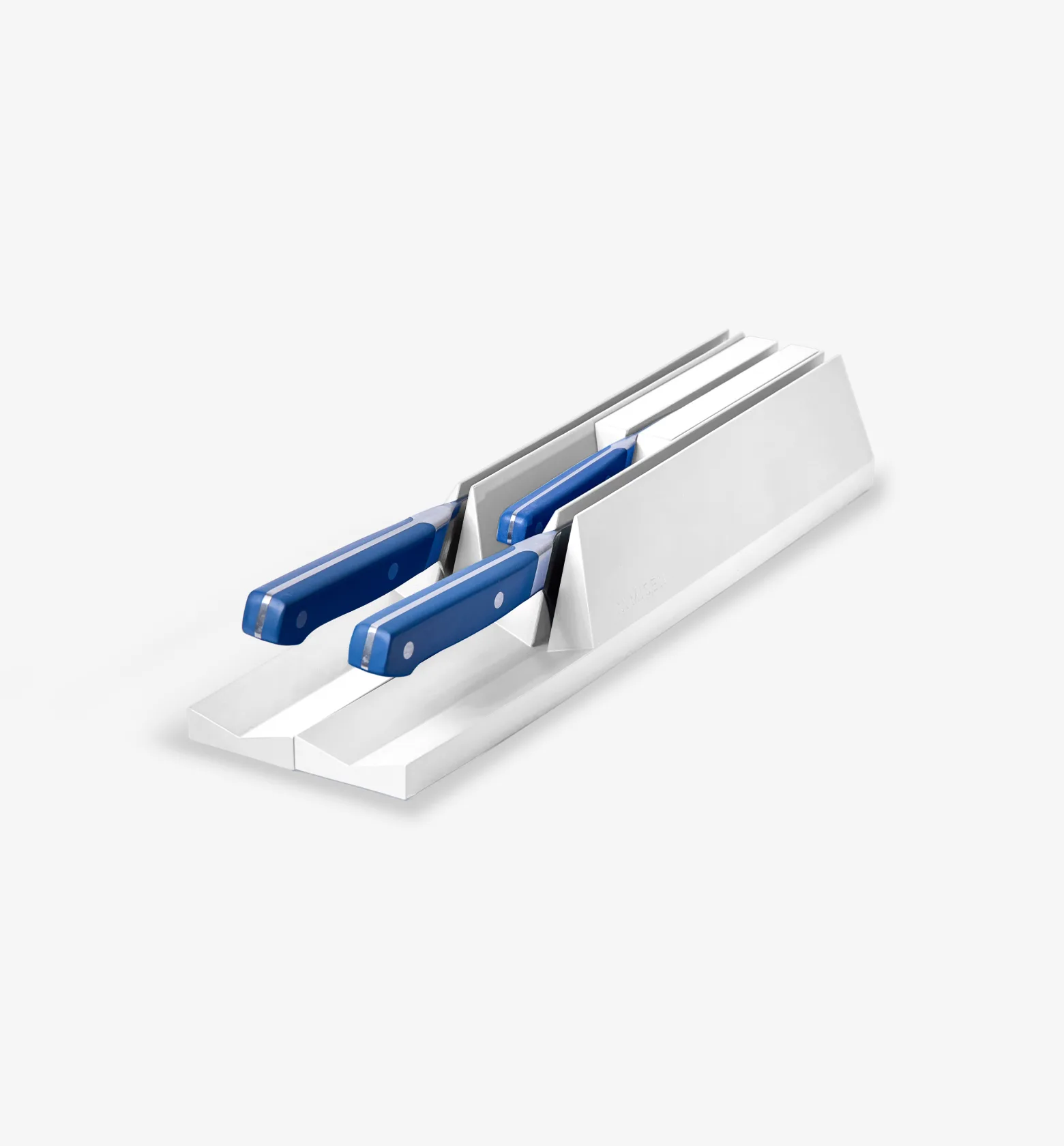
Modular Knife Storage
Who Should Choose This?
Best for
- Home cooks who want to free up counter space and keep knives safe in a drawer
- Anyone with a standard-depth drawer who uses a small set of knives daily
Not for
- People with very shallow drawers (under 5 cm) who need a countertop block
- Professional kitchens that require rapid access to many knives at once