Quick answer
For a classic look, choose a table runner that extends 6 to 12 inches past the table edge on each end. Measure your table length first, then subtract twice your desired overhang to find the runner length.
Why overhang matters
The overhang — the amount of runner hanging past the table edge — defines the visual balance. Too little and the runner looks like a placemat; too much and it overwhelms the table or gets in the way of chairs. A 6-inch overhang is safe for most dining tables, while 8 to 12 inches suits longer, more formal settings.
If you regularly use placemats or chargers, a shorter overhang (around 4 to 6 inches) keeps the runner from competing with your tableware. For buffets or console tables where you display decor, a longer overhang (up to 16 inches) can look intentional and elegant.
When to choose a custom size
Standard runner lengths (like 72 or 90 inches) work for many rectangular tables, but oval, round, or unusually long tables often need a custom size. If your table seats more than eight people or has an extension leaf, a custom runner ensures the proportions stay right.
Pappelina table runners come in a range of sizes, and the woven PVC material can be cut to length at the time of purchase. This means you can order a runner that fits your table exactly, avoiding awkward bunching or a skimpy look.
How to choose your table runner length
- Measure your table: Use a tape measure to get the full length of your table top. For round tables, measure the diameter. Write this number down — it's your starting point.
- Decide your overhang: For everyday dining, choose a 6-inch overhang on each end. For formal or decorative use, go with 8 to 12 inches. For tight spaces or small tables, 4 inches can work. A 6-inch overhang is the most versatile starting point.
- Calculate runner length: Subtract twice your overhang from the table length. Example: a 72-inch table with a 6-inch overhang needs a 60-inch runner (72 - 12 = 60). Always subtract double the overhang, not just the overhang itself.
- Consider width too: A runner should be about one-third the width of your table. For a 40-inch-wide table, aim for a 13- to 14-inch-wide runner. Too narrow looks lost; too wide crowds place settings.
Product facts
-
MONO Petrol - Table Runner: Made from woven PVC with a polyester warp, our table runners carry the same durable, water-resistant construction as our rugs. Care is simple — wipe clean or rinse with water. A water-resistant runner means you can use it on the dining table for everyday meals without worrying about spills, and cleaning up is as easy as a quick wipe.
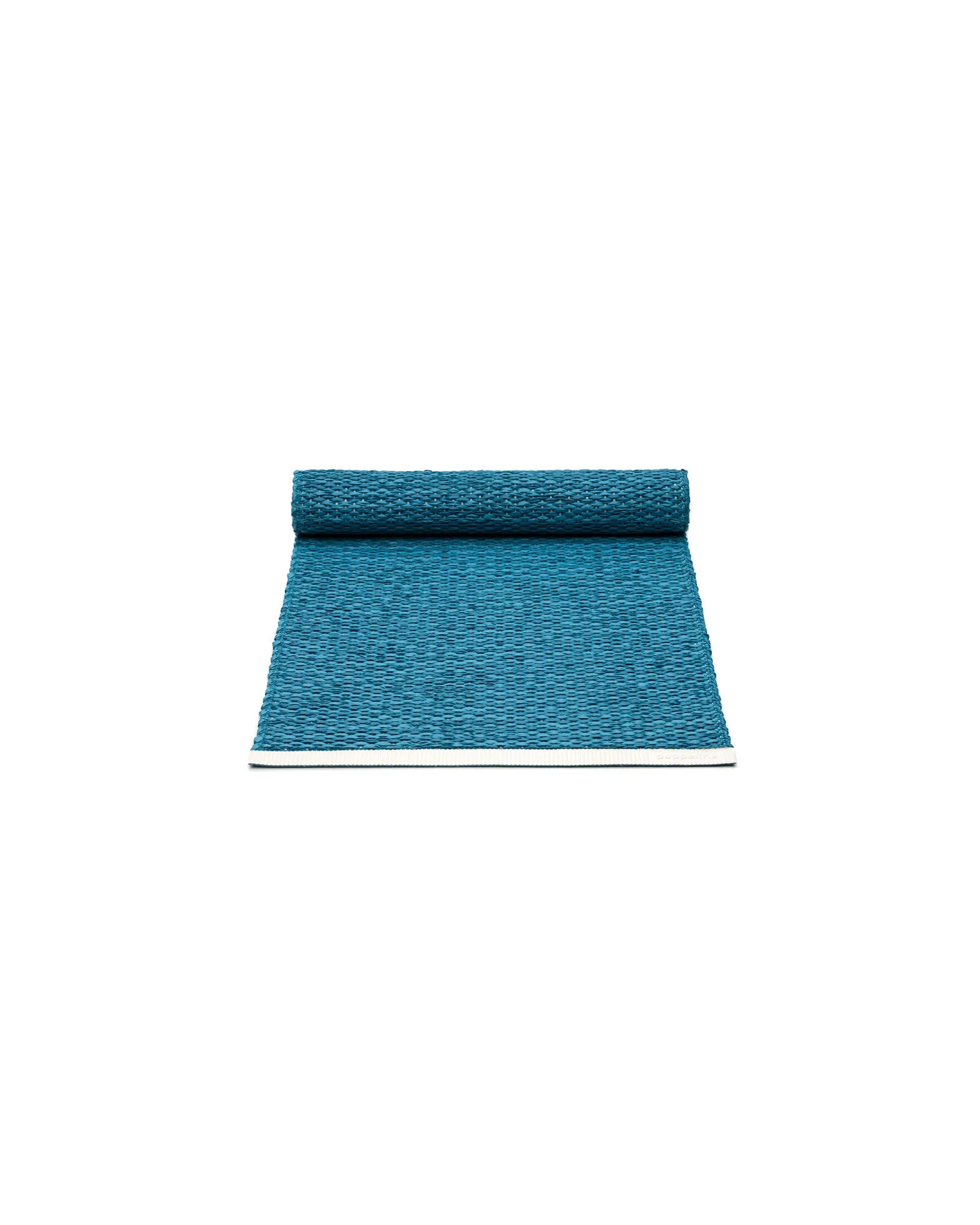
MONO Petrol - Table Runner
Who this guide is for
Best for
- Anyone buying a table runner for a rectangular dining table
- Hosts who want a balanced, classic look for everyday meals or casual entertaining
Not for
- Round tables that need a different proportion approach
- Very narrow console tables where a runner might hang over the sides