Quick answer
For most collections, 9-pocket sideloading pages offer the best balance of visibility and protection. Use 18-pocket pages when you need denser storage for bulk cards or duplicates.
Why sideloading matters for card safety
Sideloading pages insert cards from the side rather than the top, which reduces the chance of cards sliding out when you flip through a binder. This design also protects double-sleeved cards more effectively because the opening is less exposed to gravity and handling.
Both 9-pocket and 18-pocket sideloading pages fit standard- and Japanese-sized cards, so you don't need separate pages for different card sizes. The 11-hole spine ensures compatibility with almost any standard ring binder.
9 vs 18 pockets: trade-offs to consider
9-pocket pages let you display cards with more white space around each slot, making them ideal for showcasing valuable or visually striking cards. They also leave room for double-sleeved cards without crowding.
18-pocket pages pack twice the cards per sheet, which saves binder space and money per card stored. However, the pockets are narrower, so double-sleeved cards may fit more tightly, and the denser layout makes it harder to view individual cards quickly.
Steps to choose the right card pages
- Count your cards and decide on density: Estimate how many cards you need to store. If you have more than 500 cards, 18-pocket pages reduce binder bulk. For smaller curated collections, 9-pocket pages give each card more visual space. Don't buy 18-pocket pages for a small set of high-value cards—you'll waste pocket space and make viewing harder.
- Check your card sizes and sleeving: Both 9-pocket and 18-pocket sideloading pages fit standard- and Japanese-sized cards. If you double-sleeve your cards, test one page first: 18-pocket pages are tighter, so a single-sleeve setup is safer for those. Double-sleeved cards may not fit comfortably in 18-pocket pages—stick with 9-pocket pages if you use inner and outer sleeves.
- Verify binder compatibility: Look for pages with an 11-hole spine, which fits almost all standard ring binders. Measure your binder rings—pages with 11 holes work with rings up to about 1.5 inches in diameter. Avoid pages with non-standard hole patterns unless you already own a matching binder; they limit future expansion.
- Choose a color that suits your use: Clear pages let you see cards from both sides, which is great for trading or display. Colored pages (like red or black) hide dust and wear, and can help you organize sets by color-coding binders. If you frequently show cards to others, clear pages are better. For long-term storage, colored pages hide scuffs and keep the focus on the binder cover.
Product facts
-
Sideloading 18-Pocket Pages: 10 pg Red: 18 side-loading pockets per page with strong weldings and an 11-hole spine. This page stores twice as many cards as a 9-pocket sheet while still protecting double-sleeved cards, making it a space-efficient choice for bulk storage.
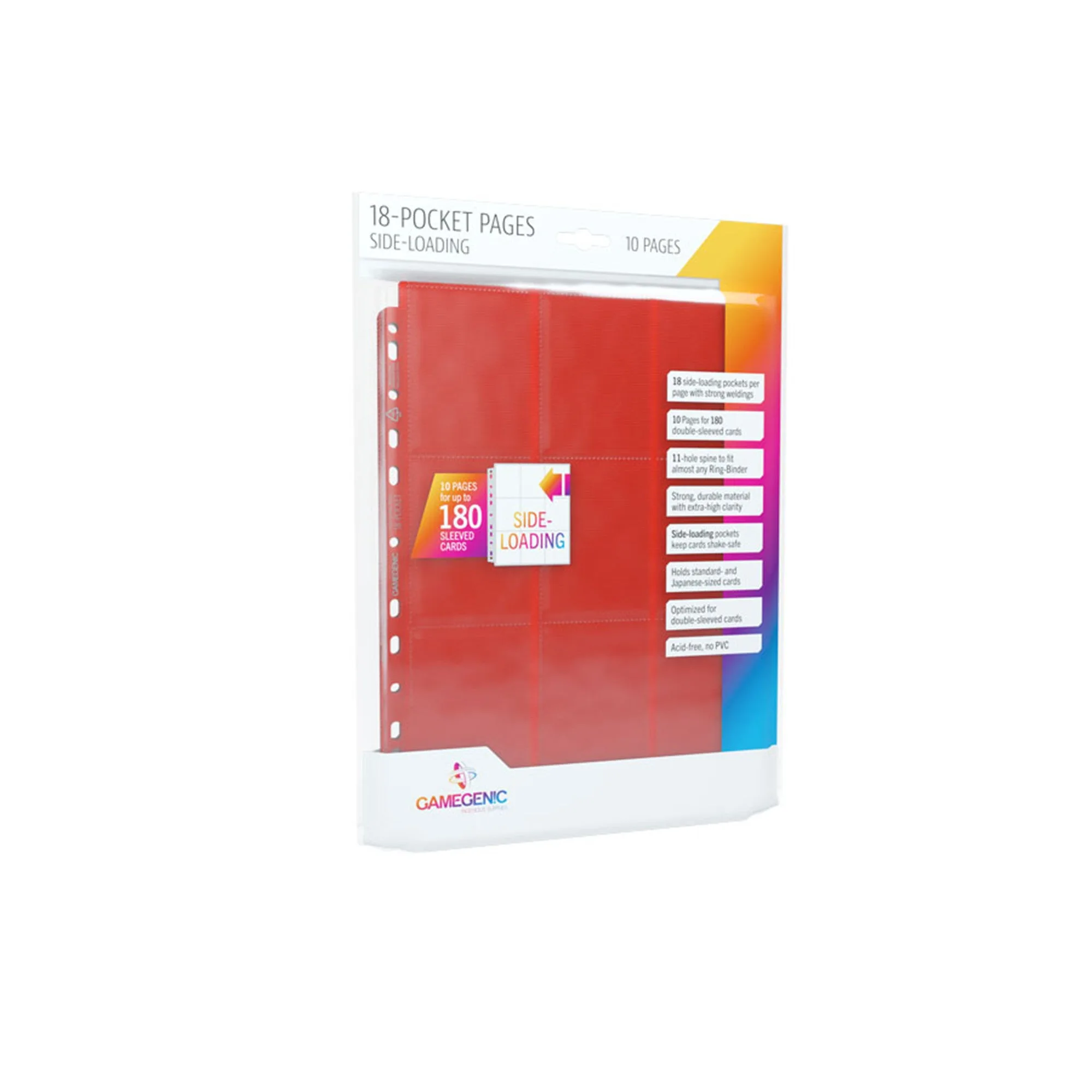
Sideloading 18-Pocket Pages: 10 pg Red
-
Sideloading 9-Pocket Pages: 10 pg Clear: Extra clear polypropylene construction with ultrasonic welded joints. The crystal-clear material lets you see card artwork without distortion, and the welded joints keep pockets precisely sized so cards don't shift or fall out.
Sideloading 9-Pocket Pages: 10 pg Clear