Quick answer
Run a small dose of Puly Caff Grinder Cleaner Crystals through an empty hopper and running burrs, then purge with fresh beans before your next shot. Do this as part of a regular burr cleaning routine, not only when the grind feels off.
Why the burrs need a cleaning routine, not a rescue
Coffee leaves oily residue and fine dust on the burrs and in the grind path. Over time that coating changes how beans feed into the burrs and how consistently they are cut, so shots can drift even when your recipe has not changed. Cleaning crystals are designed to lift that buildup, but they work best when used before performance drops noticeably.
A realistic espresso grinder cleaning schedule depends on volume. A busy home setup might need a crystal clean every few weeks, while a low-volume grinder can go longer. Check the burr chamber visually and note when grind times start to stretch; that is your cue to shorten the interval.
What the crystals can and cannot do
Puly Caff Grinder Cleaner Crystals are formulated to remove fats and proteins from the burrs and the grinding circuit. That makes them useful for the coffee-contact parts of the grinder, but they are not a substitute for brushing out packed grounds or for checking wear on the burrs themselves.
The catalog does not list a dose per grind size or a maximum run time, so follow the package instructions and start with a small amount. If your grinder manual warns against running any cleaner through it, respect that warning and clean the burrs manually instead.
Step-by-step grinder cleaning routine
- Empty the hopper and run the grinder dry: Switch off the grinder, remove the hopper, and brush or vacuum out whole beans. Run the grinder briefly to expel loose grounds, then empty the catch tray. Common mistake: leaving beans in the hopper while adding crystals, which mixes cleaner with coffee you may later grind.
- Measure a small dose of crystals: Add a small amount of Puly Caff Grinder Cleaner Crystals to the empty hopper or burr chamber, following the package directions. Start smaller than you think you need. Checkpoint: the dose should be enough to pass through the burrs, not so much that the grinder labors.
- Run the grinder in short bursts: Grind the crystals through in short pulses rather than one long run, and stop if the motor note changes or the grinder slows. Common mistake: running continuously until the chamber is spotless, which can overheat a grinder not designed for extended dry running.
- Brush out the chamber and chute: Remove the hopper and burr access cover if your model allows it, then brush residual crystals and loosened grounds from the burr chamber, chute, and dosing area. Checkpoint: any crystal left behind will end up in your next dose, so inspect before reassembly.
- Purge with fresh beans: Reassemble the grinder, add fresh beans, and grind and discard a small amount to flush out cleaner residue and stale grounds. Common mistake: skipping the purge and pulling a shot immediately, which can taste chalky or chemical.
- Reset your recipe and log the date: Dial the grind back in with your normal beans and note the cleaning date on the grinder or in a log. Use that date to set your next espresso grinder cleaning interval based on shot volume, not a fixed calendar guess. If shots still run fast or slow after purging and redialing, the issue may be burr wear or alignment rather than leftover residue.
Product facts
-
Puly Caff Grinder Cleaner Crystals - Espressomühlen Reiniger: Puly Caff Grinder Cleaner Crystals are formulated to remove fats and proteins from grinder burrs and the grinding circuit. That target matters because coffee oils and protein-rich fines are what coat burrs and change feed and cut consistency between deep cleans.
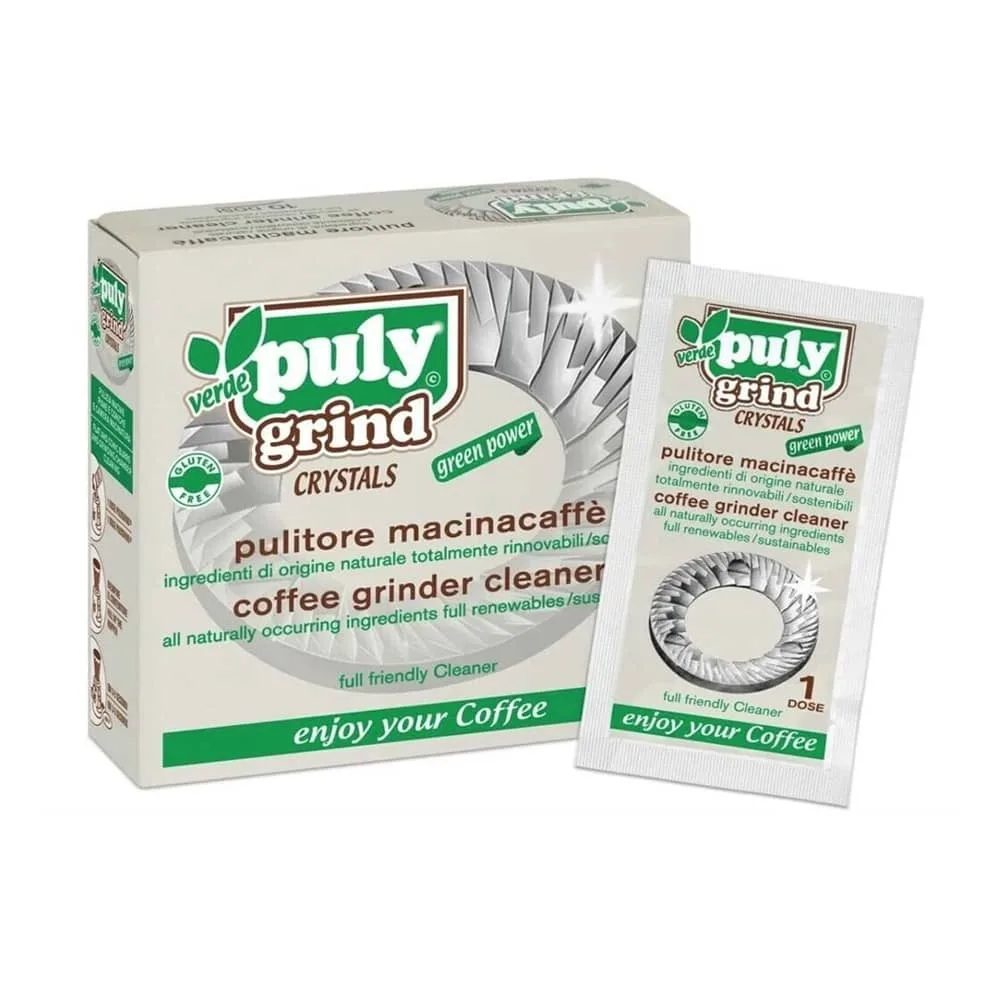
Puly Caff Grinder Cleaner Crystals - Espressomühlen Reiniger