Quick answer
Use a buttonhole opener with a sharp blade and a protective plate, and always place a cutting block underneath the fabric. Cut from the center of the buttonhole outward to the ends, keeping the blade flat against the block.
Why a buttonhole opener beats scissors
Scissors can twist and catch the fabric, especially on small or curved buttonholes. A dedicated buttonhole opener has a short, sharp blade that stays aligned with the cut, and its protective plate slides under the fabric to shield the garment and your table. That control is what helps you cut clean buttonholes without cutting fabric.
If you already own a buttonhole chisel and block, you can use the chisel to start the cut and the block to support the fabric. But for most home sewists, a buttonhole opener is faster to set up and easier to control on lightweight fabrics.
When a buttonhole opener is not the right tool
For very thick fabrics like coating or multiple layers of denim, a buttonhole chisel and block may be more appropriate because the chisel can be tapped with a mallet to cut through heavy material. A buttonhole opener is best for light to medium-weight fabrics.
Also, if your buttonhole is already fraying or the fabric is unstable, stabilize it with interfacing before cutting. No tool can give a clean result on an unsupported buttonhole.
Step-by-step: cutting clean buttonholes
- Mark and stabilize the buttonhole: Draw the buttonhole line on the fabric with a removable marker, then fuse a small piece of interfacing behind it if the fabric is light or prone to fraying. Common mistake: skipping interfacing on lightweight fabrics leads to ragged edges.
- Place a cutting block underneath: Slide a self-healing cutting mat or a dedicated buttonhole cutting block under the fabric, centered under the buttonhole. Checkpoint: the block should cover the entire buttonhole length and extend at least 1 cm beyond each end.
- Position the buttonhole opener: Insert the protective plate of the buttonhole opener under the fabric, with the blade centered on the buttonhole line and the plate between the fabric and the block. Common mistake: letting the plate slip out from under the fabric, which exposes the block to the blade.
- Cut from the center outward: Press the blade down firmly and cut from the middle of the buttonhole toward one end, then repeat toward the other end. Keep the blade flat and parallel to the fabric. Checkpoint: stop just before the bar tack at each end to avoid cutting the stitches.
- Check the cut and clean up: Remove the block and inspect the buttonhole. If any threads are loose, trim them with small sharp scissors. Do not pull or stretch the buttonhole. Common mistake: cutting too far and slicing the bar tack; always cut in small increments and check as you go.
Product facts
-
Ouvre boutonnières et sa plaque de protection: Ouvre boutonnières et sa plaque de protection features a sharp blade and a protective plate. The sharp blade cuts fabric cleanly, while the protection plate shields your work surface and helps prevent cutting through the lower layer.
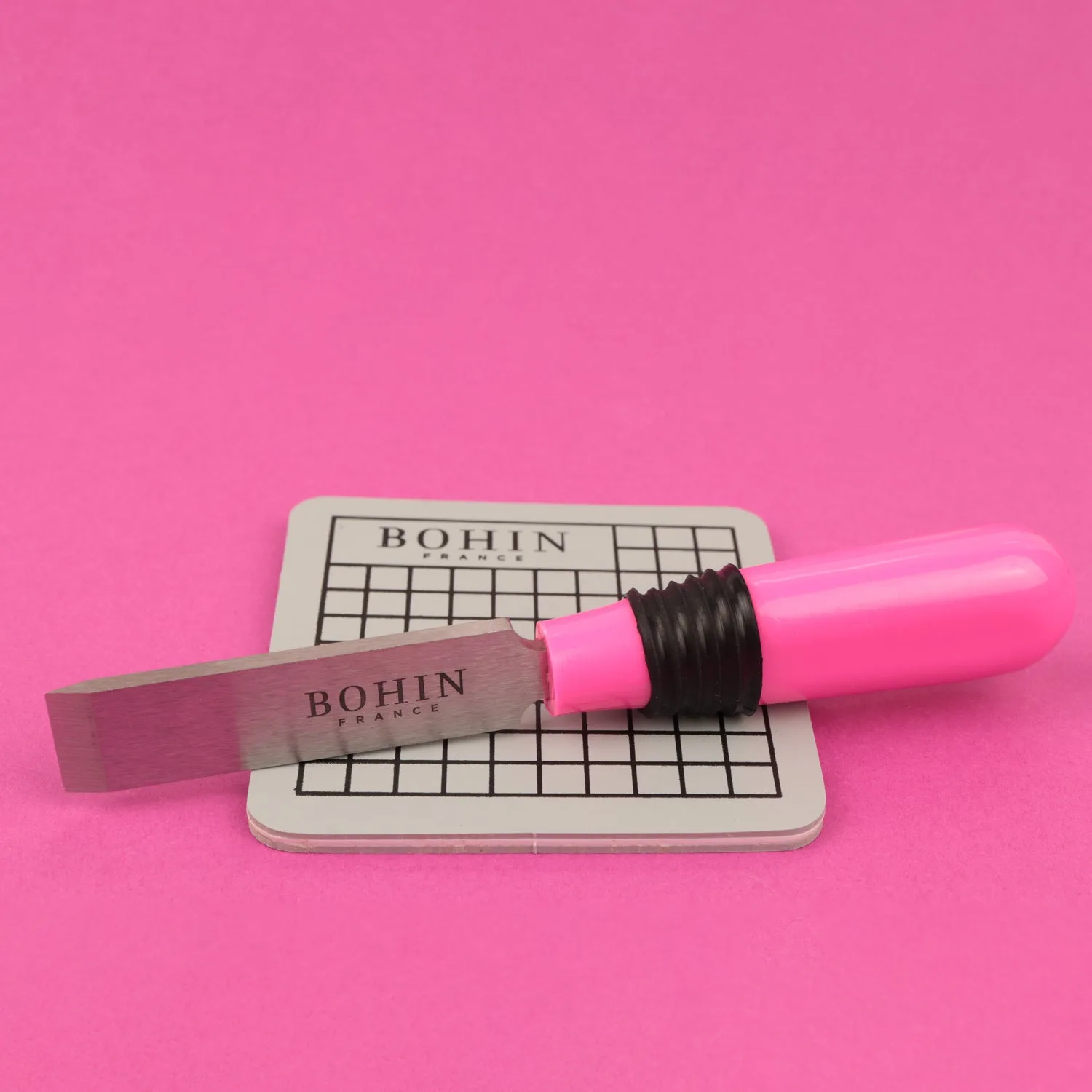
Ouvre boutonnières et sa plaque de protection