Quick answer
Fit a bait proof plastic muzzle by measuring your dog's snout, adjusting the single strap so the muzzle sits snug but allows panting, and checking that the basket stays clear of the eyes and nose. Then test for scavenging gaps before using it on walks.
Why bait proof fit is different from a standard muzzle fit
A bait proof muzzle is designed to stop your dog from picking up food or scavenged items, so the fit has to be more precise than a general-purpose muzzle. Gaps at the sides or front let a determined dog still grab something. The strap tension and nose clearance work together: too loose and the dog can work the muzzle off or reach food, too tight and you risk rubbing or restricting panting.
Plastic muzzles with a felt liner, like the Bait Proof Plastic Muzzles Black & Clear, are lightweight and use a single rubber strap around the head. That simple design is easy to adjust but leaves little room for error, so check the fit carefully before relying on it.
When a plastic bait proof muzzle is the right choice
This style suits light to medium duty use, such as short walks, vet visits, or training sessions where you need to prevent scavenging. It is not a heavy-duty agitation muzzle, and it is not intended for long unsupervised wear. If your dog is a strong puller or needs a muzzle for extended outdoor work, a basket muzzle with more structure may be more appropriate.
For reactive or aggressive dogs, a muzzle is a responsible training tool. The Bait Proof Plastic Muzzles are designed for light to medium duty, so match the muzzle to the job rather than expecting one design to cover every situation.
Sizing limits to check before you start
The catalog does not list specific snout measurements for this muzzle, so you cannot rely on a size chart alone. Instead, check that the plastic basket is wide enough for your dog's snout without pressing on the nose, and that the felt liner sits flat against the bridge of the nose. If the basket is too narrow, the muzzle will rub; if it is too wide, the dog may be able to pull it off or reach food around the edges.
Because the strap is rubber and single, it has some stretch. That helps with a secure fit but means you should recheck tension after a few minutes of wear, especially on a dog that paws at the muzzle.
Step-by-step fitting
- Measure your dog's snout: Use a soft tape to measure around the widest part of the snout, about a finger's width below the eyes, and from the tip of the nose to just behind the nose stop. Write the numbers down. Common mistake: measuring too far back toward the eyes, which gives an oversized reading. Compare your measurement to the muzzle's internal basket dimensions if available; if not, judge by eye with the muzzle held gently against the snout.
- Check basket clearance: Hold the muzzle against your dog's snout without fastening the strap. There should be enough room for the nose to sit inside without touching the front, and the top of the basket should not press on the eyes. Common checkpoint: your dog should be able to open its mouth slightly and pant.
- Fasten the strap and set tension: Slide the rubber strap around the head behind the ears and fasten it. Tighten until you can fit one finger under the strap, but no more. Common mistake: overtightening because the rubber stretches; this causes rubbing and can restrict panting. Recheck the strap after two minutes of wear; rubber can relax slightly as the dog moves.
- Test for scavenging gaps: With the muzzle on, offer a piece of food on the ground and watch whether your dog can reach it with its tongue or by pressing the muzzle. The bait proof design should block access. Common checkpoint: if your dog can grab the food, the muzzle is too loose or the basket is too wide.
- Do a short supervised walk: Take a five-minute walk on lead and watch for pawing, rubbing, or attempts to pull the muzzle off. Check for redness or hair loss around the strap and nose. Common mistake: moving straight to a long walk before checking fit. If your dog paws persistently, stop and recheck strap tension and basket alignment before continuing.
Product facts
-
Bait Proof Plastic Muzzles Black & Clear: Single rubber strap with a felt liner on the nose. The single strap makes adjustment simple, but the felt liner means you need to check for rubbing on the nose bridge.
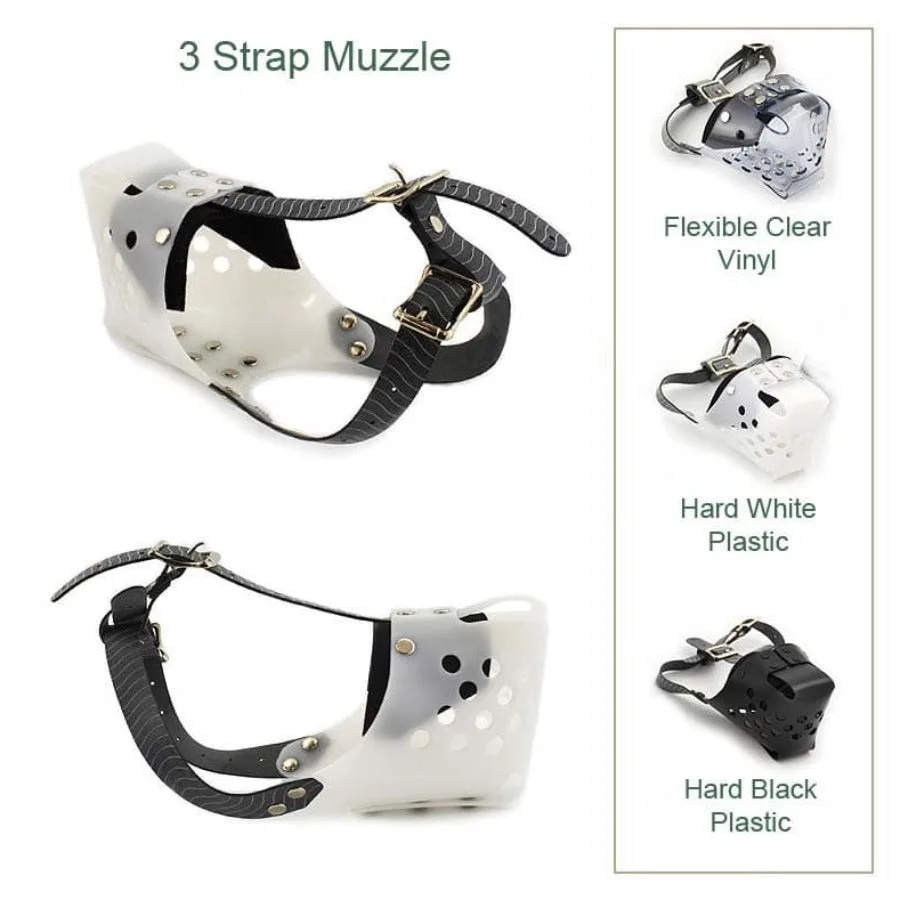
Bait Proof Plastic Muzzles Black & Clear
-
Bait Proof Plastic Muzzles Black & Clear: Light to medium duty plastic muzzle. Best for short, supervised use such as walks and training, not for heavy-duty or long unsupervised wear.