Why the fit matters more than the colour
A reflective cat collar only does its job if it stays on comfortably and releases when it should. Too loose, and your cat can paw it off or catch a leg; too tight, and it rubs. The Ancol Reflective Safety Buckle Collar in orange combines visibility with a break-away buckle and a warning bell, but the fit you create is what makes those features work.
This guide walks through fitting that collar correctly, using the manufacturer’s supplied instructions and the product’s own safety features as the reference points.
Fitting the Ancol collar step by step
Follow these steps each time you put the collar on, especially after adjusting it or if your cat has been wearing it for a while.
- 1. Check the collar is open and untangled: Lay the collar flat and make sure the reflective strip and bell are not twisted. The break-away buckle should be closed but ready to release under pressure.
- 2. Place it around your cat’s neck: Gently loop the collar around the neck, keeping the bell and buckle positioned so they don’t sit directly under the chin.
- 3. Adjust to the two-finger rule: The supplied directions state you should be able to get two fingers between your cat and the collar for safety and comfort. Adjust the strap until this is possible without the collar sliding easily over the head.
- 4. Fasten the break-away buckle: Close the buckle until it clicks. Tug gently to confirm it is secure but will still release if your cat gets caught while climbing.
- 5. Check the bell and reflective strip: The warning bell should hang freely to help protect wildlife, and the reflective material should face outward for visibility in low light.
Collar features that affect fit
-
Cat Collar Ancol Reflective Safety Buckle Orange: Break-away buckle allows your cat an easy escape if they get caught whilst climbing. This is the core safety feature: a correctly fitted collar must still be able to release under load, so never override or tape the buckle.
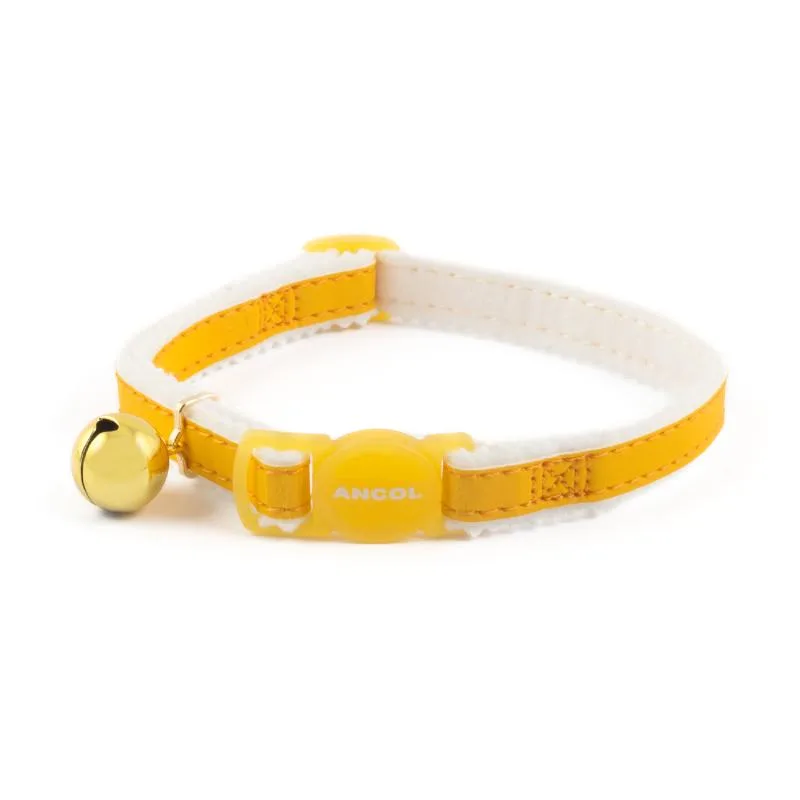
Cat Collar Ancol Reflective Safety Buckle Orange
-
Cat Collar Ancol Reflective Safety Buckle Orange: Reflective material for increased visibility in low light. The reflective strip only helps if it sits on the outside of the neck and is not covered by fur or twisted.
-
Cat Collar Ancol Reflective Safety Buckle Orange: Warning bell to help protect wildlife. The bell needs to hang freely and audibly; if it is muffled against the neck, it won’t serve its purpose.
-
Cat Collar Ancol Reflective Safety Buckle Orange: Hard-wearing, easily adjustable. You can fine-tune the fit over time, but check adjustment regularly as the strap can loosen with daily wear.
Daily checks and care that keep the fit safe
Cat collars should be checked each day. Run a finger under the collar to confirm the two-finger gap still exists, look for fraying or stiffness in the strap, and test that the break-away buckle still opens with a firm pull. A bell that has stopped ringing or a reflective strip that has become dull are signs the collar needs attention.
Remove the collar when using liquid flea treatments to prevent reactions between the treatment and the collar materials. This is a supplied instruction, not a general suggestion, so build it into your flea-treatment routine.
If your cat is not used to a collar, start with short supervised wear and check the fit frequently. Never force a collar on a cat that is panicking; instead, try again later and reward calm behaviour.
Common fitting mistakes to avoid
- Leaving it too loose: A collar that slips over the head or catches a front leg is a hazard. The two-finger check is the minimum; if the collar can be pulled over the head without unfastening, tighten it slightly.
- Fastening it too tight: If you cannot fit two fingers underneath, the collar may rub or restrict swallowing. Loosen it one notch at a time until the two-finger gap is met.
- Ignoring the bell: The bell is there to protect wildlife. If it is removed or muffled, you lose that benefit and may not notice if the collar is lost.
- Skipping daily checks: A collar can loosen or the buckle can weaken with wear. A quick daily check takes seconds and prevents avoidable problems.