Quick answer
You can froth milk without a machine using a jar, a handheld whisk, or a stovetop method. Each technique produces creamy foam with common kitchen tools.
Why froth milk without a machine?
Not everyone owns an espresso machine with a steam wand. Frothing milk by hand saves counter space and money while still giving you a lighter, airier texture for lattes, cappuccinos, and hot chocolate.
The trade-off is that hand methods produce a coarser, less stable foam than a steam wand. The foam collapses faster, so serve your drink right away. For a more consistent result, you can use a dedicated milk frother pitcher with thermometer to monitor temperature while heating and frothing.
Choosing the right milk
Whole milk (around 3.5% fat) froths best because the fat helps stabilise the foam. Semi-skimmed works too but gives a thinner foam. Plant-based barista blends with added protein or stabilisers also froth well; standard oat or almond milk may not foam as much.
3 ways to froth milk without a machine
- Method 1: Jar shaking: Pour cold milk into a clean jar with a tight lid — fill no more than halfway. Screw the lid on firmly and shake the jar vigorously for 30–60 seconds until the milk doubles in volume. Remove the lid and microwave the jar (without the lid) for 30 seconds to stabilise the foam. Common mistake: overfilling the jar leaves no room for the milk to expand, so you end up with little foam.
- Method 2: Hand whisk or French press: Heat milk in a saucepan or microwave to around 60°C (140°F). Pour into a tall container or French press. Using a hand whisk, whisk rapidly back and forth until foam forms, about 30–60 seconds. Alternatively, pump the plunger of a French press up and down for 20–30 seconds. Checkpoint: if using a French press, make sure the mesh is clean — leftover coffee oils can ruin the milk foam.
- Method 3: Stovetop whisking: Pour cold milk into a small saucepan and place over medium heat. Whisk constantly in a back-and-forth motion, not circular, to incorporate air. Keep whisking until the milk reaches 60–65°C (140–150°F) and a layer of foam forms on top. Remove from heat immediately. Common mistake: whisking in circles creates a vortex that doesn't trap air — use a side-to-side motion instead.
Helpful tool for better results
-
600ml Milk Frothing Pitcher with Thermometer: The KNOCDIC 600ml Milk Frothing Jug combines a built-in thermometer with a controlled pouring spout, helping keep an eye on milk temperature while steaming and pouring. The 304 stainless steel interior is suited to everyday use, while internal volume markings make it easier to measure the milk required. If you heat milk on the stove before frothing, the thermometer helps you stop at 60–65°C (140–150°F) so the milk doesn't scorch and the foam stays stable.
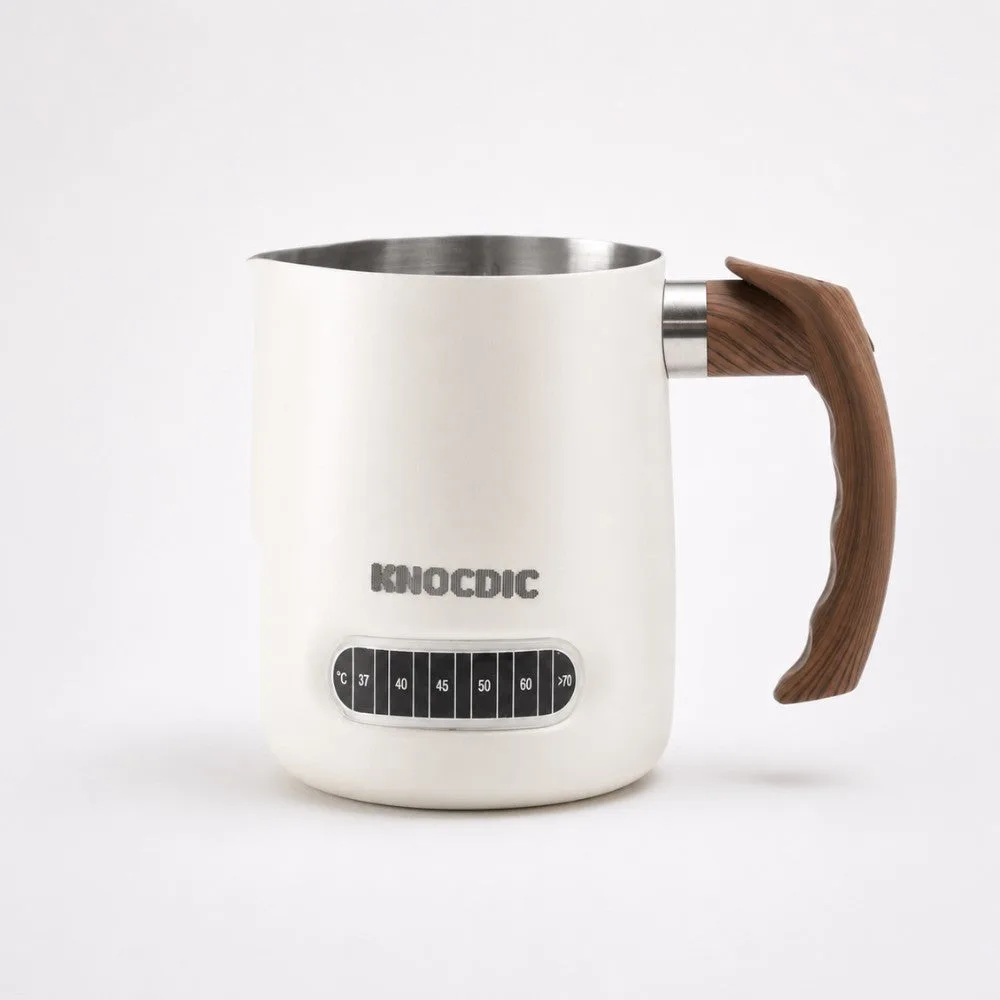
600ml Milk Frothing Pitcher with Thermometer