Quick answer
Start by letting your toddler explore the blocks freely, then gradually introduce letter names and simple games to build recognition through play.
Why alphabet blocks work for toddlers
Alphabet blocks are a classic learning tool because they combine sensory play with early literacy. Toddlers naturally want to touch, stack, and knock down blocks, which builds fine motor skills and hand-eye coordination. When you add letters into that play, you create a low-pressure way to start recognizing the alphabet.
Wooden blocks, in particular, offer a durable, natural texture that babies and toddlers enjoy. They are also easy to clean and safe for mouthing during the early months.
When to start and what to expect
Most toddlers are ready for block play around 12 months, but every child develops at their own pace. At first, your toddler may just hold, bang, or mouth the blocks. That is normal and valuable—it builds familiarity with the object. Around 18 to 24 months, many children start stacking and showing interest in the letters themselves.
Do not rush to teach the ABCs. Let your child lead. The goal is positive, playful exposure, not formal lessons.
Step-by-step: Introducing alphabet blocks
- Step 1: Free exploration: Give your toddler the blocks with no expectations. Let them hold, mouth, stack, and knock down. This builds comfort and motor skills. Sit nearby and play alongside them, but do not direct. Common mistake: Pushing letter recognition too early. Let your child explore first.
- Step 2: Name the letters while playing: When your toddler picks up a block, casually say the letter name and its sound. For example, 'That is B. Buh, buh, like ball.' Keep it light and brief. Do not quiz them. Checkpoint: If your toddler loses interest, stop and return to free play. Short sessions work best.
- Step 3: Play a simple matching game: Pick two blocks with letters your toddler has seen before. Ask, 'Can you find the one that looks like this?' Show the block and let them choose. Celebrate any attempt, even if wrong. Common mistake: Correcting mistakes too firmly. Instead, gently show the correct block and try again later.
- Step 4: Build a letter tower: Stack blocks in a tower and say the letter on each block as you place it. Let your toddler knock it down and then help rebuild. This reinforces letter names through repetition and physical play. Checkpoint: If your toddler only wants to knock down, that is fine. Repetition of the names during stacking is still valuable.
- Step 5: Introduce a simple alphabet song: Sing the ABC song while pointing to blocks in order. After a few times, pause at a letter and let your toddler try to say it. This connects auditory and visual learning. Common mistake: Expecting your toddler to sing along right away. They may just listen or hum—that is progress.
Our recommended block set
-
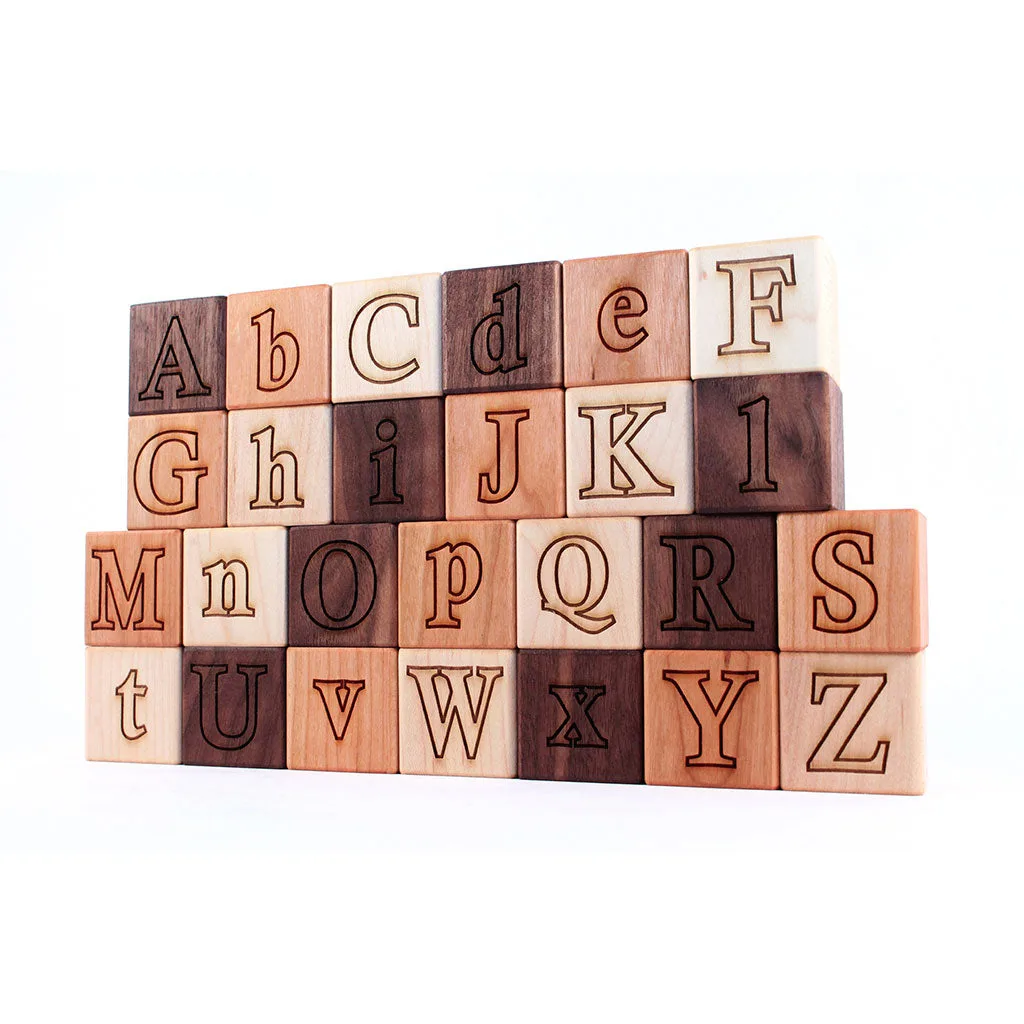
Alphabet Blocks: This set includes 26 blocks with A-Z letters engraved on two sides, with uppercase and lowercase options. Having both letter cases on the same block helps toddlers make the connection between uppercase and lowercase naturally as they play.
Alphabet Blocks