Quick answer
Measure your dog's girth at the deepest point of the ribcage and the neck where the collar normally sits, then match those numbers to the harness size chart. A no pull harness should sit high on the chest, allow two fingers under every strap, and keep the front clip centered so it can redirect forward motion without twisting.
Why girth measurement is the only number that really matters
Most no pull harness sizing charts are built around girth, not weight. Two dogs of the same weight can differ by several inches around the ribcage, and a harness that is too loose at the girth will slide sideways when your dog pulls. Measure the deepest part of the chest, usually one to two inches behind the front legs, with the tape snug but not compressing the coat. If your dog is between sizes, size up only when the larger size still adjusts down to your measurement; otherwise size down and extend the straps.
Take a neck measurement for the front opening
The neck loop controls how high the harness sits on the chest. Measure around the neck at the point where a flat collar rests, then check the harness chart for its neck range. A neck opening that is too large lets the chest panel drop toward the shoulders, which reduces steering control and can cause chafing behind the front legs. A neck opening that is too small is harder to get over the head and may press on the throat when your dog looks up.
Check the chest strap and body length
Some harnesses include a chest strap that runs between the front legs. Measure from the back of the neck, down the center of the chest, to the point just behind the front legs. If that distance is shorter than the harness panel, the strap will sit too far back and rub the armpits. If it is longer, the panel will ride forward and may interfere with leg movement. This is also the measurement that tells you whether a harness is cut for a deep-chested breed or a longer, lower body.
Adjust a front clip harness after the first walk
Fit is not finished in the living room. Put the harness on, clip the leash to the front ring, and walk for five minutes. Watch for the chest panel rotating to one side, which means the girth straps are uneven, and for the front clip pulling downward, which means the neck loop is too loose. Tighten or loosen in small increments, then recheck the two-finger rule under every strap. A front clip harness works by gently turning your dog toward you, so the clip needs to stay centered, not off to one side.
When a leather collar still makes sense
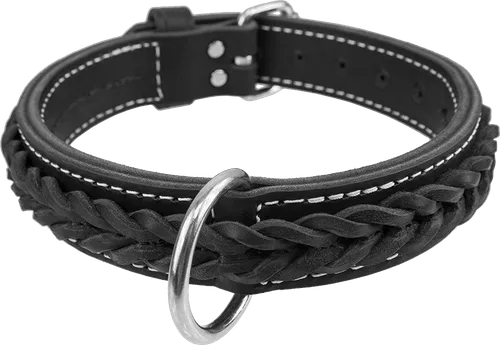
A no pull harness handles pulling, but identification and everyday control still belong on a collar. If your dog wears a harness for walks, keep a separate collar with a readable tag for the moments when the harness is off. A heavy-duty leather collar is a practical choice for strong dogs because the hardware and leather hold up to daily use, and it gives you a familiar backup point if you need to grab your dog quickly.
Step-by-step harness measuring process
- Measure girth at the deepest ribcage point: Wrap a soft tape one to two inches behind the front legs, keep it level, and record the number. Common mistake: measuring over a thick coat and then sizing down, which leaves the harness too tight in winter. Write the girth number down before you open any size chart.
- Measure the neck where a collar sits: Measure around the neck at the collar line, not at the base of the skull. Common mistake: measuring the widest part of the head and choosing a harness that is far too large at the neck. The neck loop should be snug enough to stay high on the chest.
- Measure chest length from neck to behind the front legs: Run the tape down the center of the chest from the back of the neck to just behind the front legs. Common mistake: skipping this step and discovering the chest strap rubs the armpits after a long walk. If the panel is longer than this measurement, the harness will sit too far back.
- Match both numbers to the harness size chart: Use girth as the primary size and neck as the secondary check. Common mistake: choosing a size based on weight or breed alone, which ignores the actual body shape in front of you. When you are between sizes, pick the size that adjusts down to your girth measurement.
- Put the harness on and test the two-finger rule: Slide two fingers under the girth, neck, and chest straps. Common mistake: overtightening the girth to stop movement, which restricts breathing and causes chafing. Every strap should pass the two-finger check without being loose enough to rotate.
- Walk, watch, and fine-tune the front clip: Clip the leash to the front ring and walk for five minutes. Common mistake: leaving the front clip off-center, which makes the harness twist instead of steering. Recheck the fit after the first walk and again after a few weeks of use.
Products that support a good fit
- Military Spec Leather Dog Collar 1.25": The ActiveDogs Military Spec Leather Dog Collar is handcrafted from premium black latigo leather and available in single-layer or double-layer construction for added strength. A sturdy leather collar gives you a reliable backup attachment point and a clear place to hang ID when the harness is off.
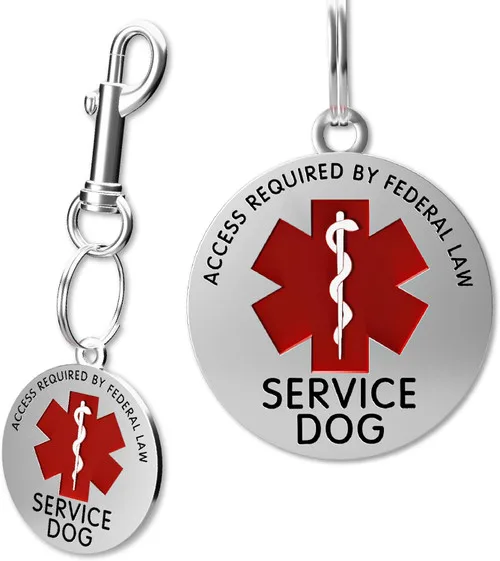
- Service Dog Double-Sided Metal Identification Tag: The Service Dog Double-Sided Metal Identification Tag is made from lightweight aluminum with permanent dye printing on a white background. Clear, durable ID matters more than ever when your dog walks on a harness and the collar is not the primary control point.