Quick answer
Pack the Stone Flap Backpack - Day by loading the heaviest, flattest items against the back panel first, then using the full-length central zip to reach everything else without unpacking. Build the bag around your actual commute, not a hypothetical one.
Why the full-length zip changes your packing order
Most backpacks force you to stack items from the top down, so whatever you need most ends up at the bottom. The Stone Flap Backpack - Day opens along a full-length central zip, which means you can lay the bag flat and see the entire main compartment at once. That changes the logic: instead of packing for vertical stacking, pack for flat visibility. Put the items you reach for least against the back panel and the items you need mid-commute near the opening.
What to leave out
The catalog does not list a laptop sleeve dimension, padded compartment, or water-bottle pocket, so do not assume those features exist. If your commute requires a dedicated padded laptop section, measure your device and check the bag's internal dimensions before relying on it. For many commuters, a slim laptop in a separate protective sleeve works fine inside the main compartment — but that is a decision you make, not a guarantee from the product listing.
Step-by-step packing routine
- Lay the bag flat and open the full-length zip: Place the Stone Flap Backpack - Day face down with the back panel on a table, then unzip the central zip fully so the main compartment lies open like a clamshell. Checkpoint: if the bag does not lie flat, remove any items already inside before continuing.
- Place the heaviest flat items against the back panel: Put your laptop (in a protective sleeve if you use one), a notebook, or a folder directly against the back panel. Keep these items flat and centered so the weight sits close to your spine. Common mistake: stacking heavy items near the zip opening, which makes the bag sag away from your back.
- Add a middle layer for bulky but light gear: Place a light jacket, a pouch of cables, or a small umbrella in the middle of the main compartment. Keep this layer thin so the bag can still close without strain. Checkpoint: press the layer down — if it springs back above the zip line, remove something before closing.
- Keep daily-reach items near the opening: Put your phone, transit card, keys, and any medication in a small pouch or loose near the top of the open compartment, closest to where the zip meets the flap. These are the items you will grab without fully opening the bag. Common mistake: burying small items in the middle layer, which forces you to open the whole bag on a crowded platform.
- Zip closed and test the carry before you leave: Close the central zip completely, lift the bag by one strap, and check that it hangs evenly. If one side pulls down, redistribute the heaviest items toward the center. Checkpoint: a bag that hangs level at home will stay comfortable through a longer walk or train ride.
Product facts that affect packing
-
Stone Flap Backpack - Day: Full-length central zip gives quick access to the entire main compartment. You can pack in flat layers and reach any item without emptying the bag, which suits a commute with multiple stops.
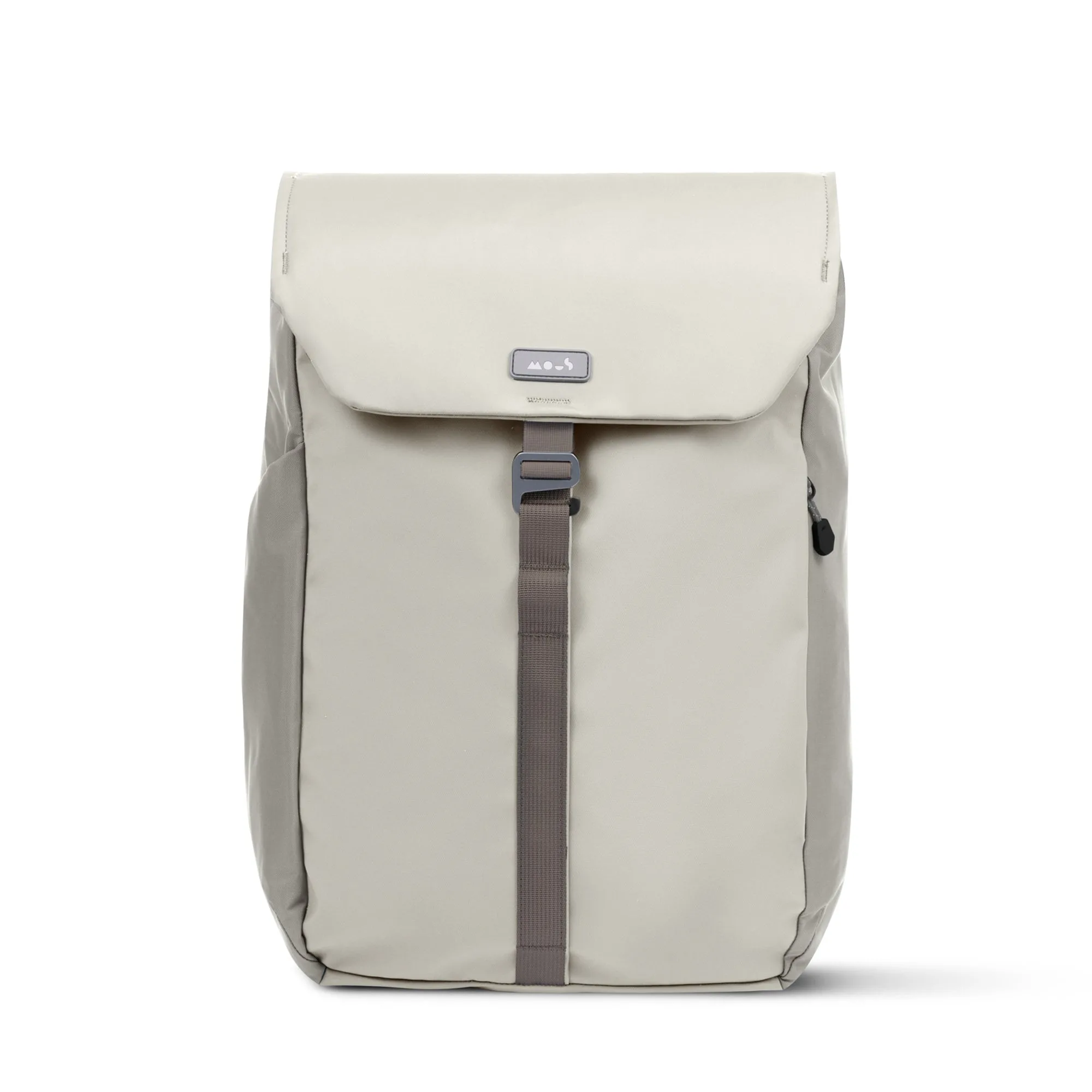
Stone Flap Backpack - Day