What makes a well-paired espresso set
An espresso cup and saucer set is more than two separate pieces. When they are designed together, the saucer should catch drips, hold a small spoon, and sit comfortably under the cup. The Cachemire collection from Jars Céramistes offers a tasse & sous-tasse espresso that is made as a pair, so the proportions and glaze are already matched.
The key is to look for a set where the cup's base fits neatly on the saucer's recess, and the overall silhouette feels balanced. With handmade ceramics, slight irregularities are part of the charm, but the fit should still be snug.
What the Cachemire set confirms
-
tasse & sous-tasse espresso cachemire: The Cachemire espresso set includes a cup and saucer in ceramic, with an organic, irregular shape that shows the hand of the ceramist. The irregular lines mean each set is unique, but the pair is designed to work together. You don't need to guess if a different saucer will fit.
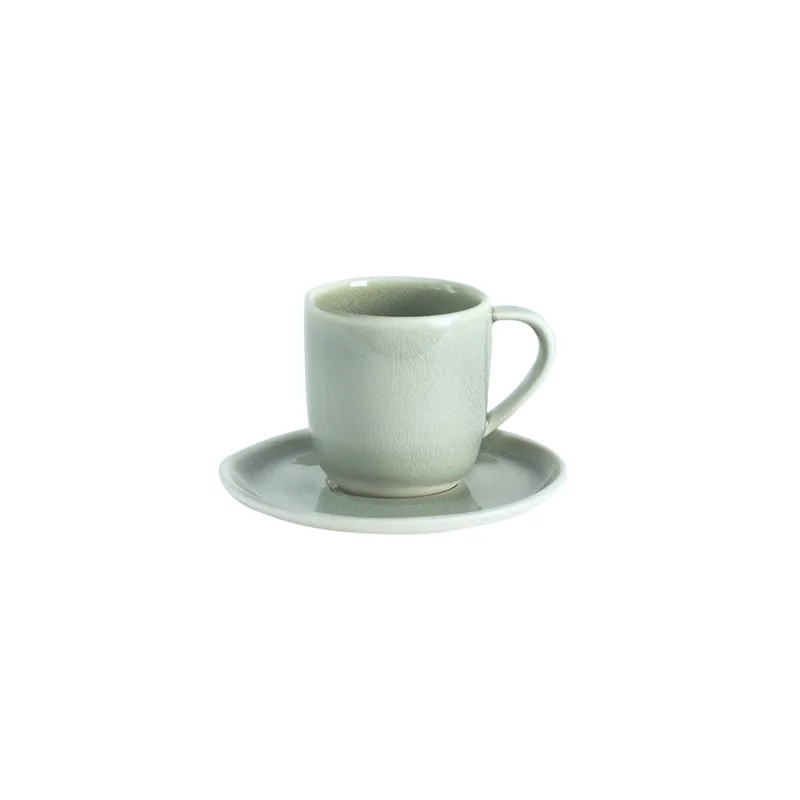
tasse & sous-tasse espresso cachemire
-
tasse & sous-tasse espresso cachemire: The glaze is described as cachemire, a bright grey with a fine crackle effect, applied by dipping in a bath. The crackled glaze is a signature finish. When pairing, you want the cup and saucer to share the same glaze batch so the crackle pattern and colour temperature match exactly.
Size and proportion: what to look for
The catalog does not specify exact dimensions, but the set is called an espresso cup and saucer. That tells you the cup is meant for a single shot of espresso, so the saucer will be proportionally small. When choosing a set, hold the cup over the saucer to see if the base sits centred. With organic shapes, a slight wobble is normal, but the cup should not slide off.
If you are mixing pieces from different collections, check that the saucer's inner rim or recess matches the cup's base diameter. A saucer that is too large or too small will look unbalanced and may not catch drips effectively.
Glaze harmony: why it matters
The Cachemire glaze is described as bright grey with fine crackle. If you buy the set as a pair, the cup and saucer are dipped in the same bath, so the finish will be consistent. If you buy the cup and saucer separately, you may get slight variations in the crackle pattern or grey tone. This is not a defect, but it is something to consider if you want a perfectly uniform look.
For a cohesive table, you can also pair the Cachemire set with other pieces from the same collection, like a larger cup or a bowl, as long as the glaze matches.
A simple pairing routine
- Check the set is a pair: Look for a product listing that includes both cup and saucer, like the Cachemire tasse & sous-tasse espresso. This guarantees they are designed together.
- Examine the fit: Place the cup on the saucer. The base should sit inside any raised rim or recess. The saucer should not be much wider than the cup's diameter.
- Compare the glaze: Hold the cup and saucer side by side in natural light. The crackle pattern and grey tone should look consistent, especially if the set is from the same production batch.
- Consider the table setting: If you plan to use the set with other pieces, choose a saucer that complements the cup's shape and glaze. The Cachemire's organic lines pair well with simple, unadorned ceramics.
What the record leaves open
The supplied evidence does not include exact dimensions, weight, or care instructions for the Cachemire set. For specific measurements or cleaning details, you may need to contact the store or check the product page directly. However, for pairing purposes, the key factors are fit and glaze consistency, both of which are confirmed by the set being sold as a pair with a single glaze description.