Quick answer
Captain Sonar is a real-time team game where two submarine crews compete to locate and destroy each other. Each player takes a unique role—Captain, First Mate, Engineer, or Radio Operator—and must communicate clearly to navigate, manage systems, and fire torpedoes.
Why real-time play changes everything
Unlike turn-based board games, Captain Sonar runs in real time. Every second counts. The Captain must give movement orders quickly, the Engineer tracks damage and repairs, the First Mate manages weapons and special systems, and the Radio Operator listens for enemy movements on the opponent's board. If your team hesitates, the enemy gets the drop on you.
Turn-based variant for new players
Captain Sonar includes a turn-based mode that is ideal for learning the game. In this mode, teams take alternating actions, giving everyone time to understand their role and the submarine's systems. Once comfortable, switch to real-time for the full experience. The turn-based mode removes the pressure but still teaches the core mechanics.
Step-by-step guide to playing Captain Sonar
- Set up the game boards and assign roles: Place the two submarine boards opposite each other with the screen divider between them. Each team of 2-4 players chooses a submarine type (each has different system layouts). Assign roles: Captain (moves the sub), First Mate (manages weapons and special systems), Engineer (tracks damage and repairs), and Radio Operator (plots enemy position). Make sure every player understands their role before starting. A common mistake is to skip the role briefing, leading to confusion during real-time play.
- Place your submarine and prepare the equipment: Each team places a transparent submarine token on their own map at a starting position of their choice (not adjacent to the enemy's starting area). Give each player the appropriate role sheet and dry-erase markers. The Radio Operator gets the opponent's map to track enemy movements. Double-check that the screen divider is high enough to block line of sight. If players can see the opponent's board, the Radio Operator's job becomes trivial.
- Start the game and begin real-time movement: The game begins simultaneously. The Captain announces movement commands (e.g., 'North, North, East') while the Engineer marks each move on the submarine's system track. The First Mate can activate special systems or prepare torpedoes. The Radio Operator listens to the enemy Captain's commands and marks their estimated position on the opponent's map. A common mistake is for the Captain to speak too quietly or unclearly. Speak loudly and repeat commands if needed so the Engineer can keep up.
- Manage systems and avoid overload: Each time the submarine moves, the Engineer checks off a box on the corresponding system (e.g., movement, weapons, or sonar). If a system track is fully checked, that system is disabled until the Engineer uses an action to repair it. The Captain must balance movement with system management to avoid being caught without essential functions. Don't ignore system overload. A disabled weapon system at the wrong moment can cost you the game. Plan repairs during quieter phases.
- Fire torpedoes and try to hit the enemy: When the First Mate declares a torpedo launch, the Captain announces the target area. The Radio Operator must have a good fix on the enemy's position. The enemy team then reveals their submarine's actual location. If it matches the targeted area, the torpedo hits and damages their submarine. A submarine is destroyed after taking four hits. A common mistake is firing too early without a solid enemy position. Wait until the Radio Operator has a clear track, or use sonar to confirm.
- Use special systems to gain an edge: Each submarine has unique special systems (e.g., sonar to reveal enemy position, silent running to hide your own, or mines to block areas). The First Mate activates these by checking off the corresponding system track. Use them strategically to break a stalemate or escape a tight spot. Don't hoard special systems. If you never use them, you waste potential advantages. Activate them when the enemy is close or when you need to disengage.
- Win by destroying the enemy submarine or forcing a surrender: The game ends when one submarine takes four hits and is destroyed. Alternatively, if a team's systems are so overloaded that they cannot continue, they may surrender. The surviving or last-operational team wins. Keep an eye on your own system tracks. If you are close to total overload, consider a desperate torpedo salvo before you lose all capability.
Product facts
-
Captain Sonar: The year is 2048. A new economic war has erupted. Rare earth has become a key element for building new machines, leading private companies to arm next-gen submarine prototypes to protect their underwater mines. This setting frames the game's conflict and explains why each submarine is equipped with advanced but unstable systems that players must manage under pressure.
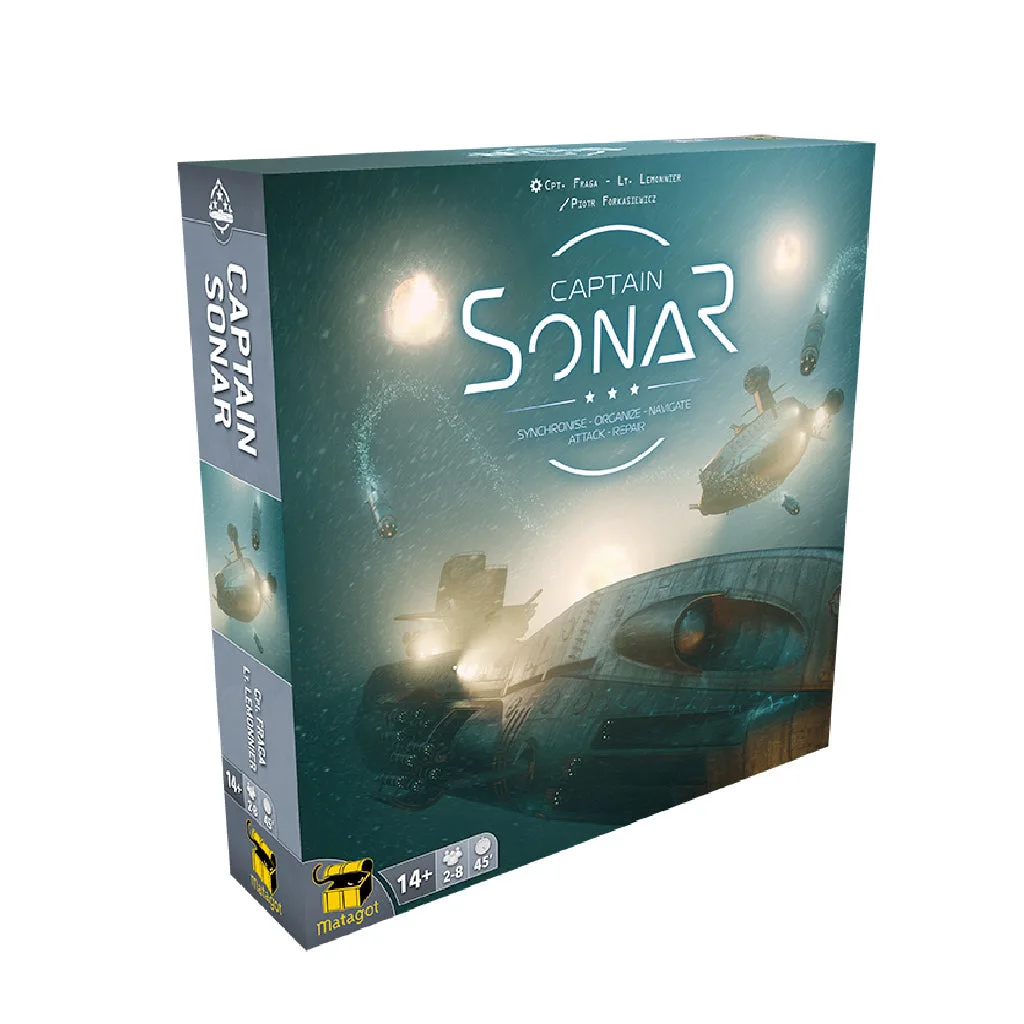
Captain Sonar