Quick answer
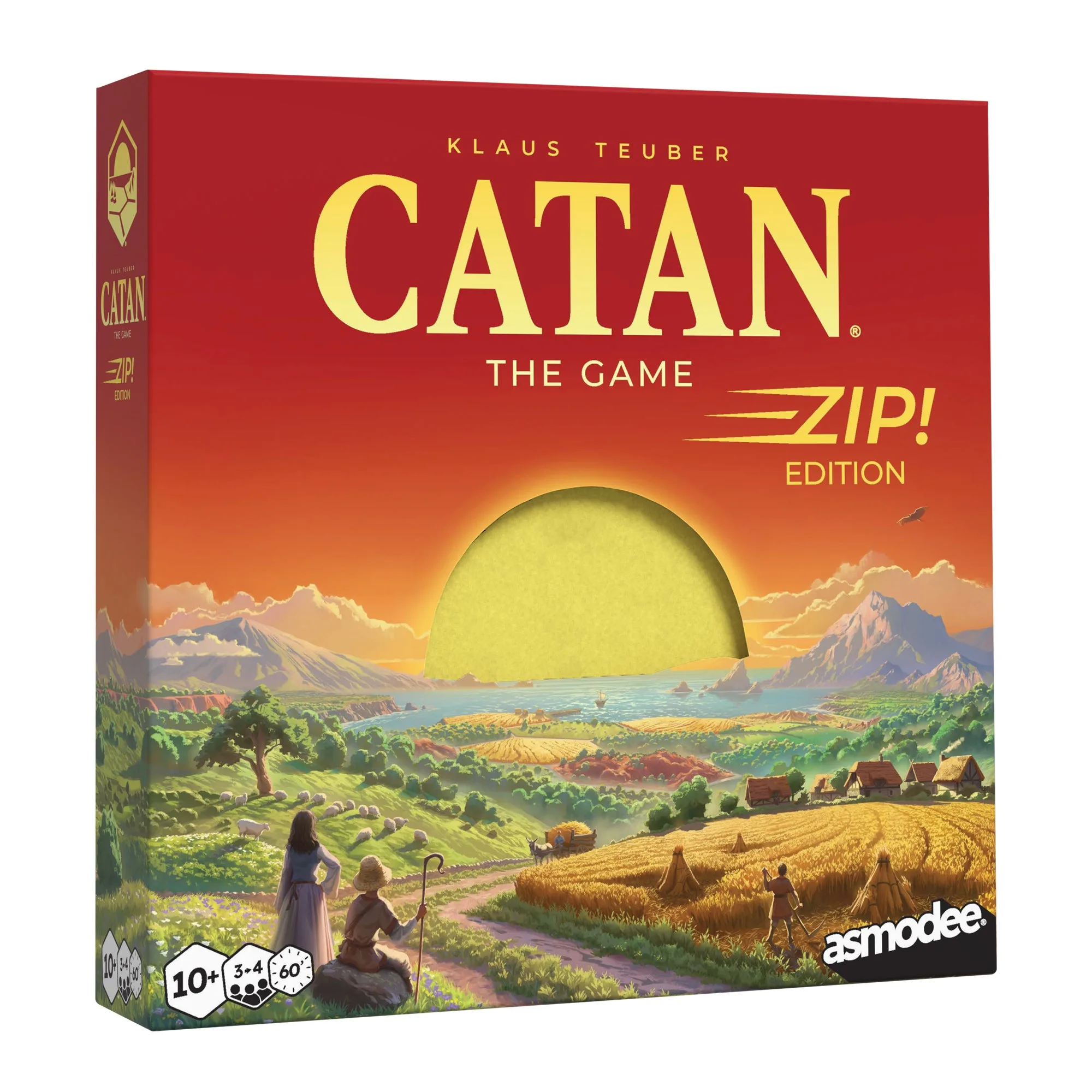
CATAN – Zip! is a compact, travel-friendly version of the classic settlement-building game. It uses the same core trading and building rules but plays on 50 unique maps instead of a modular board, making setup faster and gameplay more portable.
What makes CATAN – Zip! different from the original
Unlike the original CATAN, which uses hexagonal tiles that you arrange randomly, CATAN – Zip! comes with a pad of 50 pre-printed maps. Each map shows the island layout, including terrain hexes, numbers, and ports. This eliminates the setup step of placing tiles and numbers, so you can start playing within minutes.
The game also uses cards for resources and development instead of dice. On your turn, you draw a card from the resource deck instead of rolling dice to determine which hexes produce. This change makes the game more predictable and faster, ideal for travel or shorter sessions.
What stays the same
The core goal remains: collect resources, build roads and settlements, and earn 10 victory points to win. Trading with other players, building costs, and the victory point system are identical to the original CATAN. If you already know how to play CATAN, you will pick up CATAN – Zip! quickly.
How to play CATAN – Zip! step by step
- Choose a map and set up: Each player picks a color and takes the matching pieces: 2 roads, 2 settlements, and 2 cities. Place one settlement and one road on the map according to the starting positions shown. The map also indicates where to place the number tokens (if any) and the robber token. Common mistake: Forgetting to place the robber token on the desert hex before starting. The map pad includes starting positions, so you don't need to decide where to build first.
- Learn the card-based resource system: Instead of rolling dice, you draw a card from the resource deck on your turn. The deck contains one card for each terrain hex on the current map. When you draw a card, all players who have a settlement or city adjacent to that terrain type collect the corresponding resource. Common mistake: Forgetting that the drawn card determines which hex produces, not the dice roll. The resource deck ensures each terrain type appears exactly as many times as its hexes on the map, making resource distribution more balanced.
- Take your turn: draw, trade, build: On your turn, draw a resource card, then you may trade resources with other players or use the bank (4:1 ratio unless you have a port). After trading, you may build roads, settlements, or cities using the standard CATAN build costs (e.g., 1 brick + 1 lumber for a road). Common mistake: Trying to build a settlement without an adjacent road or on an occupied intersection. Building costs are printed on the player aid card included in the box for quick reference.
- Use development cards strategically: When you build a settlement or city, you may also draw a development card from the deck (cost: 1 ore + 1 wheat + 1 sheep). Development cards include knights, victory points, road building, and monopoly. You can play a knight card to move the robber, which blocks resource production on the hex it is placed on. Common mistake: Playing a development card on the same turn you draw it – you must wait until your next turn. Development cards can give you a surprise victory point or a tactical advantage, but they are optional – focus on building settlements first.
- Reach 10 victory points to win: You earn victory points for each settlement (1 point), city (2 points), longest road (2 points), and largest army (2 points). The first player to reach 10 points on their turn wins. Common mistake: Forgetting to count victory points from development cards or the largest army bonus. Keep your victory point total visible – the game ends immediately when someone reaches 10 points, so no extra turns.
Product facts
-
CATAN – Zip!: Compact for portability, featuring 50 maps for a unique experience every time you play. You can take CATAN – Zip! anywhere and enjoy a different game each time without needing a large table or carrying bulky tiles.
CATAN – Zip!