Doodle Heist in a nutshell
Doodle Heist is a team drawing and deduction game where speed matters as much as accuracy. Each team has an artist who sees a secret key card with the correct answer. The artist draws clues on the board while teammates race to guess what it is. Guess your own team’s drawing correctly, and you earn points — and if you are quick enough, you get a chance to steal points by guessing the other team’s drawing too. Guess wrong on your own drawing, and the opposing team gets a free chance to steal yours.
The game is designed for 4 or more players, ages 10 and up. No artistic skills are needed, but you do need to be quick. The box includes 500 noun and adjective cards, a game board, two dry-erase boards, two markers, a sand timer, four guess tokens, and 16 key cards.
Setting up a round
- Divide into teams: Split players into two teams. The game supports 4 or more players, so you can scale up with larger groups as long as each team has at least two people.
- Choose an artist for each team: Each team picks one player to draw for the round. That artist will hold the team’s secret key card and draw clues on the dry-erase board.
- Set the board with clues: Place the game board and set it up with the clue cards as directed. The board holds the clues both teams will use to identify the drawings.
- Give each artist a secret key card: Each artist receives a key card showing the correct answer for the round. Keep it hidden from the other team and from your own guessers.
- Prepare drawing supplies and timer: Hand each artist a dry-erase board and marker. Place the sand timer and guess tokens within reach. The timer limits how long artists have to draw.
Drawing and guessing: how a turn works
When the round begins, both artists draw at the same time. They use the clues on the board to sketch something that will lead their teammates to the correct answer on their key card. The challenge is that many clues are similar, so a drawing that is too vague or too clever can send guessers down the wrong path.
Teammates shout out guesses as they interpret the drawing. The first team to guess its own drawing correctly earns points for the round. Speed is the point: the faster your team guesses, the better your chance to steal points from the other team.
Stealing points and avoiding the penalty
Once a team guesses its own drawing correctly, it earns a chance to steal the other team’s points by guessing what the opposing artist was drawing. If the stealing team guesses the other team’s drawing correctly, it takes those points as well.
But there is a risk. If a team guesses its own drawing incorrectly, the opposing team gets a free chance to steal that team’s points. That means a wild guess can backfire and hand points to the other side. The game rewards confident, quick guesses — but only when your team is reasonably sure.
What the sand timer and guess tokens do
The sand timer sets the pace for each round. Artists draw while the sand runs, and guessers must call out answers before time expires. The guess tokens are used to track guesses or steals during the round. The exact token procedure is not detailed in the supplied information, so use them as a visual way to mark each team’s guess attempts and stolen points.
Doodle Heist at a glance
-
DOODLE HEIST - The Quick Drawing and Deduction Family Party Game: Ages 10+ | 4+ Players | 30 Min This tells you the game fits family game night with older kids and adults, and needs at least four people to form two teams.
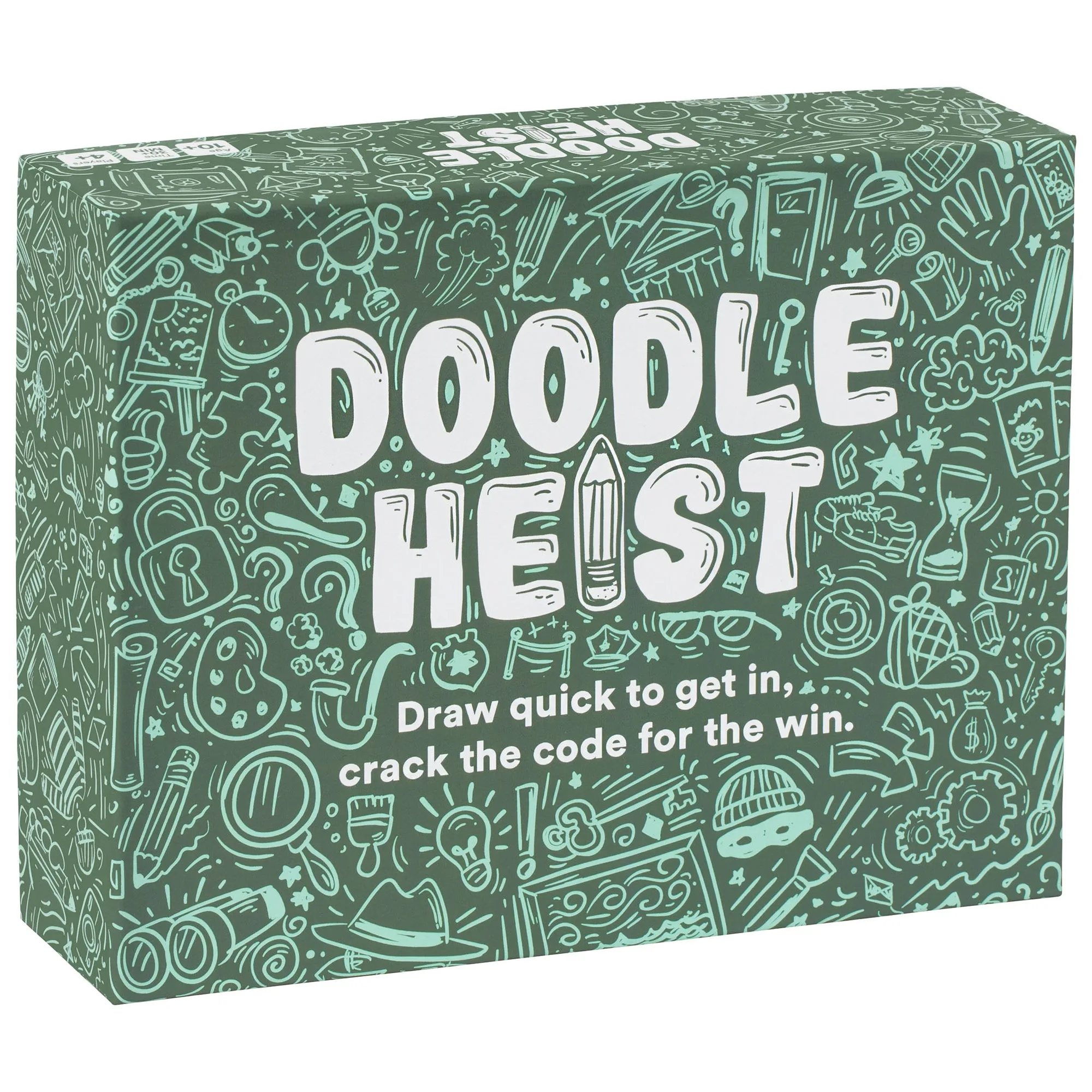
DOODLE HEIST - The Quick Drawing and Deduction Family Party Game
-
DOODLE HEIST - The Quick Drawing and Deduction Family Party Game: Includes 500 noun and adjective cards, game board, 2 dry-erase boards, 2 markers, 1 sand timer, 4 guess tokens, 16 key cards Everything needed for two teams to draw and guess is in the box, so you can start playing right away.
-
DOODLE HEIST - The Quick Drawing and Deduction Family Party Game: No artistic skills needed, but you’ve got to be quick if you’re going to win! The game is about fast thinking and clear clues, not drawing talent, which makes it accessible to a wide range of players.
Tips for smoother rounds
Keep drawings simple. Since many clues are similar, focus on one distinctive feature of the answer rather than trying to illustrate every detail. Artists should avoid writing words or numbers, which can give away the answer too easily.
Guessers should call out answers early and often. A wrong guess on your own drawing gives the other team a free steal, so it pays to be confident — but not reckless. If your team is unsure, wait for a clearer clue rather than guessing wildly.
For larger groups, rotate artists each round so everyone gets a turn to draw and guess. With 4 or more players, you can also split into more than two teams if you have enough supplies, though the box only includes two dry-erase boards and two markers.