Quick Answer
In the Red Deck, you play as Danny, Beth, CATBUG, or JELLY KID, rolling dice and playing cards to win encounters. Setup takes minutes, and turns flow fast once you know the three phases.
Why the Red Deck is a Great Starting Point
The Red Deck is designed for quick play. It uses dice and cards, so you get the fun of rolling and the strategy of playing cards without a long rulebook. If you're new to the Bravest Warriors card game, this deck is a friendly entry point.
The deck supports up to 4 players on its own, and you can combine it with the Blue Deck for up to 8 players. That makes it flexible for small or larger groups, though the game is balanced for the 2-4 player range.
Trade-offs: What the Red Deck Doesn't Do
The Red Deck focuses on fast encounters rather than deep strategy. If you're looking for a complex, hours-long game, this isn't it. But if you want a light, energetic game that fits a lunch break or a party, it delivers.
Also, the Red Deck is not a standalone campaign. It's an encounter-based game, so each session is self-contained. That's great for pick-up play, but if you want a ongoing story, you might need to house-rule it.
Step-by-Step Guide to Playing the Red Deck
- Set Up the Game: Shuffle the encounter deck and place it in the center. Each player chooses a character card (Danny, Beth, CATBUG, or JELLY KID) and takes the matching character token. Place your token on the start space of the board. Each player draws a hand of 5 cards. Check that each player has a character card and a token; if any are missing, you may have a misprint.
- Understand the Turn Structure: Each turn has three phases: Draw, Action, and End. In the Draw phase, draw one card from the deck. In the Action phase, you may play one card from your hand, use a character ability, or roll the dice to attempt an encounter. In the End phase, discard down to your hand limit (usually 5). Don't skip the Draw phase—it's the only way to get new cards, and running out of hand cards can leave you stuck.
- Resolve Encounters: When you attempt an encounter, roll the dice and compare the result to the encounter card's requirement. If you succeed, you gain the reward (often victory points or a bonus). If you fail, you lose the encounter and may suffer a penalty, such as discarding a card or moving back. Read the encounter card carefully before rolling—some require a specific dice combination, not just a high total.
- Use Your Character Ability: Each character has a unique ability that can be used once per turn. For example, CATBUG might allow a reroll, while JELLY KID could let you draw an extra card. Use these abilities strategically to turn a failing roll into a success. Don't hoard your ability for the perfect moment—using it early can prevent a setback that costs you more later.
- Win the Game: The game ends when a player reaches the target victory points (usually 10, but check the rules). That player wins. If the deck runs out, shuffle the discard pile to form a new deck. Track victory points openly so everyone knows the count—this avoids disputes at the end.
Product Spotlight
-
Encounters: Bravest Warriors (Red Deck): The Red Deck lets you play as Danny, Beth, CATBUG, or JELLY KID, and combines with the Blue Deck for up to 8 players. This means you get four distinct characters to choose from, and the option to expand your game night to a larger group without buying a new set.
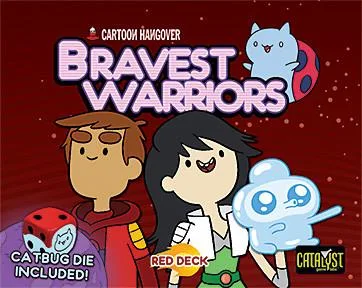
Encounters: Bravest Warriors (Red Deck)