Quick answer
Fifty is a two-player peg-leaping strategy game: move your pegs forward toward the finish hole (50), jumping over your opponent's pegs to gain ground, and be the first to land a peg in the finish hole to win.
What makes Fifty different from other peg games
Unlike solitaire peg puzzles, Fifty is a head-to-head race. Each player controls their own set of pegs and advances them toward the same finish hole. The leapfrog mechanic means you can jump over your opponent's pegs to move faster, but that same mechanic lets them jump over yours. The tension comes from deciding when to block and when to sprint.
Because the board is laser-engraved and the pegs are hand-turned from alder wood, the game has a tactile quality that makes it easy to teach and pleasant to handle. The included cover keeps the pieces together for storage, so it works well as a gift or a travel game.
Common rule mistakes to avoid
The most frequent error is treating a jump as optional when it is actually the only way to move a peg out of a stuck position. Another is forgetting that only one player can win by reaching the finish hole—so if both players have a peg near the end, the race is still on. Finally, new players often overlook that the game is quick to learn but tricky to master; don't assume the first few moves are just setup.
Step-by-step: How to play Fifty
- Set up the board: Place the board between you and your opponent. Each player takes their own set of pegs and places them in their starting positions on their side of the board. The finish hole (marked 50) is shared at the far end. Check that all pegs are on starting spots before the first move—missing a peg skews the race.
- Decide who goes first: Choose a starting player by coin toss or agreement. Players alternate turns, moving one peg per turn. Agree on the first-player rule before play begins so there is no mid-game dispute.
- Move a peg forward: On your turn, move one of your pegs one space forward toward the finish hole. Pegs move along the board's path; you cannot move backward. Plan two moves ahead—moving a peg that blocks your own future jumps can cost you the race.
- Jump to leapfrog: If your peg is directly behind an opponent's peg (or your own, depending on house rules—agree beforehand), you may jump over it to the empty space immediately beyond. Jumping lets you advance faster than a single-step move. Confirm whether jumping over your own pegs is allowed before you start; this changes strategy significantly.
- Reach the finish hole: The first player to land a peg exactly in the finish hole (50) wins. If your move would overshoot the finish hole, you cannot make that move with that peg—choose another peg or a different move. Keep track of the exact count to the finish hole; overshooting wastes a turn.
- Handle blocked positions: If none of your pegs can move forward or jump, you lose your turn. This can happen when your pegs are blocked by opponent pegs with no empty space beyond. Avoid clustering your pegs—spread them out to reduce the chance of being blocked.
About the Fifty Game
-
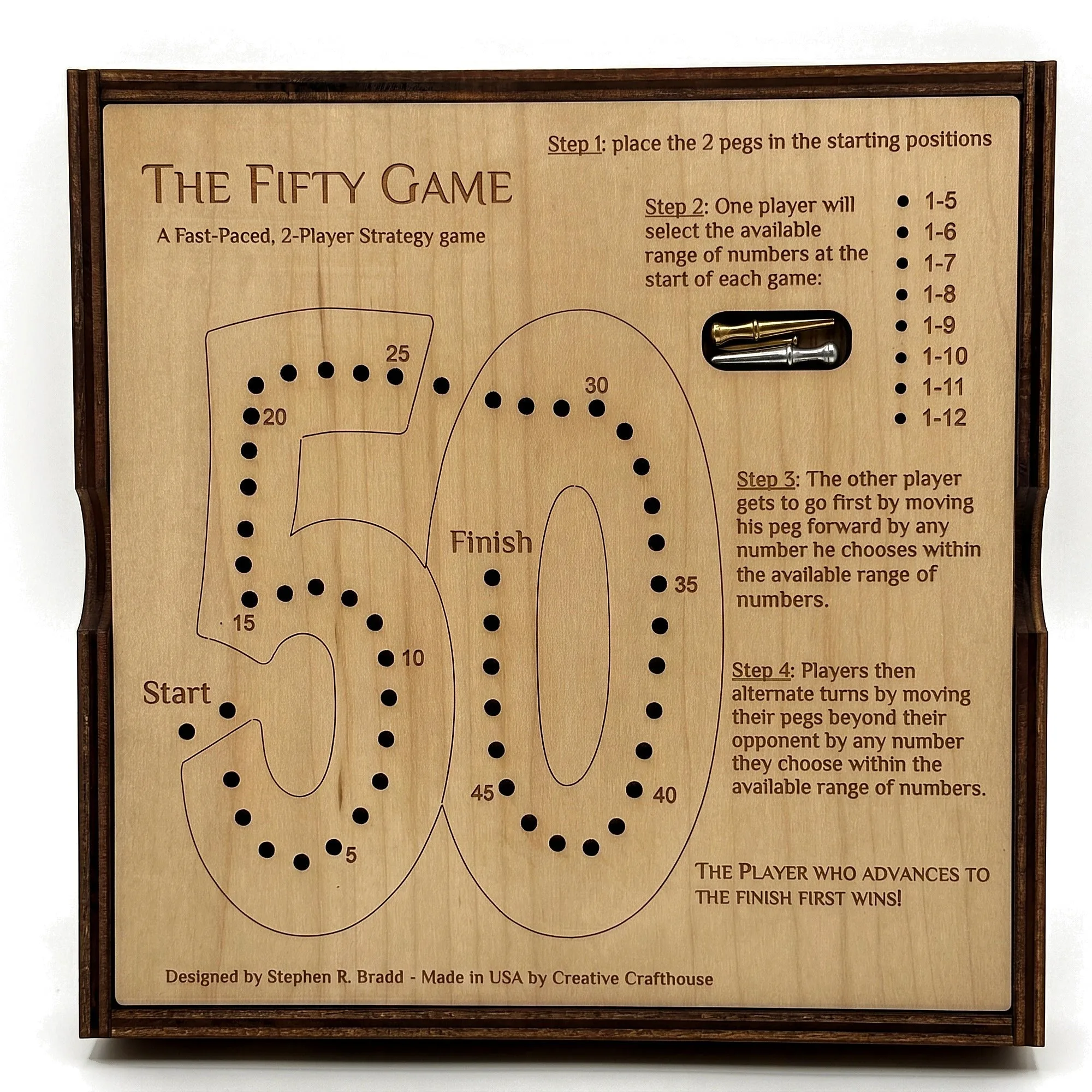
Fifty Game | Two-Player Board Game for All Ages: Fifty Game is a two-player strategy game crafted from alder wood with hand-turned pegs, a laser-engraved board, and a storage cover. The wooden construction and included cover make it a durable, gift-ready option for family game nights or travel.
Fifty Game | Two-Player Board Game for All Ages