Quick answer
Guess in 10: Countries of the World is a question-and-answer card game where players race to win 7 Game Cards by guessing the country on each card using no more than 10 yes-or-no questions. The fastest way to teach it is to set up the deck, model a smart first question, and let kids ask until someone guesses correctly or runs out of questions. Keep the pace light and let younger players peek at the country's continent.
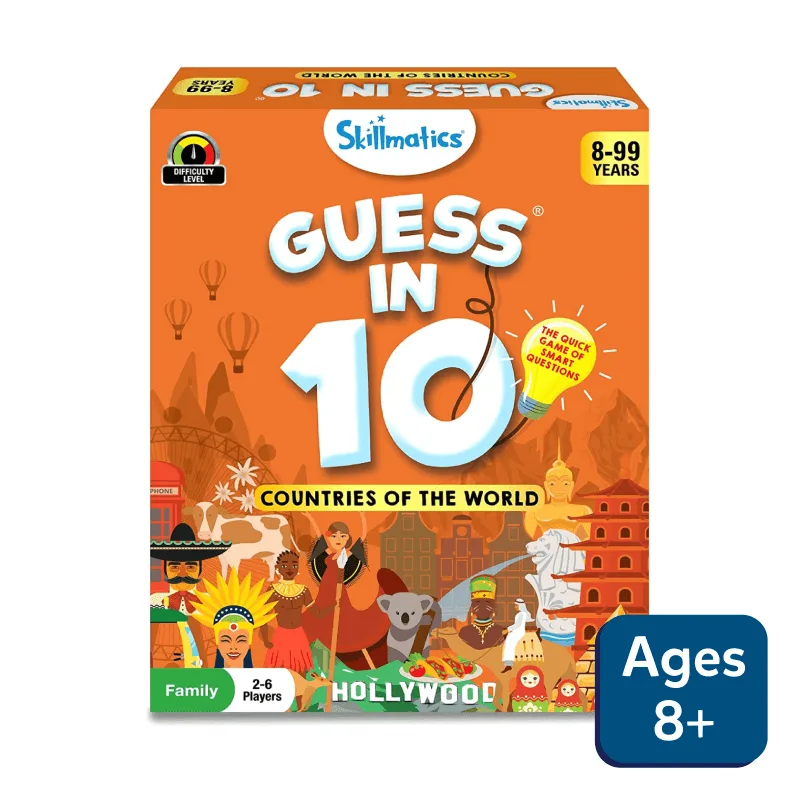
Countries of the World
Set up the deck and choose your first clue-giver
Shuffle the Game Cards and place the deck face down in the middle. Decide who will be the first clue-giver: this player draws the top card, looks at the country without showing anyone, and answers everyone else's questions. If you are playing with just two people, the clue-giver can still answer questions while the other player guesses, then swap roles after each card. For a group, rotate the clue-giver after every card so everyone gets a turn at answering.
Ask questions that split the world in half
The strongest opening questions eliminate large regions. A question like "Is this country in South America?" or "Is it an island?" cuts the possibilities dramatically, while "Is the capital Paris?" only helps if you are already close. Teach kids to ask about continent, island status, language, currency, and climate before guessing specific names. The supplied game description highlights exactly these kinds of questions: island, South America, and whether people pay with euros.
Track your 10 questions out loud
Use a simple tally on paper or count on fingers so nobody loses track. After each answer, the group should say the remaining number together. This keeps the pressure fun instead of confusing, and it stops the common argument about whether a question was the ninth or tenth. If you reach 10 questions without a correct guess, the clue-giver keeps the card and reveals the country, then the next player draws.
Adjust the rules for ages 8 and up
The game is listed for ages 8+, but you can scale it for mixed ages. For younger or newer players, allow one free hint such as the continent or the first letter. For older kids, ban continent questions for the first three turns to force sharper thinking. You can also play in teams so a stronger reader can help a younger sibling phrase questions. The goal is to keep everyone asking, not to enforce tournament rules.
Step-by-step: how to play a round
- Shuffle and deal the first card: Place the deck face down. The first clue-giver draws one card and secretly reads the country name. Checkpoint: make sure the clue-giver does not show the card to anyone.
- Ask up to 10 yes-or-no questions: Players take turns asking questions like "Is it an island?" or "Is this country in South America?" The clue-giver answers honestly with yes or no. Common mistake: asking a specific country name too early instead of narrowing by region first.
- Guess the country or run out of questions: Any player may guess the country at any time. If the guess is correct, that player wins the card. If no one guesses correctly after 10 questions, the clue-giver reveals the country and keeps the card. Checkpoint: count questions out loud so the limit is clear to everyone.
- Rotate the clue-giver and keep playing: Pass the deck to the next player, who draws a new card and becomes the clue-giver. Continue until one player collects 7 Game Cards. Next step: the first player to win 7 cards wins the game.
What you get in the box
- Guess in 10: Countries Of The World | Trivia card game (ages 8+): Ask up to 10 questions to guess the country on the Game Card, then be the first player to win 7 Game Cards. This gives you a clear win condition and a natural stopping point for each round, so games stay short enough for kids.