Quick answer
Start with a small stack of two or three cups and let your baby explore them freely during floor play. As their skills grow, introduce nesting, knocking down, and pretend play to keep the same set interesting for months.
Why open-ended toys like stacking cups earn their keep
A single set of stacking cups can support several developmental stages because the play changes as your baby does. Early on, the cups are about grabbing and mouthing; later they become tools for sorting, sequencing, and pretend play. That flexibility is what makes open-ended toys worth the shelf space—they don't lock your child into one narrow activity.
Unlike electronic toys that dictate a single script, stacking cups invite your baby to invent the game. You can follow their lead and add just enough challenge to keep them engaged without frustration.
When to introduce stacking cups—and when to wait
Most babies are ready for supervised stacking cup play around 6 months, when they can sit with support and bring objects to their mouth. If your baby is still working on head control or isn't reaching for objects, wait a few weeks and try again. There's no deadline; the toy will still be useful when they're ready.
Always supervise play, especially if your baby is mouthing the cups. Inspect the cups for tears or wear before each use, and retire any piece that looks damaged.
Step-by-step: how to play with stacking cups at each stage
- 6–9 months: free exploration: Place two or three cups on the floor within reach during tummy time or supported sitting. Let your baby grab, bang, and mouth them without directing the play. Common mistake: stacking all the cups for them—this age is about sensory exploration, not building. Rotate which cups you offer to keep novelty high.
- 9–12 months: nesting and dumping: Show your baby how to nest one cup inside another, then let them try. Celebrate when they dump a nested stack. Checkpoint: if they lose interest, switch to a simple 'fill and spill' game with a cup and a small toy. Use a clear container to extend the dumping game.
- 12–18 months: stacking and knocking down: Build a small tower of three or four cups and invite your baby to knock it down. Then encourage them to stack two cups themselves. Common mistake: building too tall too soon—start with two cups and add one only when they succeed. Narrate the action ('up, up, down!') to build vocabulary alongside motor skills.
- 18–24 months: sorting and pretend play: Use the cups for color sorting, counting, and pretend games like scooping 'soup' or giving a doll a 'bath.' Checkpoint: follow your toddler's lead—if they want to line up the cups instead of stacking, that's valid play too. Store cups in a small basket so your toddler can access them independently.
Product facts
-
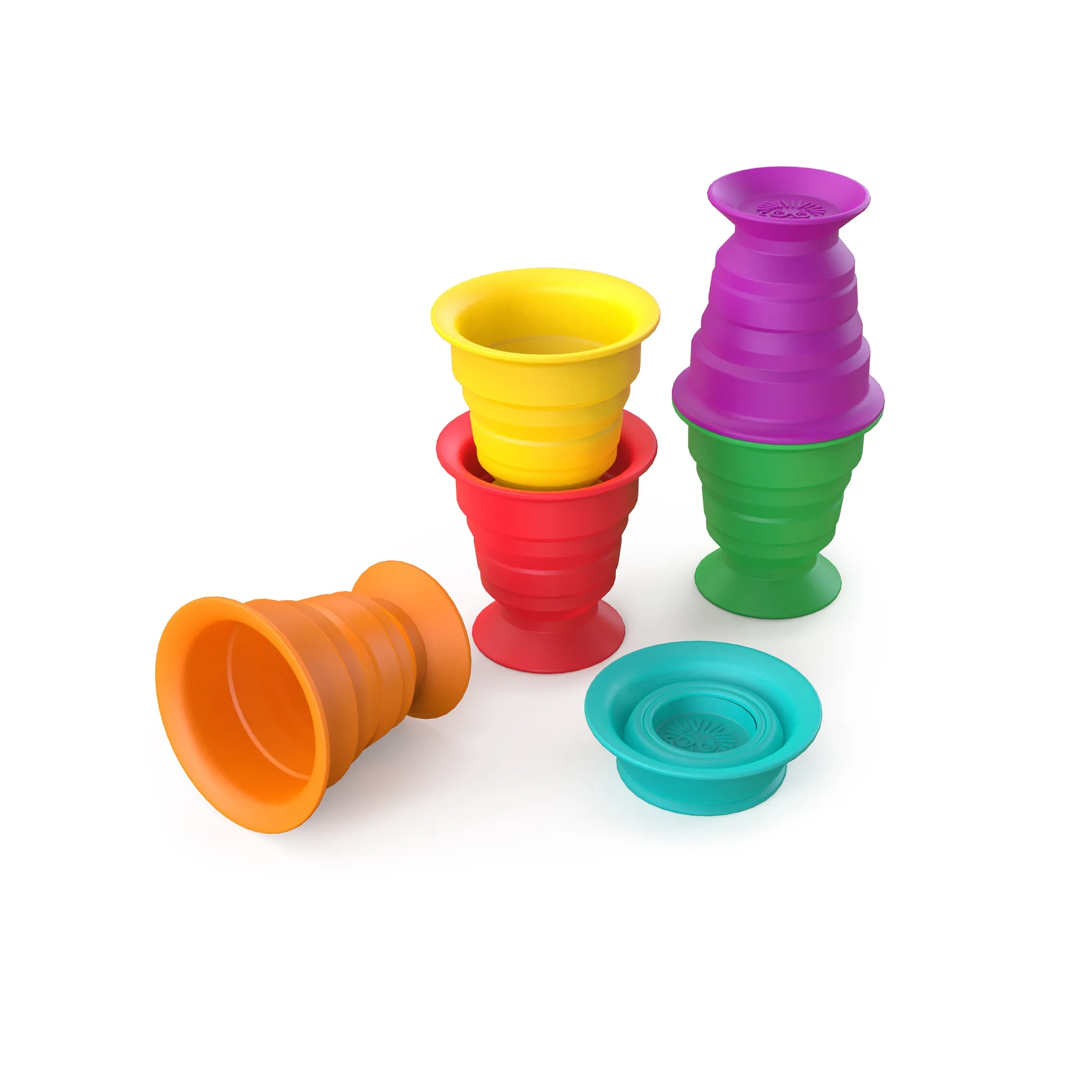
Stacking Cups - Rainbow: The Rainbow stacking cups are a nesting, stacking set made from food-grade silicone. Food-grade silicone is a practical material for a toy that babies often mouth, and the nesting design adds another layer of play beyond stacking.

Stacking Cups - Rainbow