Quick Answer
Start by showing your baby how the pop-up toy works, then encourage them to press, push, or pull the pieces themselves. Always follow their pace and celebrate each attempt to build confidence.
Why Pop-Up Toys Support Baby Development
Pop-up toys are more than just fun—they help babies learn cause and effect, develop fine motor skills, and improve hand-eye coordination. When your baby presses a button or slides a lever and sees a character pop up, they begin to understand that their actions have results.
These toys also encourage focus and attention. Because the surprise of the pop-up grabs their interest, babies often practice the action again and again, which builds persistence and problem-solving skills.
Some pop-up toys, like the Moulin Roty Apres La Pluie, come with a beautifully illustrated base and a soft character. The gentle, natural design can make play feel calm and inviting, which is great for younger babies who might be startled by loud or flashy toys.
Adapting Play to Your Baby's Age
For babies around 6-9 months, they may only watch or bat at the toy. That's okay—just demonstrate the action and let them explore. As they approach 10-12 months, they'll start to press or push with more intention. By 12-18 months, many babies can activate the pop-up on their own and even take turns with you.
If your baby doesn't seem interested at first, don't force it. Try again in a few days. Every baby develops at their own pace, and the goal is to make play feel positive and stress-free.
Step-by-Step Guide to Playing with a Pop-Up Toy
- Introduce the toy with a slow demo: Sit face-to-face with your baby and show them how the pop-up works. Press or slide the mechanism slowly, saying something like 'pop!' when the character appears. Do this a few times so your baby can watch and process. Checkpoint: If your baby looks away or seems overwhelmed, take a break and try again later.
- Let your baby explore freely: Hand the toy to your baby and let them touch, mouth, and manipulate it without instructions. This helps them learn through their senses and builds interest. Checkpoint: Always supervise to ensure safety, especially if the toy has small parts.
- Guide their hands gently: If your baby doesn't activate the pop-up on their own, gently place their hand on the button or lever and help them press it. Say 'you did it!' when the character pops up. Checkpoint: Avoid doing it for them every time—let them try independently to build confidence.
- Add language and sounds: Name the character and describe the action ('Rosee the mouse pops up!'). Use a cheerful tone and add sound effects. This builds vocabulary and connects words with actions. Checkpoint: Pause after the pop-up to see if your baby reacts or tries to communicate.
- Create a simple turn-taking game: Once your baby can activate the toy, take turns: you press it, then they press it. This teaches social skills like sharing and waiting. Checkpoint: If your baby gets frustrated waiting, keep turns short and fast.
- Encourage repeated practice: Let your baby repeat the action as many times as they want. Repetition is how they master the skill and build neural connections. Checkpoint: If your baby loses interest, stop and try again later—don't force it.
Pop-Up Toy Spotlight
-
Moulin Roty: Pop-up Toy - Apres La Pluie: Moulin Roty's Apres La Pluie pop-up toy features a beautifully illustrated base with Rosee the mouse and a soft character dressed in linen and organic cotton. The gentle, natural materials and engaging illustration make it a visually appealing and tactile toy that invites your baby to explore and practice cause-and-effect play.
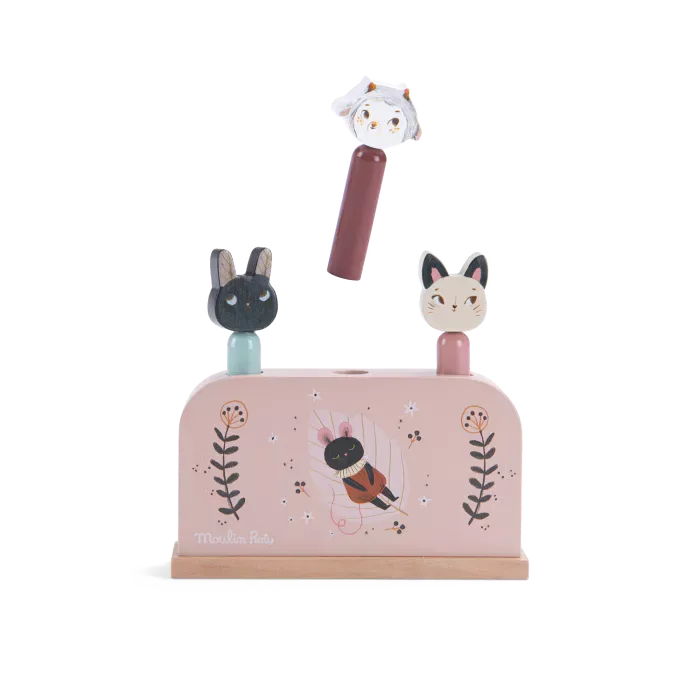
Moulin Roty: Pop-up Toy - Apres La Pluie