Why Start with A Grand Idea?
If you're looking for a picture book that blends history, engineering, and a good story, A Grand Idea: How William J. Wilgus Created Grand Central Terminal is a strong choice. It tells the true story of the civil engineer behind one of New York City's most iconic landmarks, and it's written by award-winning author Megan Hoyt with whimsical illustrations by Dave Szalay.
This STEM-oriented picture book biography is perfect for kids who love asking 'how did they build that?' and for parents or teachers who want to introduce urban history in a way that feels personal and exciting.
What Makes This Book Special
Before you read, it helps to know what makes this book stand out. The story focuses on William J. Wilgus, an experienced engineer who wanted to create a new electric-powered train system. He knew he needed to house this fleet somewhere exceptional, so he came up with a grand idea: an underground multilevel train station.
The book is packed with surprising facts about Grand Central Terminal. For example, did you know that the building once housed a tennis club, ski slope, movie theater, and art gallery—all in the same building? It also had a secret passageway used by President Franklin D. Roosevelt and a library with more than three thousand books, photos, and newspapers.
These details make the book feel like a treasure hunt for facts, which is a great hook for young readers.
Key Facts from the Book
-
A Grand Idea: How William J. Wilgus Created Grand Central Terminal: The book is a STEM-oriented picture book biography by award-winning author Megan Hoyt, with illustrations by Dave Szalay. Knowing the author and illustrator helps you set expectations: it's a factual biography with a playful, whimsical visual style that appeals to kids.
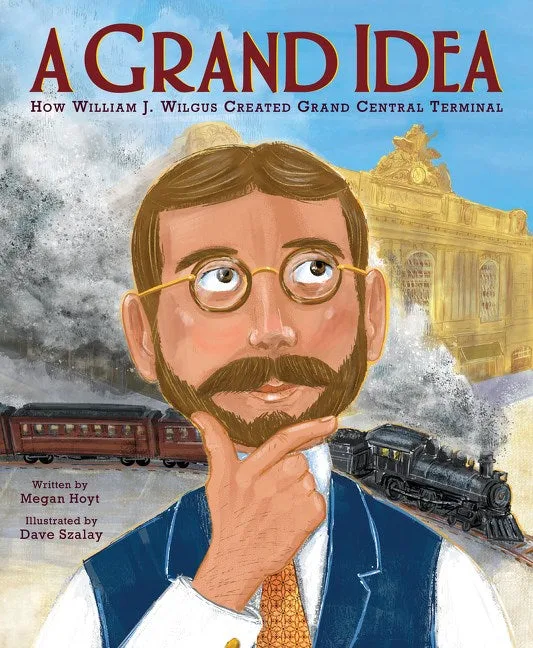
A Grand Idea: How William J. Wilgus Created Grand Central Terminal
-
A Grand Idea: How William J. Wilgus Created Grand Central Terminal: The story follows William J. Wilgus, the American civil engineer responsible for designing and constructing Grand Central Terminal. This gives you a clear focus for discussion—how one person's idea can shape a city.
-
A Grand Idea: How William J. Wilgus Created Grand Central Terminal: The book mentions that Grand Central Terminal once had a tennis club, ski slope, movie theater, art gallery, and a secret passageway used by President Franklin D. Roosevelt. These fun facts are great for engaging kids and sparking curiosity about history and architecture.
How to Read A Grand Idea with Young Readers
Here's a simple approach to make the most of this picture book, whether you're reading at home or in a classroom.
- Start with the cover and title: Ask your child what they think a 'grand idea' might be. This sets the stage for the story of an engineer who solved a big problem.
- Introduce William J. Wilgus: Before you dive in, mention that the book is about a real person. Explain that he was an engineer who designed Grand Central Terminal, and that his idea changed how trains moved through New York City.
- Pause on the surprising facts: When you reach the parts about the tennis club, ski slope, or secret passageway, stop and let your child react. These details are perfect for making history feel alive.
- Connect to the present day: After reading, talk about how Grand Central Terminal is still used today. The book mentions you can still catch a 4, 5, 6, 7, or Metro-North train there any day of the week. This helps kids see that history isn't just in the past.
- Discuss the engineering theme: Ask questions like 'What problem did Wilgus need to solve?' and 'Why was an underground station a good idea?' This reinforces the STEM thinking behind the story.
What to Keep in Mind
The catalog description doesn't specify an age range, so you'll want to gauge your child's attention span. The book is rich with facts and history, so it may work best for kids who are already curious about buildings or trains.
Also, note that the hardcover edition is available, and signed copies are offered. If you're a collector or want a special keepsake, that could be a nice option, but the content is the same.
When you read, don't worry about covering every detail in one sitting. The book is designed to teach 'as many facts about Grand Central Terminal to fill . . . well, Grand Central Terminal!' So you can revisit it multiple times and discover something new each reading.