Quick answer
Read the Vintage Christmas Oracle by first setting a seasonal intention, then drawing cards into a simple three-card spread and interpreting each image through its Victorian holiday context. Treat the deck's old-fashioned symbols as prompts for reflection rather than fixed predictions.
Why seasonal symbolism changes an oracle reading
Oracle decks work through image association, and the Vintage Christmas Oracle leans on Victorian chromolithography and holiday motifs. That means your reading depends on what those specific images evoke for you, not on a universal dictionary. Before you draw, note which seasonal symbols—candles, evergreens, ornaments—already carry personal weight, because those associations will shape the reading more than any printed guidebook.
One limitation to plan around
The Vintage Christmas Oracle is a 50-card deck, and the product listing does not specify a companion guidebook or a fixed card-interpretation system. If you prefer a deck with an extensive printed guide, treat this as a creative prompt deck and build your own symbol notes as you go. That absence is a design choice, not a flaw, but it does mean the reader supplies more of the interpretive framework.
Your step-by-step yuletide oracle reading
- Set a seasonal intention: Before shuffling, write one sentence about what you want the reading to illuminate—such as how to approach a family gathering or where to focus your energy this holiday. Keep it specific enough to test against the cards. If your intention is vague ('tell me about Christmas'), rewrite it until it names a situation or decision.
- Choose a spread that fits the question: For most seasonal questions, use a three-card spread: what the season asks of you, what to release, and what to welcome. For a larger gathering or year-ahead question, lay out five cards in a row and read them as a sequence rather than separate answers. Match the number of cards to the number of distinct parts in your question; extra cards without a role create noise.
- Draw and describe before interpreting: Turn each card face up and say aloud what you actually see—colors, objects, figures, the mood of the scene. Do this for all cards before assigning any meaning. Skipping straight to meaning is the most common mistake; description first keeps you anchored to the image instead of guessing.
- Map each image to a seasonal symbol: For each card, name the holiday symbol it shows or suggests (for example, a candle for hope, an evergreen for endurance). Then ask what that symbol means in your own holiday history. If a symbol feels neutral to you, note it and move on; forcing an association weakens the reading.
- Connect the cards into one sentence: Combine your symbol notes into a single sentence that answers your original intention. Keep it plain and actionable rather than poetic. If the sentence contradicts your intention, revisit your intention before blaming the cards.
- Close with one concrete action: Write down one small thing you will do differently this season based on the reading—a conversation to have, a tradition to adjust, or a boundary to set. Date it. A reading without a next action is entertainment; the action is what makes it a practice.
Product facts
-
The Vintage Christmas Oracle 🎁 A 50-card oracle deck filled with seasonal symbols, heartfelt wisdom, and old-fashioned magic: A 50-card oracle deck blending Victorian chromolithography with mystical symbolism, designed as a partner to The Vintage Christmas Tarot. The 50-card count gives you a compact set for focused holiday spreads, and the Victorian artwork rewards slow, image-led interpretation rather than rapid draws.
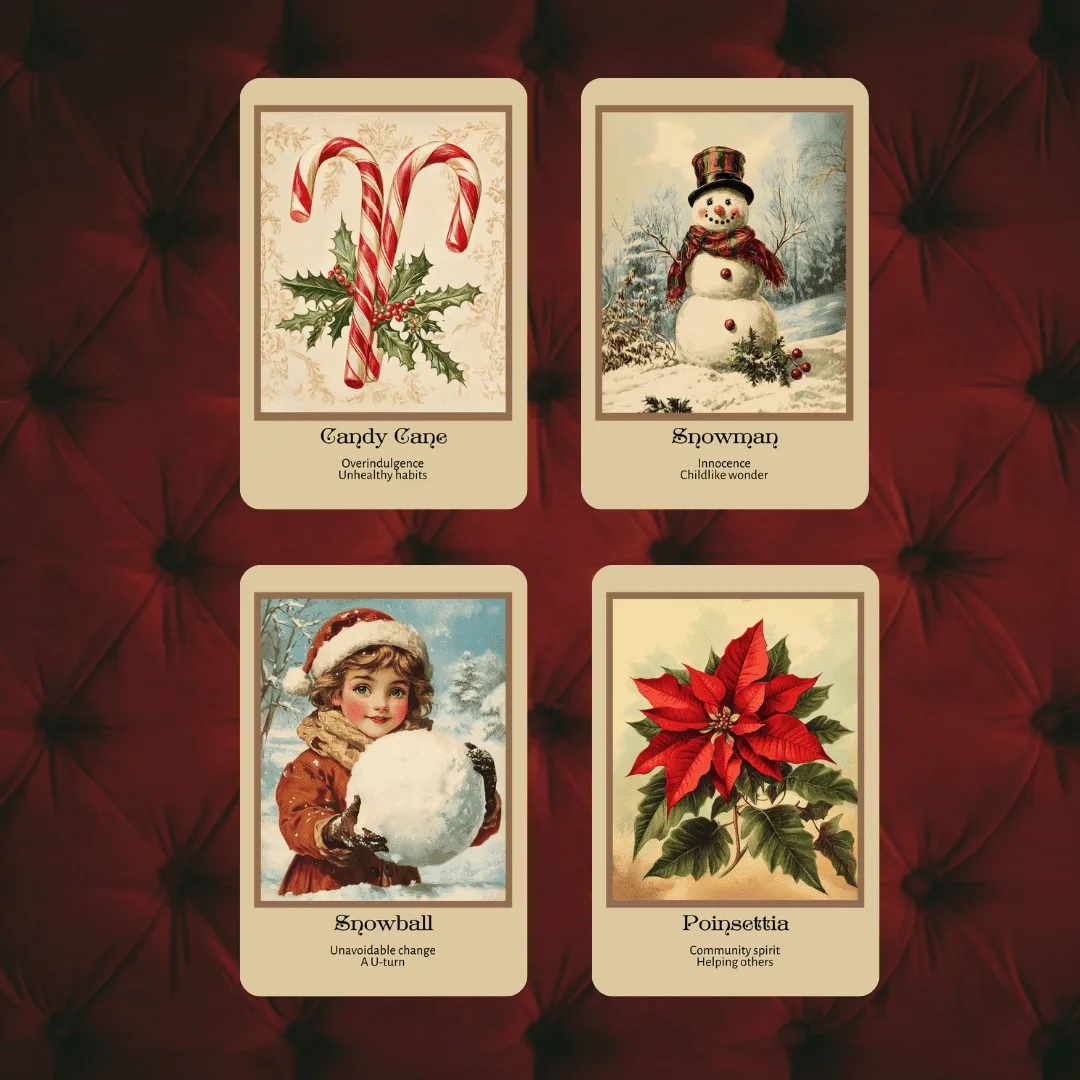
The Vintage Christmas Oracle 🎁 A 50-card oracle deck filled with seasonal symbols, heartfelt wisdom, and old-fashioned magic