Quick answer
Sewing patchwork floral viscose challis requires a fine needle, reduced presser foot pressure, and French seams to handle the fluid drape and prevent fraying.
Why viscose challis needs special handling
Viscose challis is a lightweight, fluid fabric that can shift and fray during construction. The patchwork floral print adds visual complexity, but the 100% viscose composition means it has no stretch and a delicate hand. Without proper technique, seams can pucker and the fabric can stretch out of shape.
How to sew patchwork floral viscose challis
- Prepare the fabric and cut accurately: Pre-wash the fabric on a gentle cycle and press while damp. Use a rotary cutter and a large cutting mat to cut single layers; avoid stacking. Pin pattern pieces within the fabric grain to prevent shifting. Common mistake: cutting multiple layers causes misalignment. Always cut single layers.
- Choose the right needle and thread: Fit a new size 70/10 or 80/12 sharp needle (Microtex or universal). Use a polyester all-purpose thread. Reduce presser foot pressure to 2 or 3 (if adjustable) to avoid stretching the fabric as it feeds. Checkpoint: test stitch on a scrap to confirm tension and stitch length (2.5 mm works well).
- Stabilize seams before stitching: Staystitch curved edges (neckline, armholes) within the seam allowance using a 2 mm stitch length. For long straight seams, use a walking foot or place tissue paper under the fabric to prevent the feed dogs from pulling. Common mistake: skipping staystitching leads to stretched-out necklines. Always staystitch immediately after cutting.
- Sew with French seams for a clean finish: Pin the seam with right sides together and stitch 1 cm (3/8 in) from the edge. Trim the seam allowance to 3 mm (1/8 in). Press the seam open, then fold the fabric so wrong sides are together and stitch again 6 mm (1/4 in) from the folded edge. This encases the raw edge. Checkpoint: French seams work best on straight or gently curved seams; for armholes, use bias binding instead.
- Press carefully without heat damage: Use a dry iron on a medium-low (silk/wool) setting. Press each seam as you sew, using a pressing cloth to protect the print. Avoid steam on the fabric surface—steam can cause water spots. Let the fabric cool completely before moving it. Common mistake: pressing with too much heat or steam flattens the drape and may distort the patchwork design.
Product facts
-
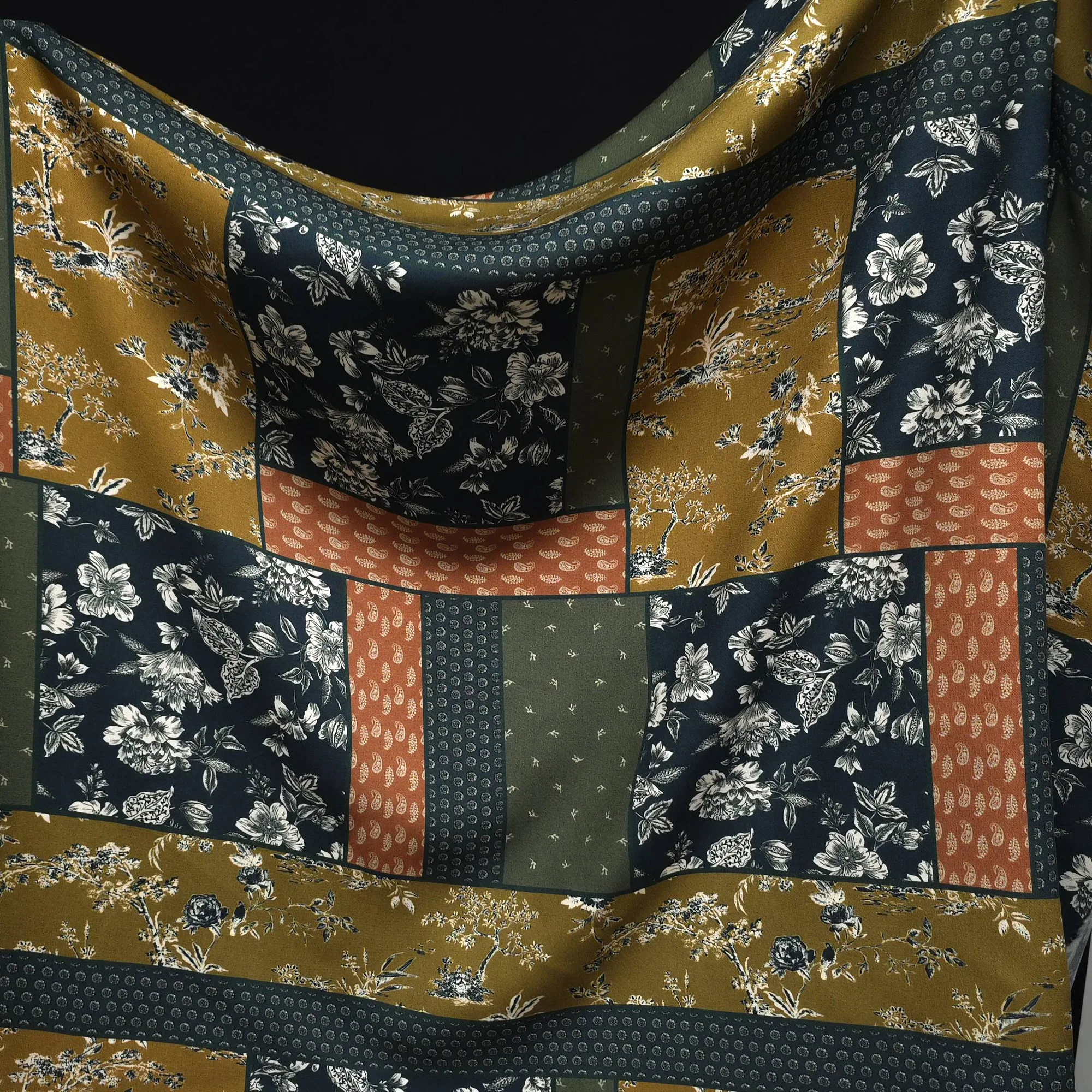
Patchwork Floral Viscose Challis | Mustard, Navy & Olive: This 100% viscose challis weighs 120 gsm and is opaque with a fluid, flowing drape. The lightweight nature means you must stabilize seams and avoid excessive handling to prevent distortion.
Patchwork Floral Viscose Challis | Mustard, Navy & Olive