Why a Hand-Held Sharpener Works for Most Kitchen Knives
A hand-held knife sharpener is one of the simplest ways to keep your kitchen knives sharp without learning freehand techniques on a whetstone. The WÜSTHOF Universal Hand-Held Knife Sharpener is designed to handle both standard and Asian-style blades, so you can use one tool for all your premium kitchen knives.
The key advantage is the adjustable setting that switches between blade types, and the two-stage sharpening process that first reshapes the edge, then hones it to a razor finish.
How to Sharpen with the WÜSTHOF Universal Hand-Held Sharpener
Follow these steps using the two-stage sharpening system. Each setting provides carbide and ceramic slots for a total of four stages.
- 1. Adjust the sharpener for your blade type: Switch the setting to standard or Asian-style blade. This adjusts the angle guide so the edge meets the abrasive at the correct angle.
- 2. Use the carbide slot first: Draw the knife through the carbide sharpening slot. This smooths irregularities and refines the blade edge angle. Use light, even pressure and pull the blade from heel to tip.
- 3. Finish with the ceramic slot: Next, draw the knife through the ceramic sharpening slot. This hones the edge to a refined, razor-sharp finish. Repeat as needed until the blade cuts cleanly.
Understanding the Two Stages
The carbide stage is the coarse step. It removes small burrs and re-establishes a consistent edge angle. The ceramic stage is the fine step, polishing the edge for smooth cutting. Because you can switch between standard and Asian settings, this is the only sharpener you need for all your premium kitchen knives.
Product Facts
-
Universal Hand-Held Knife Sharpener: The WÜSTHOF Universal Hand-Held Knife Sharpener can be adjusted to sharpen either standard or Asian-style blades. This means you don't need separate sharpeners for different knife types. One tool covers your whole knife set.
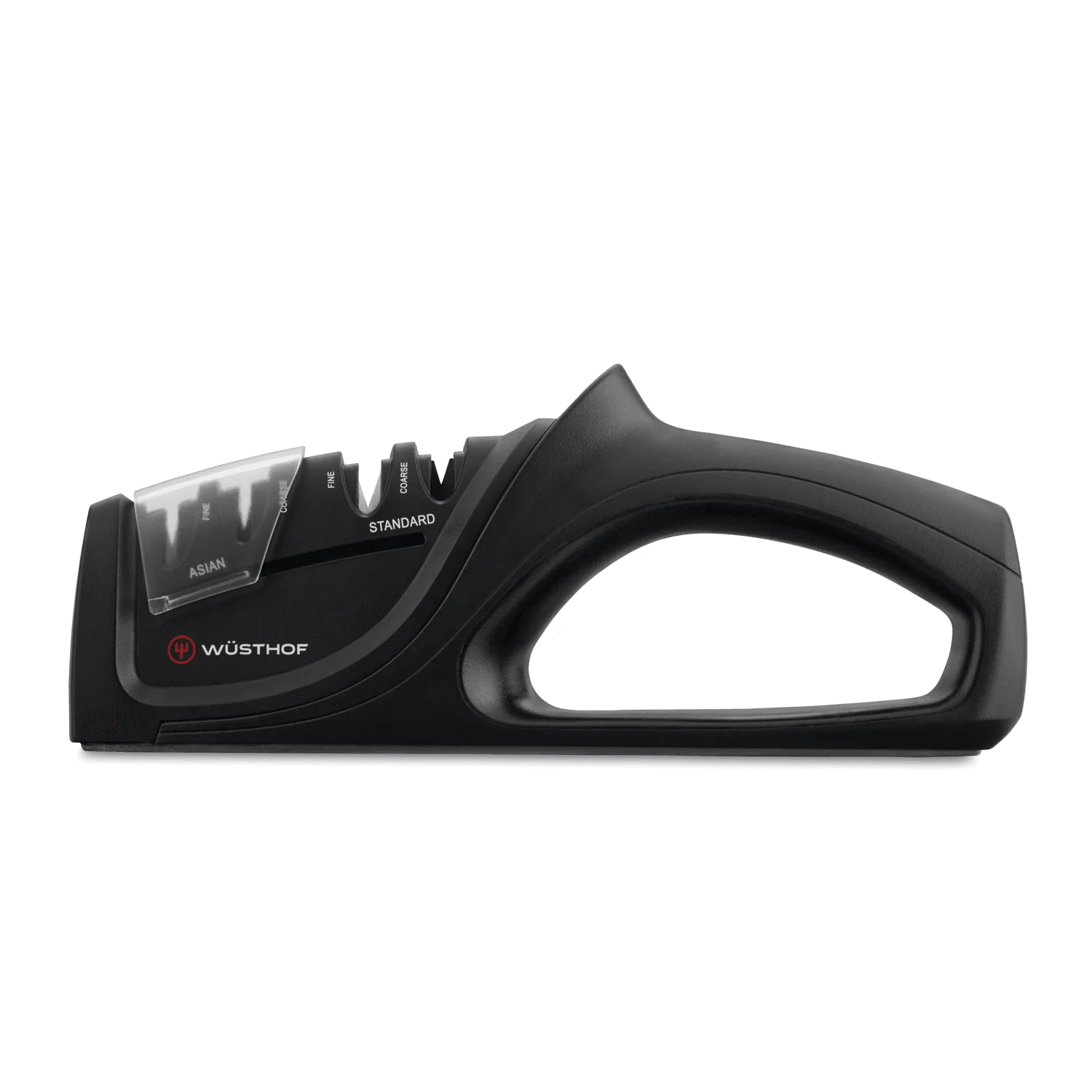
Universal Hand-Held Knife Sharpener
-
Universal Hand-Held Knife Sharpener: Each setting provides two stages of sharpening for a total of four stages: first carbide, then ceramic. The two-stage process ensures you get a proper edge first, then a fine finish, without guessing grit sequences.
Trade-offs vs. Other Sharpening Methods
A hand-held sharpener is faster and more consistent than a whetstone, but it removes slightly more metal per use. For most home cooks, the convenience outweighs the minimal loss of blade life. If you prefer maximum control over edge geometry, a whetstone remains the gold standard. But for quick, reliable sharpening between stones or professional services, a hand-held sharpener is a practical choice.