Understanding the Challenge
The Splitting Headache is a 3D wooden packing puzzle designed by Bill Cutler in 1991. Your goal is to reconstruct a perfect 3×3×3 checkered cube from nine uniquely shaped pieces. Each piece is made from small cubes or partial cube segments, creating a deceptively complex spatial challenge. The puzzle sits in a distinctive four-legged wooden base with clear acrylic sides, allowing you to view the cube from multiple angles.
Before diving into a solution, it helps to understand the structure. The finished cube features a visually striking checkerboard pattern. The nine pieces are not all the same shape, and their arrangement requires careful alignment of layers and orientations. For exact dimensions, please refer to the product instructions.
Start by Studying the Pieces
When you first take the puzzle apart, resist the urge to immediately start reassembling. Instead, lay out all nine pieces and study their shapes. Notice how each piece is made from cube segments—some are straight, some have bends, and others have protrusions. Understanding how these pieces fit together is the first step toward a solution.
Pay attention to the checkerboard pattern of the finished cube. This pattern is not just decorative; it provides clues about how the pieces must be oriented. The pattern requires that adjacent faces of the cube alternate colors, which limits how pieces can be placed.
Step-by-Step Solving Strategy
The following approach can help you make progress without getting stuck. It combines logic, trial and error, and spatial reasoning.
- Step 1: Build a Foundation: Start by trying to form one complete layer of the cube. Look for pieces that can lie flat to create a 3×3 square. Not all pieces will fit in the base layer, so experiment with different combinations. Use the base with acrylic sides to hold the pieces in place as you work.
- Step 2: Add the Middle Layer: Once you have a stable base layer, begin adding pieces that will form the middle layer. These pieces will interlock with the base layer and create the checkerboard pattern. Focus on how the pieces connect at the edges and corners.
- Step 3: Complete the Top Layer: The top layer is often the trickiest because you must fit the remaining pieces while maintaining the checkerboard pattern. Try different orientations and rotations. If a piece doesn't fit, set it aside and try another. The puzzle is designed so that only one arrangement works.
- Step 4: Refine and Adjust: As you work, you may find that pieces need to be rearranged. Don't be afraid to take apart partial assemblies and start over. Each attempt reveals new relationships between the pieces, bringing you closer to the solution.
Tips for Success
Work in a well-lit area with a flat surface. The acrylic-sided base helps keep pieces from sliding, but you can also use it as a frame to visualize the cube. If you get frustrated, take a break—the puzzle is called Splitting Headache for a reason. Returning with fresh eyes often helps.
Some solvers find it helpful to sort pieces by shape or by the number of cube segments. Others prefer to focus on the checkerboard pattern and use it as a guide. There is no single correct method; the puzzle can be solved through logic, strategy, or trial and error.
About the Splitting Headache Puzzle
-
Splitting Headache - 3D Wooden Cube Puzzle by Bill Cutler: The Splitting Headache is a 3D wooden packing puzzle that challenges you to reconstruct a perfect 3×3×3 checkered cube from nine uniquely shaped pieces. Understanding the puzzle's structure—nine pieces forming a 3×3×3 cube with a checkerboard pattern—is essential before attempting a solution.
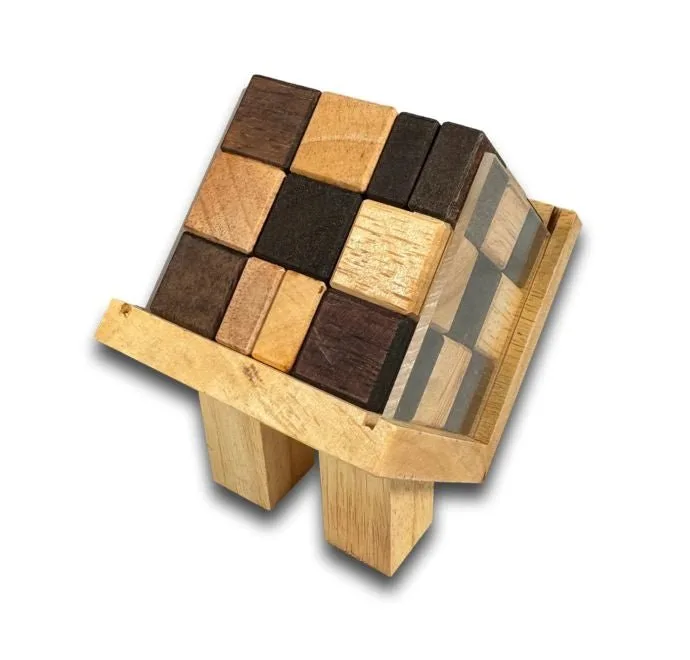
Splitting Headache - 3D Wooden Cube Puzzle by Bill Cutler
-
Splitting Headache - 3D Wooden Cube Puzzle by Bill Cutler: Each piece is made from small cubes or partial cube segments, creating a deceptively complex spatial challenge. The irregular shapes of the pieces mean that trial and error is a valid approach, but studying the pieces first can save time.
-
Splitting Headache - 3D Wooden Cube Puzzle by Bill Cutler: The puzzle sits in a distinctive four-legged wooden base with clear acrylic sides, allowing you to view the cube from multiple angles. The base provides a stable platform for assembly and helps you see the cube from all sides, which is useful for checking the pattern.
-
Splitting Headache - 3D Wooden Cube Puzzle by Bill Cutler: Originally designed by Bill Cutler in 1991, this puzzle has stood the test of time as a favorite among serious puzzlers. Knowing the puzzle's pedigree can reassure you that the challenge is intentional and has been enjoyed by many.