Quick Answer
Roll metal dice on a padded, lipped surface, not directly on bare wood, glass, or veneer. A dice tray with a leather or fabric inlay absorbs the impact and keeps dice from bouncing off the table. If you already see dents or scratches, stop rolling on that surface until you add a tray, and treat deep gouges in glass or veneer as a repair job rather than a cleaning job.
Metal dice feel great in the hand, but they land with far more force than resin or plastic. A heavy D20 dropped from standing height concentrates that energy into one small corner, and bare tabletops take the hit every single time.
The good news is that metal dice table damage is almost always preventable, and the fix costs less than resurfacing a table. Below you will find how to diagnose what is actually happening, what to change first, and when a surface is beyond saving.
Why Metal Dice Damage Tables So Easily
Damage comes down to mass and contact area. Metal dice are denser than resin, so the same throw carries more momentum into a tiny point of contact. Rounded edges spread that force slightly; sharp-edged dice concentrate it, which is why a crisp corner can leave a visible mark on a soft finish.
The surface matters just as much. Lacquered wood, veneer, and glass have little give, so energy goes straight into the material. Felt, leather, and padded fabric deform slightly on impact and spread the load, which is the entire reason a dice rolling surface exists.
- Heavier dice plus a hard table equals dents, not just scuffs.
- Sharp edges mark finishes faster than rounded edges.
- A thin tablecloth helps with sound but does little for impact.
Read the Damage Before You Buy Anything
Run a fingertip across the mark with your eyes closed. If you feel a shallow depression but the surface is smooth, you are looking at a compression dent in the finish or wood. If your nail catches on a ridge, material has been displaced or removed, which is a true scratch.
Shallow dents in solid wood sometimes lift with a damp cloth and a warm iron, but that is a finishing technique, not a dice habit. Deep gouges in veneer, glass, or stone will not buff out at home. Knowing which one you have tells you whether to buy protection or book a repair.
- Smooth dip equals dent; catching nail equals scratch.
- Check the same spot under raking light from a lamp.
- Photograph the mark with a coin beside it for scale before any repair attempt.
The Fix That Solves Most Cases
Add a lipped tray with a soft inlay and roll only inside it. The raised wall stops dice from escaping onto the table, and the padded floor absorbs the landing. This single change removes the direct metal-to-table contact that causes nearly all of the damage people write in about.
If you already own a tray with a hard or bare interior, line it or replace it. A tray that simply moves the impact to a hard wooden floor inside a frame still transfers force, just in a smaller area. Look for a leather or fabric inlay rather than an unfinished base.
- One tray per player is ideal; one shared tray works if it has tall walls.
- Set the tray on a mat so it does not slide or scratch the table beneath it.
- Keep a spare cloth liner for travel games on borrowed tables.
When a Tray Is Not Enough
Some tables should never see loose metal dice at all: glass tops, high-gloss lacquer, thin veneer over particle board, and anything antique or borrowed. On those surfaces, use a full-table mat plus a tray, or switch to resin dice for that session and save the metal set for home games.
If you are rolling on a surface you do not own or cannot repair, treat that as your stopping point. No inlay fully guarantees protection on glass, and a chip in a glass top is a replacement, not a touch-up. Choose another option rather than testing the odds.
- Glass and high-gloss finishes: mat plus tray, or resin dice.
- Borrowed or antique tables: bring your own padded surface.
- Outdoor stone or concrete: expect finish wear no matter what you use.
Dice Damage Diagnosis
- Symptom: faint circular dents in the finish: Likely cause is repeated metal dice landings on bare lacquer or soft wood with no padding. Corrective action: add a leather- or fabric-lined tray and roll only inside it. Stop here if the dents are shallow and the surface is still smooth; protection prevents new marks.
- Symptom: scratches your fingernail catches on: Likely cause is a sharp-edged die corner dragging across the surface, often when dice skid out of a shallow tray. Corrective action: switch to a tray with taller walls so dice cannot escape. Stop here once the tray contains every roll; existing scratches need refinishing, not more rolling.
- Symptom: chips, cracks, or gouges in glass or veneer: Likely cause is a heavy die hitting a hard, brittle surface directly. No inlay can guarantee protection on glass. Corrective action: use a full-table mat plus tray, or roll resin dice instead. Choose another option: treat this as a repair or replacement decision, not a dice-accessory decision.
Trays Built for This Exact Problem
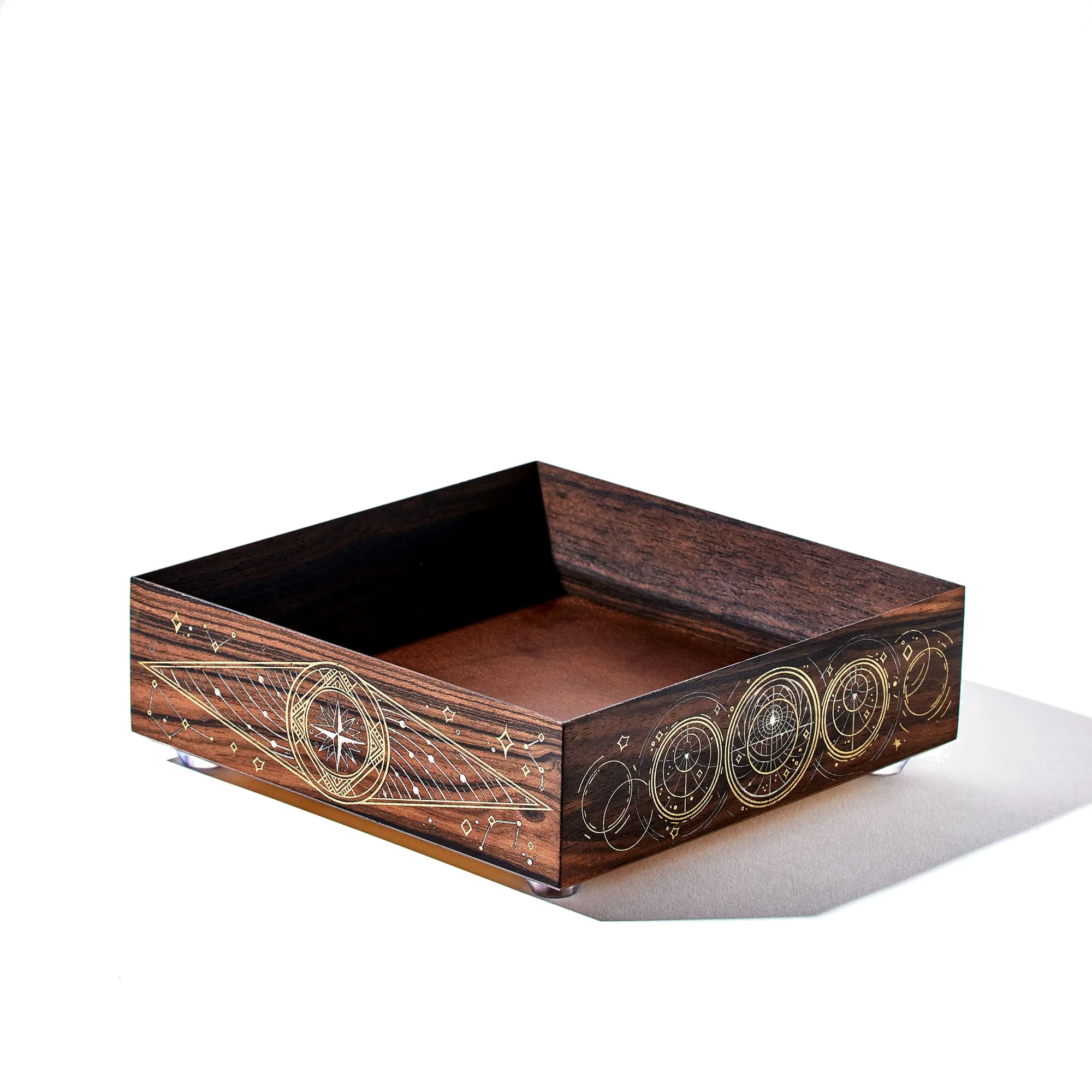
- Dispel Dice x LaserOx Endless Horizons Tray: Handcrafted in Ziricote wood and lined with leather, with a premium leather inlay that gives dice a smooth landing while keeping a satisfying sound on each roll. The leather inlay is the part doing the protective work: it absorbs impact instead of passing it into your table, and the solid wood frame keeps dice contained.
- Dispel Dice x Laserox "Be Not Afraid" Dice Tray in Zircote Wood: Made of Ziricote wood with ash corner embellishments, inlaid with opalescent and gold effect resin, and lined with leather. A leather-lined interior means metal dice land softly, so you get the look of a display piece without sacrificing the protection a rolling surface needs.
Metal dice are worth the weight, but only if the surface under them can take the hit. Diagnose the mark, fix the cause with a padded, lipped tray, and know when a table is simply off-limits to metal. Your table will outlast the campaign.