Why the right negative page matters
Storing 35mm negatives isn't just about keeping dust off. The page you choose determines how many frames you can file per sheet, whether you can make contact prints without removing the film, and how easily you can flip through an archive. A dedicated archival negative preserver solves all three by holding strips in place and fitting a standard binder.
The Dotline Print File Archival Preservers are a clear example: each sheet holds 7 strips of 5 frames, for 35 images total, and fits a standard 3-ring binder. That layout is worth understanding before you buy any 35mm negative storage supplies.
What one preserver sheet holds
-
Dotline Print File Archival Preservers 35mm/5 Frames/7 Strips - 25: Each sheet holds 7 strips of 5 35mm frames each, or 35 images total per sheet. This capacity determines how many sheets you need for a roll or a project and helps you plan binder size.
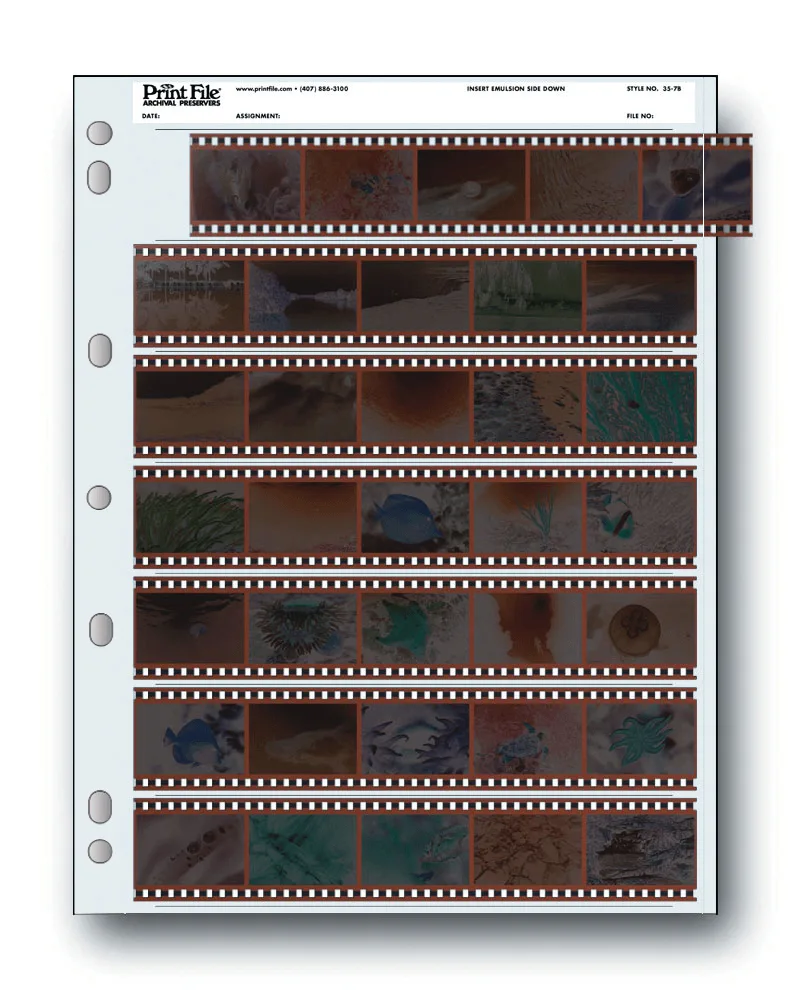
Dotline Print File Archival Preservers 35mm/5 Frames/7 Strips - 25
-
Dotline Print File Archival Preservers 35mm/5 Frames/7 Strips - 25: The holders fit into a standard 3-ring binder. You can integrate them into a familiar binder system without special equipment.
-
Dotline Print File Archival Preservers 35mm/5 Frames/7 Strips - 25: The filmstrip holder is designed for easy contact prints on 8x10 paper. You can proof a whole sheet without removing strips, which reduces handling and the risk of scratches.
A simple workflow for loading negatives
The following steps assume your negatives are already cut into strips of five frames. The product record does not specify cutting instructions, so cut according to your own workflow and the needs of your enlarger or scanner.
- Prepare a clean, dry workspace: Work on a surface free of dust and grit. Keep the preservers face up and have your negative strips ready in a dust-free container.
- Slide each strip into a channel: Each sheet has 7 channels for 5-frame strips. Insert strips emulsion-side down or up according to your preference, but be consistent across the archive.
- Check the fit: The record confirms 7 strips of 5 frames fit per sheet. If your strips are a different length, this page may not be the right match.
- Place the sheet in a binder: Use a standard 3-ring binder. The record does not specify binder material or ring size, so choose one that suits your storage space.
Contact prints without removing the film
One practical advantage of this preserver is that it is intended for contact prints on 8x10 paper. That means you can place the loaded sheet directly on photographic paper under an enlarger or contact printer, expose, and develop as usual. You get a proof sheet of 35 frames while the negatives stay protected in their channels.
- Proof whole rolls at once: A single sheet covers 35 images, so a 36-exposure roll fits with one frame left over or trimmed.
- Reduce handling: Keeping strips in the preserver during printing minimizes direct contact and the chance of fingerprints or scratches.
- Label before printing: Write identification on the sheet margin, not on the film, so you can match proofs to the archive later.
What the product record does not confirm
The supplied information does not specify the preserver material, whether it is archival-grade plastic, or whether it is suitable for long-term museum storage. It also does not include instructions for cleaning, handling fragile negatives, or storing in different climates. Treat those as open questions and consult a conservator or the manufacturer if your negatives are especially valuable.
Likewise, the record does not state whether the pages are compatible with hanging files or other systems beyond a standard 3-ring binder. Stick to the confirmed use: a 3-ring binder.
Pack size and value
- Dotline Print File Archival Preservers 35mm/5 Frames/7 Strips - 25: The preservers come in a pack of 25 sheets. That is enough for 25 sheets × 35 frames = 875 individual 35mm images, which suits a large project or a year of shooting.
When this page is the right choice
Choose the Dotline Print File Archival Preservers if you shoot 35mm, cut your negatives into strips of five, and want a binder-based archive that doubles as a contact-printing system. They are less suitable if your strips are longer or shorter than five frames, or if you need a page with different capacity. For those cases, look for a preservers size that matches your cutting style.