Start with a clean, dry home for your shears
Before you decide where the shears go, give them a dedicated spot that stays clean and dry. Emergency shears are compact and easy to store in a bag, pouch, or glovebox, but they should not rattle around loose among other gear. A little separation protects the cutting edges and keeps the handles from getting snagged.
Choose a location that is easy to reach without unpacking the entire kit. The top lid or a front pocket works well because you can grab the shears quickly when seconds matter. Avoid burying them under bulky items like bandages or cold packs.
Four steps to secure shears in your kit
- Pick a dedicated slot: Reserve a pocket or elastic loop that fits the shears snugly. If your kit has no built-in loop, a small stuff sack or pouch can serve as a dedicated home.
- Keep the blades covered: If your shears came with a sheath or guard, use it. If not, store them blade-down in a pocket so the handles are easy to grab and the edges are less exposed.
- Orient for one-handed access: Place the shears so the handles point up or toward the opening. You should be able to pinch the handles and pull them out without fumbling.
- Check clearance: Make sure the shears do not press against other items in a way that could bend the blades or tear packaging. Close the kit and give it a gentle shake—if you hear metal clanking, add a soft divider or pouch.
Use a pouch or loop to keep shears from wandering
An emergency shears pouch does more than organize—it keeps the blades away from sterile supplies and prevents the shears from poking through soft kit walls. Look for a pouch that fits the length of your shears and has a closure that stays shut but opens fast.
If your kit lacks a pouch, a wide elastic band or a hook-and-loop strap can hold the shears against the inside wall. Just make sure the strap does not cover the handles or interfere with a quick draw.
Why the Tacticsandgear Emergency Shears suit kit storage
-
Emergency Shears: Compact and easy to store in a bag, pouch, or glovebox. Their compact size means they can fit into tight kit pockets without crowding out other essentials.
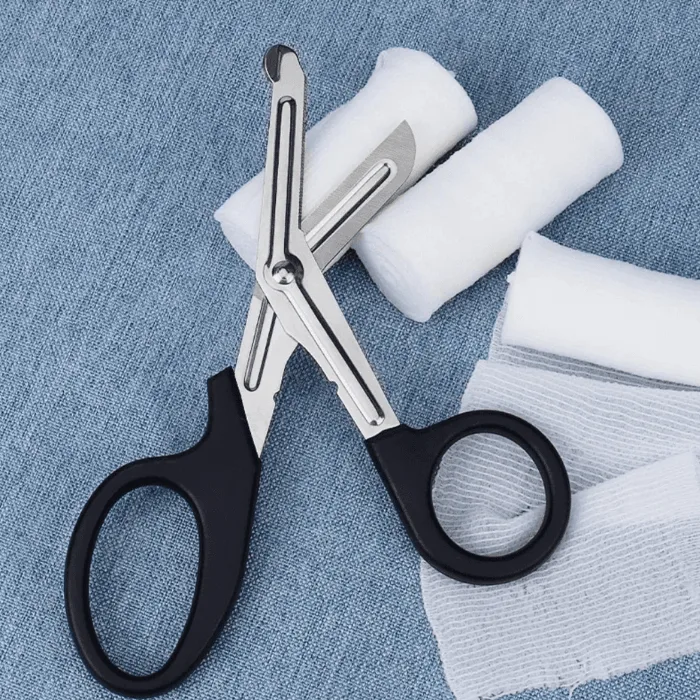
Emergency Shears
-
Emergency Shears: Built for cutting through common materials like clothing, webbing, or tape. Knowing the intended materials helps you store them where they are protected but still quick to reach for those tasks.
-
Emergency Shears: Simple, no-nonsense design from a brand focused on tactical gear. A straightforward design means fewer parts to snag or break during storage and retrieval.
Keep shears accessible without sacrificing protection
The best storage spot balances speed and safety. If your kit has a MOLLE-style webbing or elastic loops, thread the shears through a loop that holds them firmly but leaves the handles exposed. Avoid storing them loose in the same compartment as glass ampoules or other fragile items.
For kits that live in a vehicle or pack, check the shears periodically. Heat and vibration can loosen straps or cause the shears to shift. A quick glance each time you open the kit will tell you whether they are still in place and ready to use.
Storage options compared
- Dedicated pouch: Best protection for blades and nearby supplies. Takes up a bit more room but keeps shears clean and contained.
- Elastic loop or webbing: Fast access and low bulk. Works well if the loop is tight enough to prevent sliding, but blades may be exposed.
- Loose in a pocket: Simplest option, but shears can rattle, snag on other items, or get buried. Use only if the pocket is otherwise empty and has a closure.
Simple habits that keep shears ready
After any use, wipe the blades clean and let them dry before returning them to the kit. Store them in the same spot every time so you build muscle memory. If you swap kits or move supplies, do a quick inventory to confirm the shears are still in their dedicated home.
Finally, avoid storing shears in a location where they can be crushed by heavy gear. While the Tacticsandgear Emergency Shears are designed for straightforward functionality, protecting them from unnecessary stress helps them stay reliable.