Quick Answer
To teach Star Realms in 10 minutes, focus on the core loop: buy cards, play cards, and attack. Use a simplified demo game with open hands, skip the more complex rules initially, and let players learn by doing. This approach gets everyone playing quickly and builds confidence for their first real game.
Star Realms is a fast-paced deck-building game, but its rules can feel overwhelming at first. The good news: you don't need to explain everything upfront. With a focused, hands-on approach, you can have new players making meaningful choices within 10 minutes.
This guide distills the essential rules and provides a step-by-step teaching method. We'll cover what to explain, what to skip, and how to avoid common mistakes that slow down learning. By the end, you'll be ready to run a smooth demo game that gets everyone excited for more.
Before You Start: Setup and Materials
Before teaching, set up the game so it's ready to play. Use the starter decks from the base game or a standalone set like Star Realms Frontiers. If you're teaching multiple players, consider using a display of 6 to have enough copies for everyone. Ensure each player has their own deck and a clear play area.
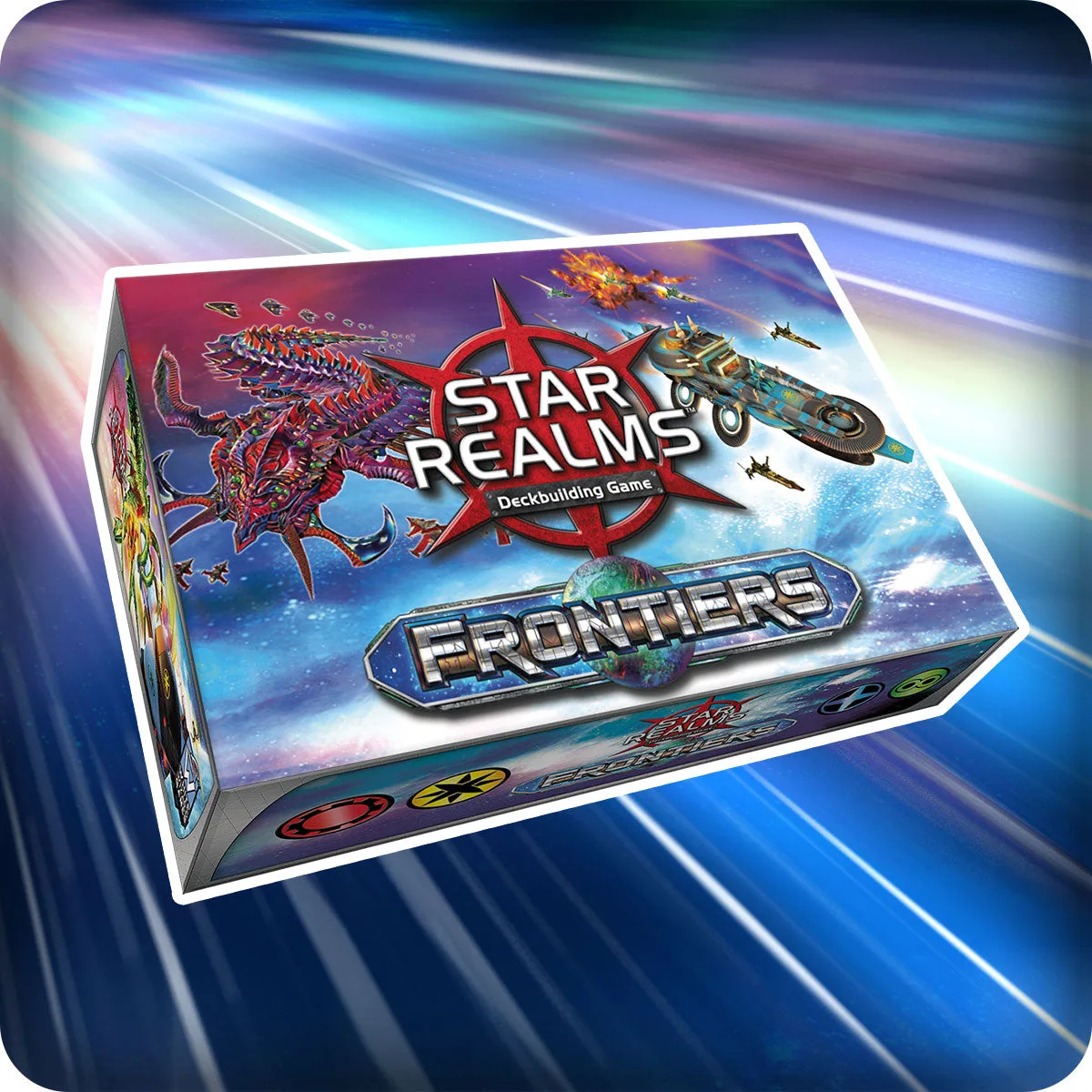
Star Realms Frontiers
For the demo, you can use the standard rules but simplify the initial explanation. Focus on the main actions: playing cards for their trade or combat value, buying from the trade row, and attacking opponents. Don't worry about explaining every card ability in detail; players will learn by reading the cards as they play.
- Use open hands for the first game so you can guide decisions.
- Place the trade row face-up and explain the center row concept.
- Have each player's starting deck ready: 10 cards (8 Scouts and 2 Vipers).
The Core Loop: Buy, Play, Attack
The heart of Star Realms is a simple loop: on your turn, you play cards from your hand to generate trade (to buy new cards) or combat (to damage opponents). Then you discard your hand and draw a new one. Explain this loop clearly and demonstrate it with your own turn.
Use a concrete example: 'I play this Scout for 1 trade, and I'll buy this Blob Fighter from the trade row. Now I'll play another card for combat and attack you for 2 damage.' This makes the mechanics tangible. Avoid diving into advanced concepts like scrapping or ally abilities until the second game.
A common mistake is explaining all card types at once. Instead, point out that cards have a faction color and a cost, but let players discover synergies as they play. This keeps the learning curve gentle and the game moving.
- Demonstrate one full turn before letting players take their first turn.
- Encourage players to read their cards aloud to reinforce learning.
- Remind players that they can play cards in any order, but trade and combat are separate.
What to Skip in the First Game
Some rules are better left for later. Don't explain the nuances of scrapping (unless a card in the trade row requires it), ally abilities, or the different game modes (like the raid boss variant). These add depth but can confuse beginners. Stick to the basic turn structure and let players focus on the flow.
Also, avoid explaining the full list of factions and their strategies. Let players naturally gravitate toward cards they like. If a player asks about a specific card ability, explain it briefly, but don't turn the demo into a lecture. The goal is to get them playing, not to memorize the rulebook.
If you're using expansions like Command Decks, save them for later. The base game is balanced for learning. Once players grasp the core, you can introduce expansions for variety.
- Skip the rule about 'outposts' unless a card with that keyword appears.
- Don't explain the 'authority' track in detail; just say 'you start at 50, and if it hits 0, you lose.'
- Avoid explaining the 'trade row' refresh rule until someone buys a card.
Common Mistakes and How to Avoid Them
One of the most common teaching mistakes is rushing through the rules. Take a breath and let players absorb each step. Another mistake is playing too fast yourself; slow down and narrate your decisions so players can follow your reasoning.
Also, be careful not to 'quarterback' the game. Let players make their own choices, even if they're suboptimal. The learning comes from experiencing the consequences. If a player is stuck, ask guiding questions like 'What do you want to achieve this turn?' rather than dictating moves.
Finally, don't get bogged down in edge cases. If a rules question comes up, make a quick call and move on. You can look up the exact rule after the game. Keeping the momentum is more important than perfect rule adherence.
- If a player forgets to draw, remind them gently without making a big deal.
- If a player buys a card but doesn't know how to use it, explain it right then.
- Keep the first game short—play until someone reaches 30 authority or 15 minutes, whichever comes first.
10-Minute Teaching Steps
- Step 1: Set Up the Game: Lay out the trade row with 5 cards. Give each player their starting deck of 10 cards (8 Scouts and 2 Vipers). Place authority trackers at 50. Explain the goal: reduce your opponent's authority to 0. Checkpoint: Everyone has their deck and knows the win condition.
- Step 2: Explain the Turn Structure: Say: 'On your turn, you play cards from your hand. Cards give you trade (money) or combat (attack). You can use trade to buy cards from the trade row, and combat to damage your opponent. Then discard your hand and draw 5 new cards.' Checkpoint: Ask each player to repeat the three actions in order.
- Step 3: Play a Demo Turn: Take a turn yourself, narrating every action: 'I play a Scout for 1 trade, I'll buy this Blob Fighter, then I play a Viper for 1 combat and attack you for 1 damage.' Show how to place bought cards into the discard pile. Checkpoint: Players see the loop in action and understand the discard pile.
- Step 4: Let Players Take Their First Turn: Encourage players to play their cards and make their own choices. Offer guidance only if they ask. Remind them they can play cards in any order and that trade and combat are separate. Checkpoint: Each player completes a turn without major confusion.
- Step 5: Simplify Rules as Needed: If a player buys a card with a complex ability, explain it briefly. For the first game, ignore scrapping, ally abilities, and outposts unless they come up naturally. Keep the focus on the core loop. Checkpoint: Players are comfortable with the basic flow, and the game is moving.
Products That Help You Teach
- Star Realms Frontiers Display of 6: Frontiers is a deckbuilding game for 1-4 players, that is both a standalone game and fully compatible with Star Realms Deckbuilding Game and all of its expansions! Star Realms Frontiers raised over $1,100,000 on Kickstarter! This $19.99 Box Set Features: Great gameplay for 1-4 players. Solitaire and Cooperative mode! Plays on its own, or combined with any other Star Realms set. If you're teaching a group, having multiple copies of Frontiers allows everyone to play simultaneously without sharing cards. Its standalone nature also makes it a great starting point for new players.
- Star Realms Sleeves (60): 60 count pack of plastic sleeves with a gloss finish. PVC and Acid Free. 67mm x 92mm 2.5 oz. Refer to our Sleeve Counts spreadsheet to determine how many sleeves you need. Sleeving your demo decks protects them from wear and tear, especially when teaching multiple new players. The gloss finish also makes cards easier to shuffle and handle.
Teaching Star Realms doesn't have to be intimidating. By focusing on the core loop, skipping unnecessary details, and letting players learn by doing, you can have a fun, fast demo in 10 minutes. Once they've got the basics, they'll be ready to explore the game's depth on their own.