Quick Answer
The 2-1/2" x 5" 60 degree parallelogram is an EPP shape that creates dynamic diagonal lines and interlocking patterns. Use it with precise basting and flat-fell seams to keep the sharp angles crisp.
Why the 60 Degree Angle Matters
The 60 degree angle is the same angle found in hexagons and equilateral triangles, which means this parallelogram can combine with those common shapes to form larger geometric designs. Its 2-1/2" x 5" size gives you a noticeable diagonal shift without being oversized, making it ideal for borders or focal blocks.
One trade-off: the acute 60 degree corners can be trickier to baste and sew than right-angle shapes. If you are new to EPP, practice on a few scrap pieces before committing to a full project.
Step-by-Step Sewing Guide
- 1. Cut Fabric and Baste the Shape: Cut fabric at least 1/4" larger than the paper piece on all sides. Fold the seam allowance over the paper and baste through the paper using a thread or glue. For the 60 degree corners, clip the fabric at the acute tip to reduce bulk. A common mistake is not clipping the acute corner—this causes puckered seams later.
- 2. Arrange Pieces in Your Design: Lay out the basted parallelograms to form a continuous pattern (e.g., a zigzag or chevron). Because the shape is not symmetrical, rotate pieces 180 degrees to create mirror images. Pin matching edges together before sewing. Double-check the orientation before sewing—it is easy to accidentally flip a parallelogram the wrong way.
- 3. Sew with Flat-Fell Seams: Place two pieces right sides together, matching the paper edges. Use a whipstitch or flat-fell stitch, taking small bites through the fabric only (not the paper). Sew from one corner to the other, backstitching at the start and end. Avoid catching the paper with your needle—it makes removing the papers harder later.
- 4. Press and Remove Papers: Once all seams are sewn, press the block flat with a warm iron. Remove the basting threads or glue and carefully take out the paper pieces. For the 60 degree points, use tweezers to avoid tearing the fabric. Leaving the papers in until the block is fully assembled prevents distortion at the sharp angles.
- 5. Incorporate into a Larger Project: Use the finished parallelogram block as a border, a repeating tile, or an accent in a quilt top. The 2-1/2" x 5" size pairs well with 1" hexagons or 2" diamonds for secondary patterns. Test a small sample block first to see how the diagonals interact with your chosen layout.
Product Details
-
2-1/2" x 5" 60 Degree Parallelogram: This 2-1/2" x 5" 60 Degree Parallelogram paper piece is sold separately from acrylic templates; select production options for quantity. Order the exact number of paper pieces you need for your project, and consider the acrylic template if you plan to cut fabric multiples from the same shape.
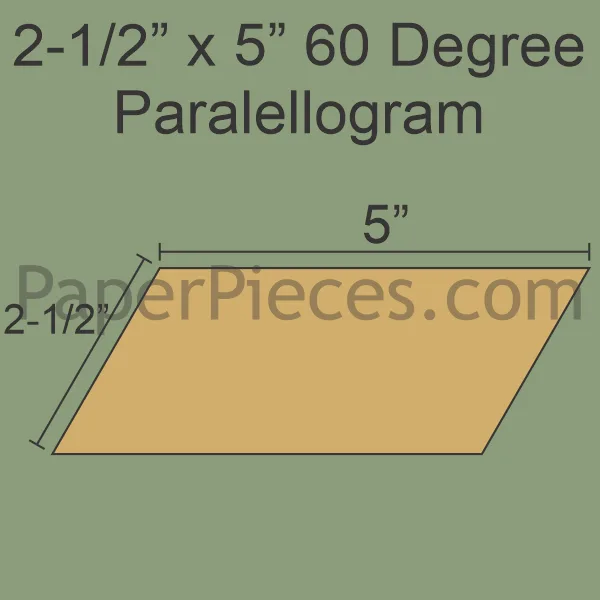
2-1/2" x 5" 60 Degree Parallelogram