Quick answer
Use the #64 BERNINA straight-stitch hemmer foot to create 4 mm double-fold hems on fine materials. Set up with a straight-stitch plate, fold the hem start by hand, then let the foot's scroll guide the fabric while you sew slowly and steadily.
Why the #64 works best on fine fabrics
The #64 is designed for lightweight, fine materials like batiste, voile, and silk. On heavier fabrics, the double-fold mechanism can struggle to fold cleanly, leading to skipped stitches or uneven hems. If you're working with medium-weight cotton or linen, consider a different hemming method or a larger hemmer foot.
The foot creates a double-fold hem, meaning the raw edge is folded under twice before stitching. This encases the raw edge and gives a clean finish on both sides, which is especially useful for sheer fabrics where a single-fold hem would show through.
When to choose a different hemming method
If your fabric frays heavily or has a loose weave, a double-fold hem may not secure the edge well enough. In those cases, a French seam or a serged edge followed by a single-fold hem might be more durable. Also, the #64 produces a fixed 4 mm hem width; if you need a wider or narrower hem, you'll need a different foot or a manual fold.
Step-by-step: using the #64 hemmer foot
- Attach the straight-stitch plate: Replace your standard stitch plate with a straight-stitch plate (single hole) for optimal results. This prevents fabric from being pulled into the feed dogs and ensures a clean stitch formation. Check that the plate is securely seated before sewing.
- Set up your machine: Select a straight stitch with a length of about 2–2.5 mm. Use a fine needle (size 60/8 or 70/10) and lightweight thread. Lower the feed dogs? No—keep them up; the #64 relies on the feed dogs to move the fabric. Always test on a scrap of your actual fabric before starting your project.
- Prepare the fabric edge: Press the first 2–3 inches of your hem fold by hand: fold the raw edge under about 4 mm, then fold again by another 4 mm. This pre-folded section will feed into the foot's scroll. A crisp pre-fold is crucial; a messy start will cause the foot to jam.
- Insert the fabric into the foot: Raise the presser foot and slide the pre-folded edge into the scroll of the #64, making sure the fold sits snugly against the metal guide. Lower the presser foot and take a few stitches by hand (turn the handwheel) to catch the fold. If the fabric doesn't feed smoothly, re-fold and try again—don't force it.
- Sew slowly and guide the fabric: Sew at a slow, steady speed. Let the foot's scroll do the folding; your job is to keep the fabric edge aligned with the guide. Don't pull or push the fabric—just support it lightly. If the hem starts to wander, stop, raise the foot, and re-align the fold.
- Finish and press: At the end, sew off the fabric edge and clip threads. Press the hem flat with a warm iron (no steam) to set the fold. Pressing after sewing improves the hem's appearance and durability.
Product facts
-
#64 BERNINA Straight-stitch Hemmer Foot: Creates double-fold hems using straight stitch, with a 4 mm finished width, and is intended for fine materials. This foot saves time by folding and stitching in one pass, but it's optimized for lightweight fabrics, so testing on a scrap first is essential.
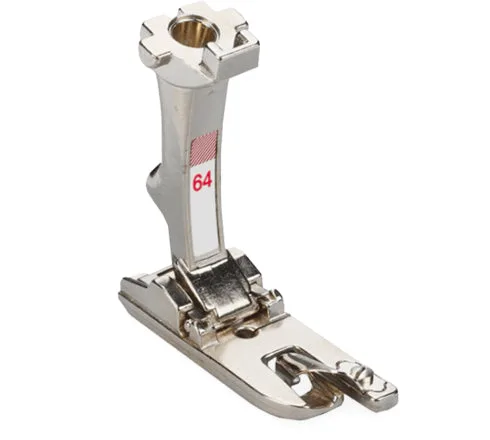
#64 BERNINA Straight-stitch Hemmer Foot