If you’ve ever wondered why your morning pour-over tastes different from the one you had at a specialty café, the answer often comes down to one small but mighty tool: a coffee scale. While many home brewers rely on scoops and guesswork, precision brewing demands accuracy. Using a coffee scale isn’t just for obsessive perfectionists—it’s the single most impactful upgrade you can make to your daily routine. By measuring both coffee grounds and water by weight, you ensure every cup is balanced, repeatable, and delicious.
In this guide, we’ll walk you through everything you need to know about using a coffee scale for precision brewing. From understanding brew ratios to step-by-step techniques for pour-over, espresso, and French press, you’ll learn how to dial in your favourite beans—like our rich https://brewbarai.shop/products/the-brixton-500g-whole-bean-132460The Brixton 500g Whole Bean—for consistently outstanding results. Let’s weigh in.
Why Use a Coffee Scale? The Case for Precision
Coffee brewing is a chemical extraction process, and like any good recipe, the ratio of coffee to water is critical. A scale eliminates the variability of volume-based measurements. A tablespoon of whole beans can vary by 2–3 grams depending on roast level, grind size, and bean density. That small difference can make the difference between a bright, balanced cup and a bitter, over-extracted one. Precision brewing ensures you extract the right amount of flavour compounds, acids, and oils from your grounds, revealing the unique character of each origin.
Beyond consistency, a scale helps you replicate your favourite recipes. Whether you’re trying a new single origin like Hermosa - Costa Rica or perfecting your espresso shot, weighing your dose and yield lets you fine-tune your technique. It also helps you save money by avoiding waste—no more guessing and pouring too much or too little. For home baristas and professionals alike, a coffee scale is the foundation of quality.
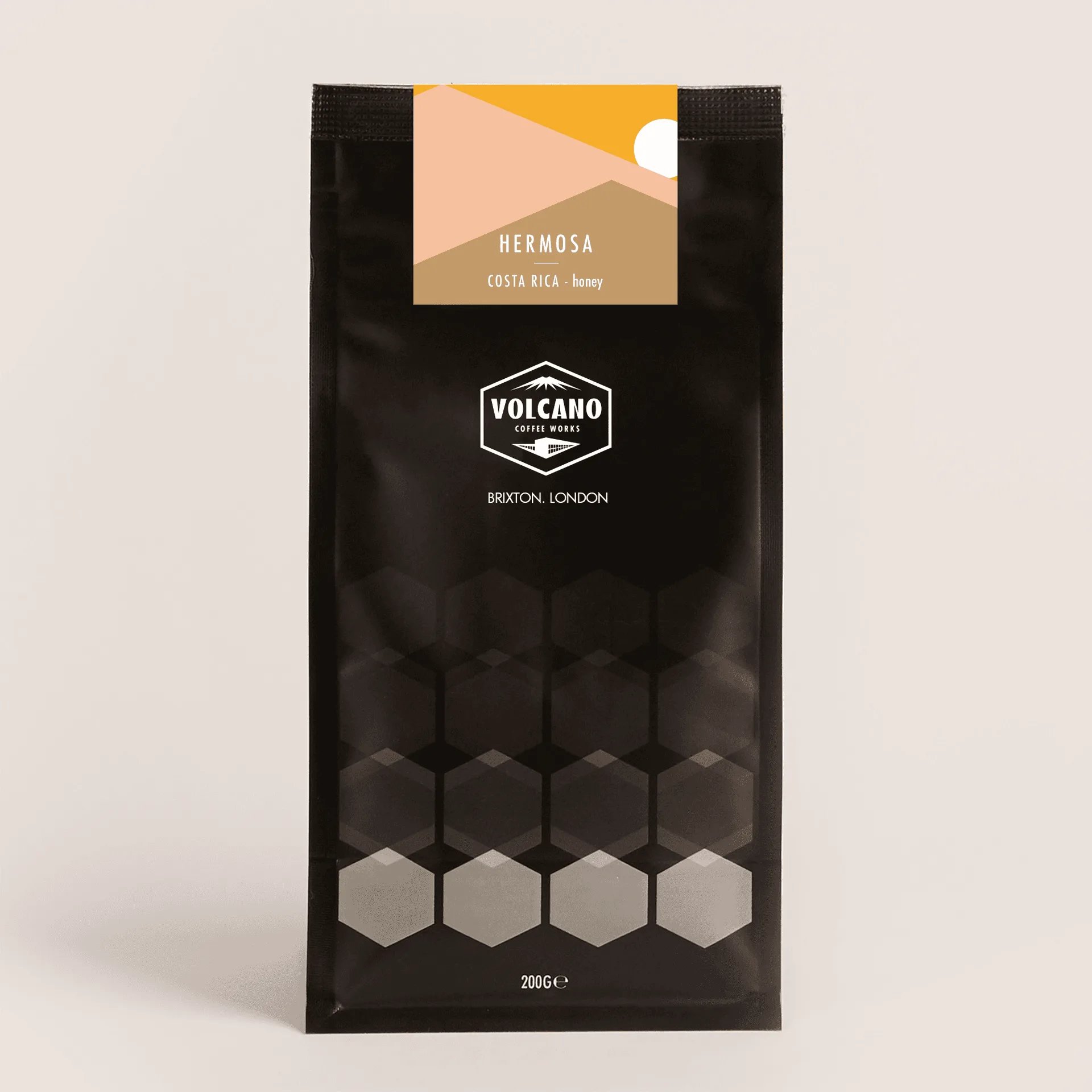
Hermosa - Costa Rica
- Eliminates guesswork from scoop-based measurements
- Ensures consistent strength and flavour from brew to brew
- Helps you dial in new beans quickly and adjust recipes
- Reduces waste by using only the exact amount of coffee needed
Understanding Brew Ratios: The Golden Rule of Precision
The brew ratio is the relationship between the weight of coffee grounds and the weight of water used. Most specialty coffee recommendations fall between 1:15 and 1:18 (one gram of coffee to 15–18 grams of water). A 1:16 ratio is a popular starting point for pour-over, producing a balanced cup that highlights sweetness and acidity. For espresso, ratios are much tighter—typically 1:2 to 1:3 (e.g., 18g coffee to 36g water yield).
To apply this, decide your target beverage volume. For a 300ml pour-over, you’d use roughly 18.75g of coffee at a 1:16 ratio. Weigh your beans before grinding, then tare your scale with your brewing vessel and add water until you hit the target weight. This method works for any brewing method. Experiment with ratios to find what you love—start at 1:16 and adjust by 0.5g increments. A quality scale with 0.1g precision is ideal for espresso, while 1g precision suffices for most drip methods.
- Start with a 1:16 ratio for pour-over and adjust to taste
- For espresso, aim for a 1:2 to 1:3 ratio (dose to yield)
- Use a scale with 0.1g resolution for espresso, 1g for batch brew
- Record your ratios to replicate your favourite cups
Step-by-Step: How to Use a Coffee Scale for Pour-Over
Pour-over brewing is where a scale truly shines. Begin by placing your dripper and carafe on the scale, then tare it to zero. Add your ground coffee—for a single cup, start with 15g of medium-fine grounds. Tare again, then start your timer and pour water in stages. A common technique is a 30-second bloom (2x the coffee weight in water), followed by a main pour up to your target weight. For example, with 15g coffee at a 1:16 ratio, you’d pour 240g total water.
Watch the scale as you pour to maintain a steady flow. Many baristas use a slow, spiral motion to ensure even extraction. The scale helps you hit your target weight precisely, avoiding under- or over-extraction. After brewing, note the total time—ideally 2:30 to 3:30 for a single cup. With practice, you’ll learn to adjust grind size or pour speed based on the results. Pair this method with a fresh roast like The Brixton 500g Whole Bean for a consistently excellent morning brew.
- Tare the scale with your empty dripper and carafe
- Weigh coffee grounds (e.g., 15g for one cup)
- Pour water in stages, watching the scale for accuracy
- Aim for a total brew time of 2:30–3:30 minutes
Using a Scale for Espresso: Dose, Yield, and Timing
Espresso is the ultimate test of precision. A few tenths of a gram can turn a sublime shot into a sour or bitter mess. Start by weighing your dose directly into the portafilter—18g is a common starting point for a double shot. Tamp evenly, then lock in and start your shot. Place a small cup on the scale, tare it, and position it under the group head. As the espresso flows, watch the scale to stop the shot when you reach your target yield, typically 36–45g for a double.
Timing is also crucial: a well-extracted shot should take 25–30 seconds. If it runs too fast (under 20 seconds), grind finer; if it drips slowly (over 35 seconds), grind coarser. A scale with 0.1g precision and a built-in timer simplifies this process. For home baristas using a machine like the Lelit Victoria Espresso Machine & Free 1kg Coffee, a scale is an essential companion for dialling in perfect shots every time.
- Weigh your dose (e.g., 18g) before tamping
- Place a cup on the scale and tare before brewing
- Stop the shot at your target yield (36–45g for a double)
- Adjust grind size to hit a 25–30 second extraction time
Tips for Choosing and Using Your Coffee Scale
Not all scales are created equal. Look for one with 0.1g precision, a tare function, and a responsive display. A built-in timer is a bonus for tracking brew time. Water resistance is helpful for pour-over setups, and a compact size fits easily on a coffee station. Avoid scales with auto-shutoff that kicks in too quickly—nothing ruins a brew like the display going dark mid-pour.
Practical tips: always calibrate your scale monthly if it allows, and keep it clean from coffee dust and water. Use a small bowl or cup to weigh beans before grinding to avoid static mess. For the best results, grind immediately before brewing and use filtered water. A scale also helps you portion beans for the week—weigh out 18g doses into small containers for grab-and-go convenience. With these habits, precision becomes second nature.
- Choose a scale with 0.1g precision and a timer
- Calibrate monthly for accuracy
- Weigh beans before grinding for consistency
- Pre-portion doses for busy mornings
Common Mistakes and How to Avoid Them
Even with a scale, beginners can stumble. One common error is forgetting to tare the vessel before adding coffee or water—this leads to inaccurate measurements. Another is using the wrong unit: always use grams, not ounces, for precision. Some brewers also neglect to account for the weight of the filter or portafilter. Always tare with everything in place.
Over-relying on the scale without adjusting for taste is another pitfall. The numbers are a guide, not a rule. If your coffee tastes too strong, try a slightly higher ratio (e.g., 1:17). If it’s weak, lower the ratio. Finally, don’t rush the pour—use the scale to maintain a steady flow rate. With a little practice, these mistakes become easy to avoid, and your brewing will reach new heights.
- Always tare your vessel before adding ingredients
- Use grams for consistency
- Adjust ratios based on taste, not just numbers
- Pour steadily and watch the scale
A coffee scale is the simplest, most effective tool for transforming your home brewing. By measuring with precision, you unlock the full potential of every bean—from bright single origins to bold blends. Whether you’re perfecting your pour-over or dialling in espresso, the scale is your guide to consistency and flavour. Ready to elevate your coffee game? Explore our range of brewing essentials and discover how the right tools can make every cup extraordinary. Start with The Brixton 500g Whole Bean and a reliable scale, and taste the difference precision makes.