Quick answer
To use a doming and bezel micro forming set, select the wheel stake that matches your curve, position your metal disc or bezel wire, and strike evenly with a forming hammer to shape without marring the surface.
Why a micro forming set is different from full-size stakes
Full-size forming stakes are designed for larger bowls, bangles, and broad curves. A micro forming set concentrates that same shaping ability into small wheel stakes and mandrels that fit fine jewellery work. The wheel stakes in a typical set range from 10 mm to 19 mm in diameter, which lets you dome earring blanks, shape tiny bezel cups, and form loops without the stake edge getting in the way.
Because the working surfaces are polished, you can hammer directly on the metal without transferring tool marks. This matters most when you are forming bezels for one-off stone settings — any scratch or dent becomes part of the final piece.
Trade-off: precision vs. force
Micro forming sets are not meant for heavy forging or shaping thick sheet metal. The small stake heads concentrate force, which is excellent for detail work, but they can also leave deep hammer marks if you strike too hard. Use a lightweight forming hammer and let the stake do the shaping, not the force of your blow.
How to use a doming & bezel micro forming set
- 1. Choose the right stake for your curve: Select a wheel stake whose diameter matches the curve you want. For a shallow dome (e.g., earring blank), use a larger stake (16–19 mm). For a tight bezel cup, use a smaller stake (10–12 mm). Insert the stake into the wooden stand or a bench vice. Using a stake that is too small for a shallow dome will create a sharp dent instead of a smooth curve.
- 2. Position your metal on the stake: Place your metal disc or bezel wire directly on the centre of the stake face. Hold it steady with your non-dominant hand or use a pair of nylon-tipped tweezers. For bezel forming, slide the wire over a tapered mandrel and rotate it as you shape. If the metal shifts during hammering, the curve will be uneven. Secure it before striking.
- 3. Strike evenly with a forming hammer: Use a polished or nylon-faced forming hammer. Start with light taps around the outer edge of the metal, working inward in a spiral pattern. Let the stake shape the metal — do not try to force the curve with heavy blows. A single heavy blow can create a flat spot. Multiple light taps produce a smooth, even dome.
- 4. Check your progress and anneal if needed: After a few strikes, lift the metal and inspect the curve. If the metal starts to feel stiff or shows cracking at the edge, it has work-hardened. Anneal (heat to dull red and quench) before continuing. Skipping annealing when the metal hardens can cause cracks, especially in bezel wire.
- 5. Finish with a sanding or polishing step: Once the shape is correct, remove any light hammer marks with fine sandpaper (400–1200 grit) or a polishing mop. The polished stake surface helps minimise marks, but some texture is normal and can be removed in seconds. Do not over-polish thin bezel walls — you may thin the metal and weaken the setting.
Product used in this guide
-
Doming & Bezel Micro Forming Set — 8 Stainless Steel Wheel Stakes, 4 Mandrels, Wooden Stand: The set includes eight polished stainless steel wheel stakes from 10 mm to 19 mm diameter and four micro mandrels — tapered and straight — for shaping miniature bezels, loops and fine detail. You get a range of curve sizes in one kit, so you can dome earrings, form bezel cups, and shape small tubing without buying separate stakes.
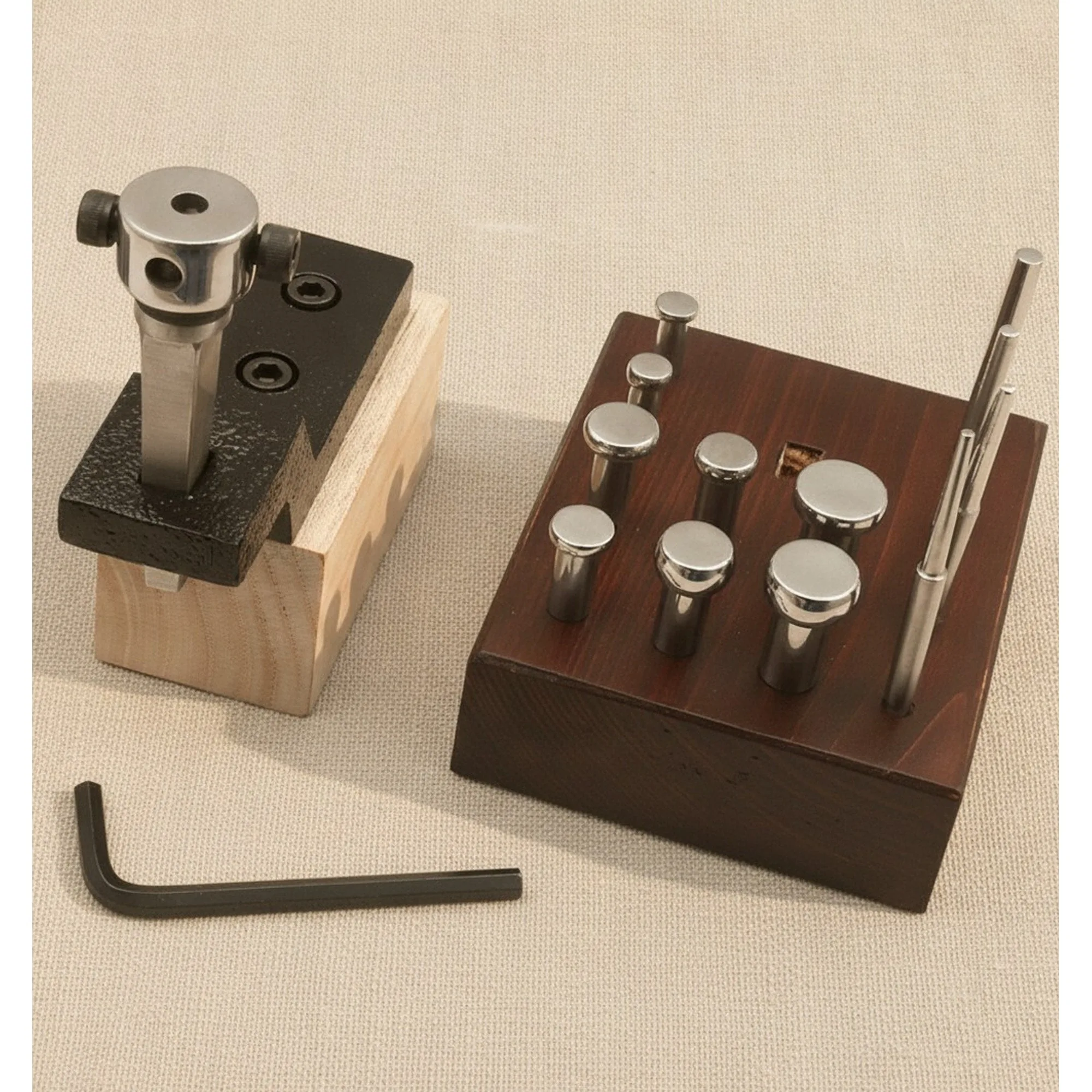
Doming & Bezel Micro Forming Set — 8 Stainless Steel Wheel Stakes, 4 Mandrels, Wooden Stand