Quick Answer
You can use a spiral notebook for bullet journaling by setting up an index, future log, monthly log, and daily log. The spiral binding lets the notebook lay flat, making it easy to write and draw across the page.
Why a Spiral Notebook Works for Bullet Journaling
A spiral notebook offers flexibility that bound journals don't. The wire binding allows pages to fold back completely, so you can write comfortably even on a small desk or while holding the notebook in one hand. This makes it ideal for quick daily logging or on-the-go journaling.
Trade-Off: No Pre-Printed Dots
Most bullet journal enthusiasts prefer dot grid pages for easy alignment, but spiral notebooks often come with lined or blank pages. If you use a lined notebook like the White + Periwinkle Octopus Toile Spiral Notebook, you'll need to adapt your layouts. The lines can serve as guides for straight text, but you may want to add your own dots or use a ruler for drawings and charts.
Step-by-Step Bullet Journal Setup
- Create an Index: Number the first few pages of your notebook. Reserve pages 1 and 2 for an index where you'll log the page numbers of key spreads (future log, monthly log, collections). As you add new pages, update the index. Common mistake: forgetting to update the index. Set a reminder to add entries each time you start a new spread.
- Set Up a Future Log: Use the next 2-4 pages to create a future log. Divide each page into three sections (one for each month) or list all 12 months across the spread. Write down events, appointments, or goals that fall outside the current month. Checkpoint: keep future log entries brief—just a word or two—so you can scan it quickly later.
- Build a Monthly Log: On the next two-page spread, write the month name at the top. On the left page, list the dates and days of the week. On the right page, write a task list for the month. This helps you see your month at a glance. Common mistake: cramming too many tasks. Limit your monthly task list to 5-10 key items.
- Start Daily Logs: Each day, write the date and a brief bulleted list of tasks, events, and notes. Use simple symbols: a dot for tasks, a circle for events, a dash for notes. Cross off completed tasks, and migrate unfinished ones to the next day. Checkpoint: if you miss a day, just start a new entry for the current date. Don't backfill—keep it low pressure.
- Add Collections as Needed: When you need a dedicated page for a topic (like books to read, a project tracker, or a habit tracker), create a new collection. Add its page number to the index so you can find it later. Common mistake: creating too many collections at once. Start with one or two and add more only when you feel the need.
Notebook for This Setup
-
White + Periwinkle Octopus Toile Spiral Notebook: This spiral notebook measures 8.75" x 6.25", has gold double-O wire binding, and 200 lined pages. The 200 pages provide plenty of room for months of journaling, and the lined pages help keep your handwriting neat while you learn the bullet journal system.
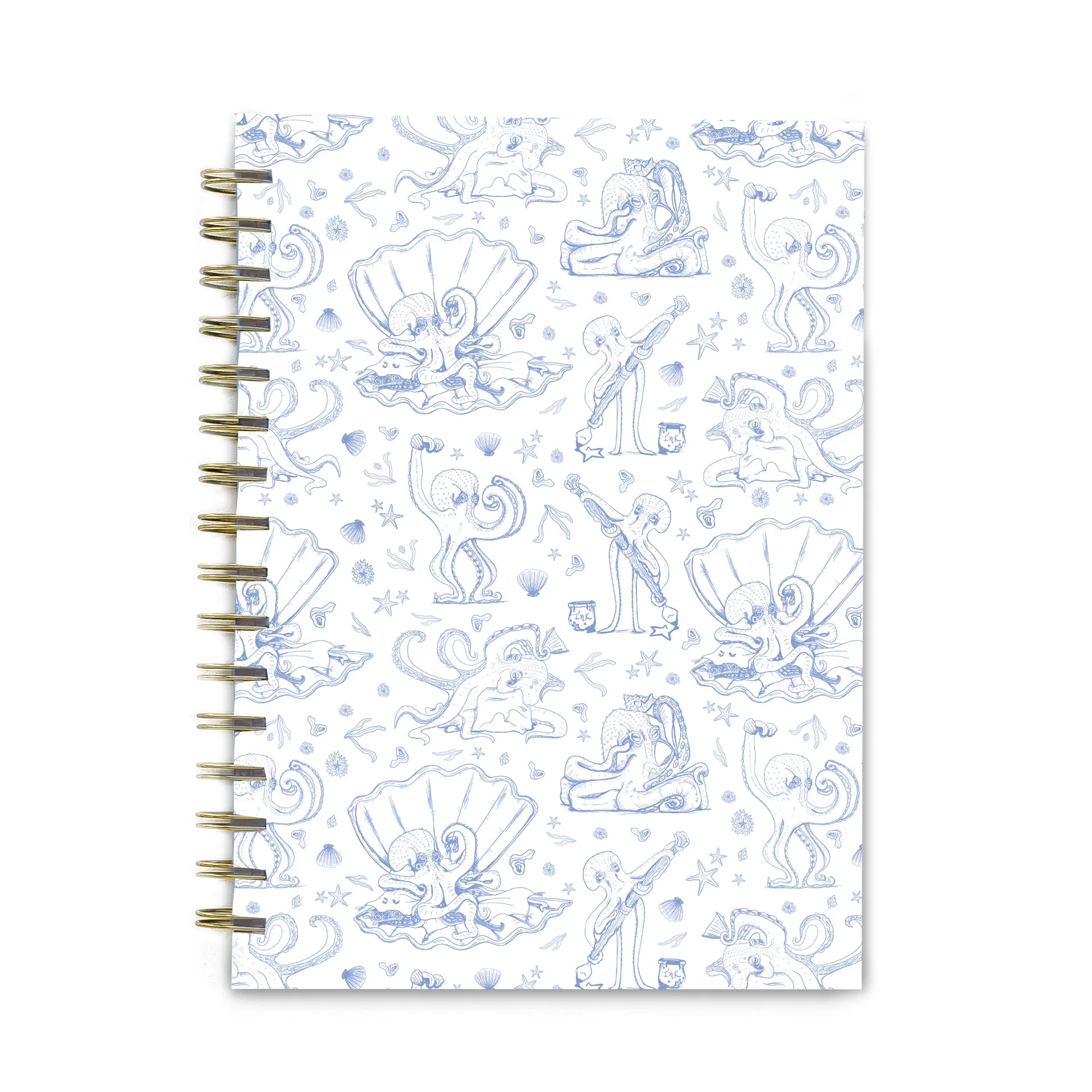
White + Periwinkle Octopus Toile Spiral Notebook