Quick answer
To use a weekly planner effectively, set aside 10 minutes each Sunday to map out your week, prioritize tasks, and review daily to adjust as needed.
Why a weekly planner beats a to-do list
A weekly planner gives you a bird's-eye view of your week, helping you balance work, errands, and fun. Unlike a daily to-do list, it lets you see conflicts ahead of time and plan around them, so you're less likely to overcommit or forget important tasks.
The trade-off: planning takes time
Building a weekly planning habit requires a small time investment upfront. But the few minutes you spend each week can save you hours of decision-making and last-minute scrambling. If you're new to planning, start with just the essentials: appointments, deadlines, and one or two personal goals.
How to plan your week in 5 steps
- Set a weekly planning time: Choose a consistent 10-15 minute slot each week—Sunday evening or Monday morning works well. Use this time to open your planner and review the week ahead. Mistake to avoid: skipping this step because you think you'll remember everything. You won't. Put a recurring reminder on your phone so the habit sticks.
- Brain-dump everything: Write down every task, appointment, deadline, and even small errands you need to handle. Don't filter yet—just get it all on paper. Mistake to avoid: trying to organize while you write, which slows you down and makes you forget things. If it takes more than one page, that's okay—you can consolidate next.
- Prioritize with a simple A-B-C system: Label each item as A (must do), B (should do), or C (nice to do). Then assign each to a specific day, keeping your energy levels in mind. Mistake to avoid: putting too many A's on one day and burning out. If a day has more than three A's, move a B or C to another day.
- Block time for your top tasks: For each A task, schedule a specific time slot in your planner, just like an appointment. This turns an intention into a plan. Mistake to avoid: leaving tasks unscheduled and hoping you'll find time—you won't. Use the margins or a separate column to note the time blocks.
- Review and adjust daily: Each morning or evening, spend two minutes reviewing your planner. Cross off what's done, move what's not, and adjust the rest. Mistake to avoid: treating the plan as rigid. Life happens, and the planner should flex with you. If you miss a day, don't abandon the week—just pick up where you left off.
A planner that fits your week
-
My Week Planner: The My Week Planner is a 6" x 9" notepad with 60 sheets, printed and bound in the USA by Conveyor Studio and published by People I've Loved. Its compact size makes it easy to carry, and the 60 sheets give you a full year of weekly planning without taking up much desk space.
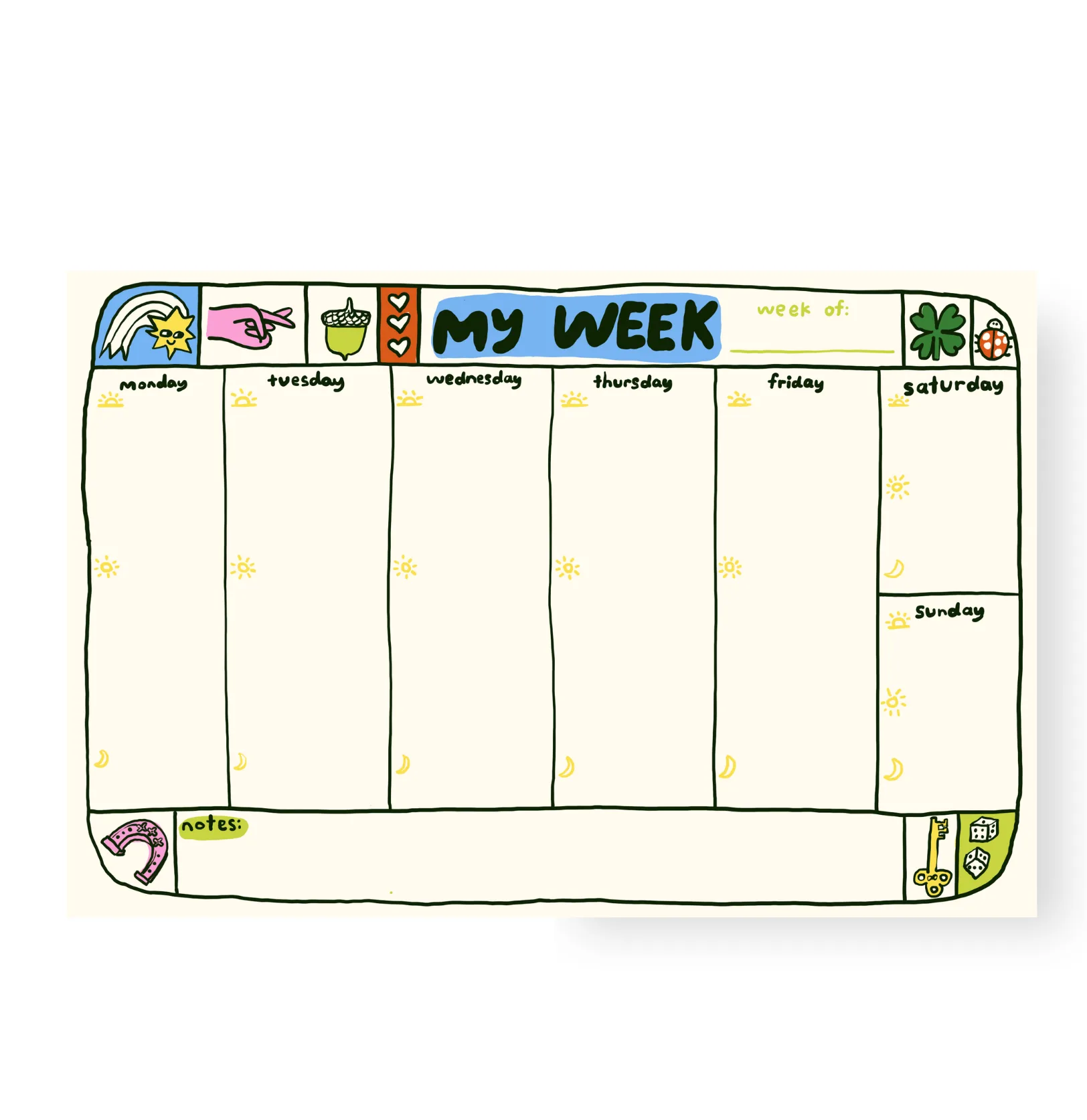
My Week Planner