Quick answer
A wooden puzzle plateau gives you a dedicated, portable surface with built-in drawers for sorting and storing pieces, making it easier to keep your puzzle organized and your table free for other uses.
Why a dedicated puzzle plateau beats a bare table
Working directly on a dining or coffee table means you lose the entire surface until the puzzle is finished. A puzzle plateau lets you slide the whole project out of the way—under a sofa, against a wall—so your table stays usable. The raised edges also prevent accidental spills from ruining pieces, and the smooth fiberboard surface keeps pieces from sliding around as you work.
Step-by-step: Set up your puzzle plateau for organized puzzling
- 1. Choose your workspace and position the plateau: Place the wooden puzzle plateau on a flat, stable surface like a dining table or desk. Make sure there's enough room around it for your elbows and any reference image. The plateau's raised edges will keep pieces contained, so you don't need a border. Avoid placing the plateau on an uneven or wobbly surface—pieces can shift and the drawers may not slide smoothly.
- 2. Sort pieces into the sliding drawers: Use the four reinforced drawers to group pieces by category: edge pieces in one drawer, dominant colors in another, and distinct patterns or textures in the rest. This saves time compared to digging through a single pile. Don't overfill a drawer—leave room to flip and view pieces. Overcrowding makes sorting harder, not easier.
- 3. Build the puzzle directly on the fiberboard surface: Start with the edge pieces, assembling the frame on the smooth work surface. The board's texture holds pieces in place without sticking, so you can nudge them without disturbing neighbors. If you need to pause mid-puzzle, cover the plateau with a thin cloth or sheet to protect pieces from dust and pets—but avoid pressing down on the assembly.
- 4. Use the drawers to store partial sections: As you complete small clusters (like a house or a tree), gently slide them onto a drawer or a separate tray if you need to free up surface space. The drawers are deep enough to hold small assembled sections temporarily. Don't stack assembled sections on top of each other in a drawer—they can break apart. Lay them flat in a single layer.
- 5. Move the plateau when you need the table: Grip the plateau firmly from underneath (or by the edges if it has handles) and lift it to a safe spot—under a bed, against a wall, or on a shelf. The raised edges keep pieces from falling off during transport. Never tilt the plateau while carrying it. Keep it level to prevent pieces from sliding into one pile or falling out.
What you get with the Wooden Puzzle Plateau
-
Wooden Puzzle Plateau: Includes four wooden reinforced sliding drawers to sort and hold your pieces. You can separate edge pieces, colors, or sections without needing extra trays or bowls, keeping your workspace clutter-free.
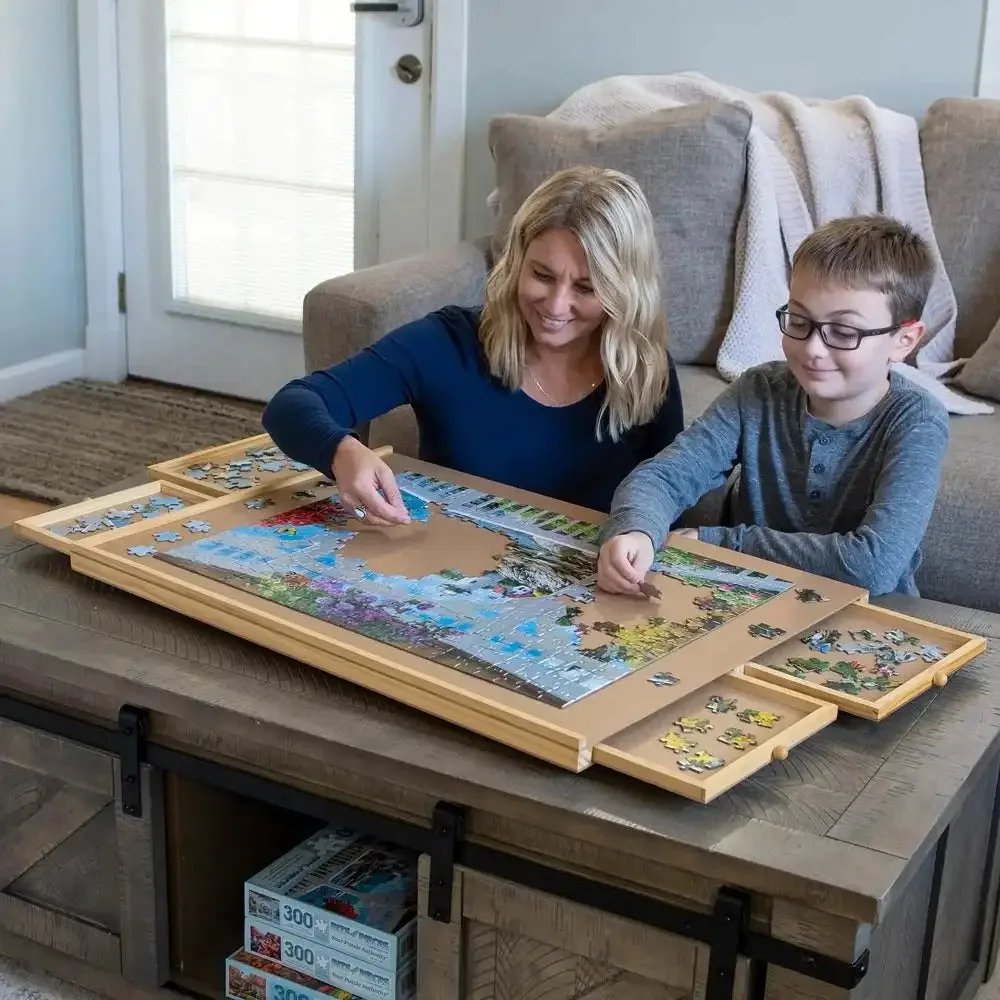
Wooden Puzzle Plateau