Quick Answer
To use a zippered eyeless hood for sensory play, start with a clear safety plan, then gradually introduce the hood while communicating with your partner. The zipper allows you to control mouth access and adjust the level of sensory deprivation.
Why Choose an Eyeless Hood for Sensory Play
An eyeless hood removes sight, which heightens other senses like touch, hearing, and smell. This makes every sensation more intense and unpredictable. The zippered mouth opening adds flexibility: you can leave it open for breathing and communication, or zip it closed for deeper silence and vulnerability.
Unlike a simple blindfold, a full hood covers the entire head, creating a more complete sensory deprivation experience. It also adds a psychological element of surrender and anonymity that many players find exciting.
Safety Considerations Before You Start
Always establish a clear safeword or non-verbal signal before putting on the hood. Because the wearer cannot see or speak when the mouth is zipped, agree on a tap-out signal (e.g., three taps on any surface).
Never leave a person wearing an eyeless hood unattended. Check in regularly, especially if the mouth zipper is closed. The hood should fit snugly but not restrict breathing or cause discomfort. If you feel dizzy, claustrophobic, or panicked, remove the hood immediately.
Step-by-Step Guide to Using a Zippered Eyeless Hood
- 1. Prepare Your Partner and Environment: Discuss the scene beforehand. Agree on a safeword and a non-verbal signal (e.g., three taps). Choose a quiet, comfortable space where you won't be interrupted. Have the hood ready and check that the zipper moves smoothly. Common mistake: skipping the non-verbal signal. Without it, the wearer cannot communicate when the mouth is zipped.
- 2. Put on the Hood Slowly: Start with the mouth zipper fully open. Gently pull the hood over the wearer's head, adjusting it so it sits comfortably. The material should be snug but not tight around the nose or ears. Let the wearer get used to the darkness and confinement before proceeding. Checkpoint: Ask the wearer to take a few breaths. If they feel panicked or the hood feels too tight, remove it and try a different size or style.
- 3. Experiment with the Mouth Zipper: Once the wearer is comfortable, you can zip the mouth opening partially or fully closed. Start with it partially open so they can still breathe easily and speak if needed. Close it fully only when you are both ready for deeper sensory deprivation. Common mistake: zipping the mouth too quickly. Always give the wearer time to adjust and confirm they are okay before increasing deprivation.
- 4. Introduce Sensory Stimuli: With sight removed, use touch, sound, and temperature to play. Lightly stroke the hood with a feather, run your fingers over the material, or whisper close to the ear. The wearer will feel every sensation more intensely. You can also combine the hood with other toys like a Wartenberg wheel or a vibrator. Checkpoint: Watch for signs of overwhelm. If the wearer tenses up or stops responding, pause and check in using the non-verbal signal.
- 5. End the Scene Safely: When you are ready to finish, unzip the mouth opening first. Speak calmly to reassure the wearer. Slowly remove the hood, allowing light to return gradually. Ask how they felt and discuss what worked well. Common mistake: rushing the removal. Abruptly pulling off the hood can be disorienting. Take your time and offer comfort.
Product Spotlight
-
Zippered Eyeless Hood: This zippered eyeless hood encloses the head in a stylish black finish with only a mouth opening. The mouth opening can be closed by pulling the zipper. The hood has a matte black finish. The zipper gives you control over the level of sensory deprivation: leave it open for easy communication or close it for deeper silence and vulnerability.
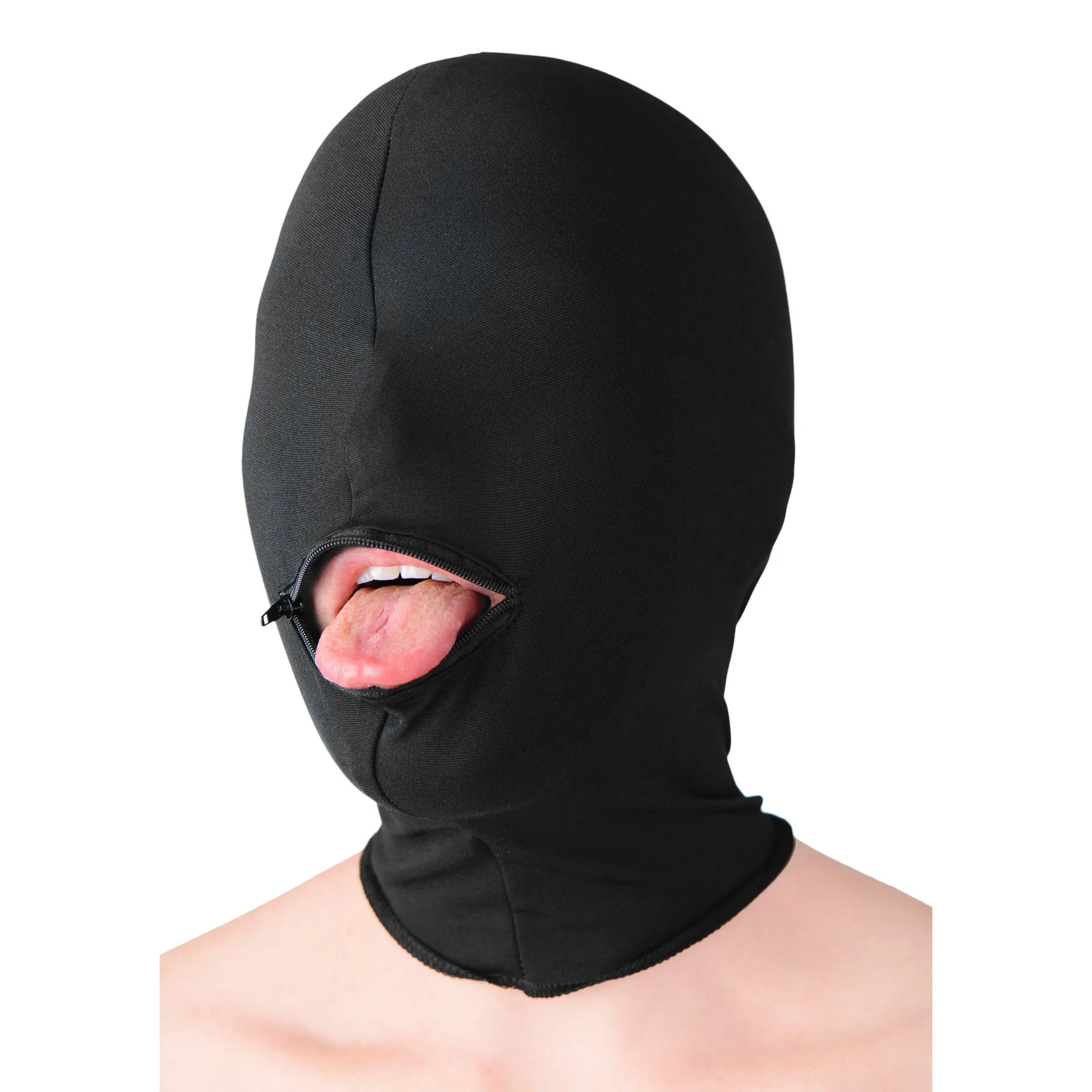
Zippered Eyeless Hood