Quick answer
Start by opening the Coral Reef TOOB® and sorting its figures into three groups: fish, invertebrates and habitat features. Then use those groups for a food-web role-play and a small reef diorama, so each mini figure becomes a talking point rather than a loose toy.
Why a TOOB® works better than a worksheet for reef lessons
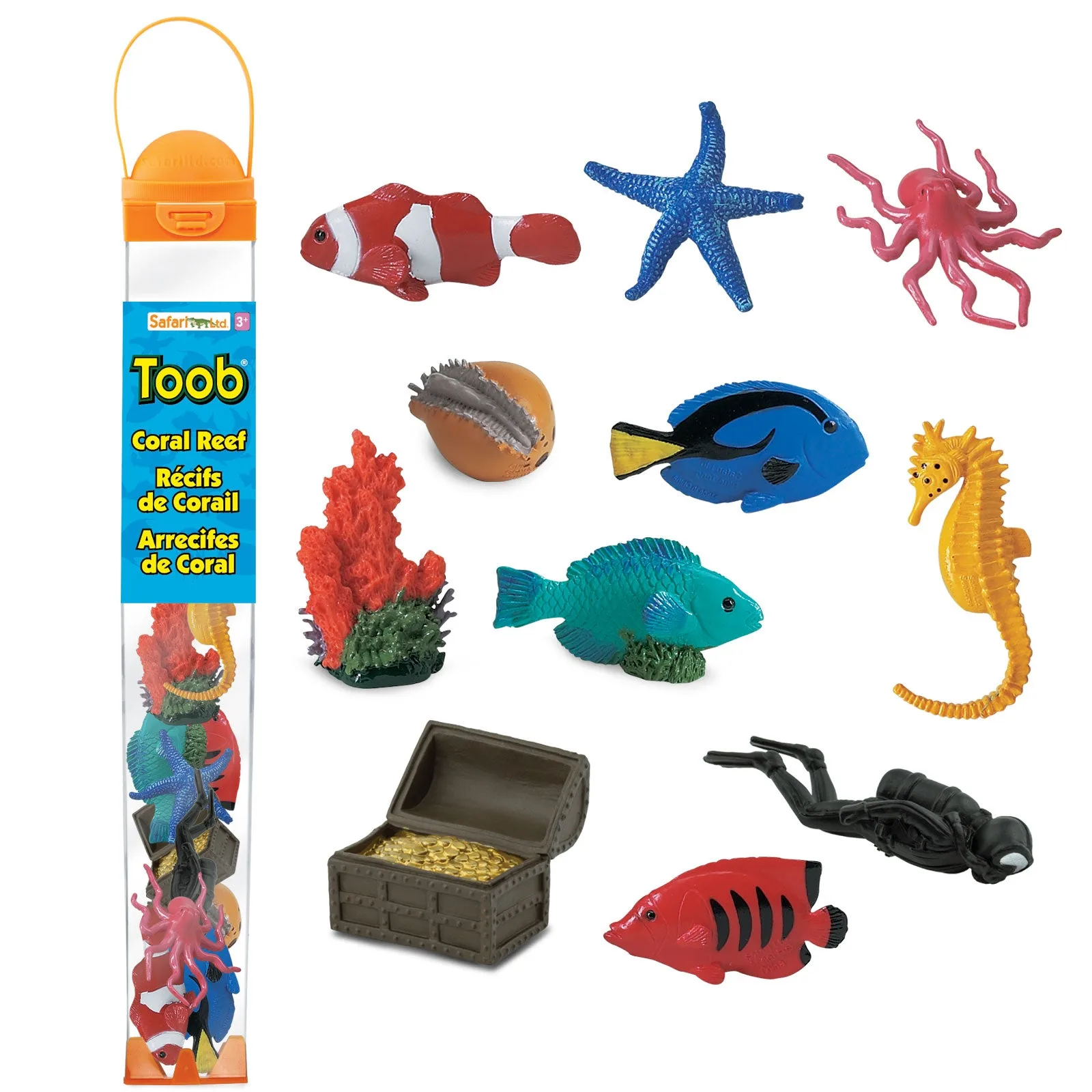
A coral reef is hard to picture from a flat page. The Coral Reef TOOB® puts a parrot fish, angel fish, blue tang, octopus, starfish, seahorse, coral, cowry shell, clown anemone fish, scuba diver and treasure chest into a child’s hands. That mix lets you show relationships — who eats whom, who hides where — without needing a screen.
The set also includes a human diver and a treasure chest, which are not reef organisms. Treat them as teaching tools for the human side of reefs: observation, tourism and the difference between natural habitat and introduced objects. That distinction is often the most memorable part of the lesson.
Where the set stops and you need to add context
The TOOB® does not include a lesson plan, species cards or a reef background. You will need to supply those or keep the activities simple enough to run from conversation. It also does not show scale, so avoid implying that the octopus and the blue tang are the same size in real life.
Because the figures are small, they suit tabletop work and supervised play better than sandbox or water play. If you want a durable classroom set, check the figures after each session for lost pieces — the cowry shell and seahorse are easy to misplace.
Step-by-step reef lesson with the Coral Reef TOOB®
- Sort the figures into three groups: Lay out all the pieces and ask your child to make three piles: fish (parrot fish, angel fish, blue tang, clown anemone fish), invertebrates (octopus, starfish, seahorse, cowry shell) and habitat or human objects (coral, scuba diver, treasure chest). Name each group together. Check that the seahorse and cowry shell are not left in the fish pile — that is the most common sorting mistake.
- Build a simple reef food web: Place the coral at the centre. Put the plant-eating fish and invertebrates around it, then add the octopus as a predator. Use the scuba diver to ask who else uses the reef. Draw arrows with a dry-erase marker on a tray to show the direction of energy. Keep the arrows pointing from the eaten to the eater; children often reverse them.
- Run a hiding-and-matching game: Hide the clown anemone fish, blue tang and seahorse around the room. Call out a reef clue, such as ‘I hide in coral’ or ‘I have a curled tail’, and have your child find the matching figure. Repeat with the remaining animals. Stop after two rounds if attention drops — the game works best as a warm-up, not the whole lesson.
- Make a shoebox reef diorama: Line a shoebox with blue paper. Have your child place the coral and cowry shell first as the reef base, then arrange the fish and invertebrates around them. Add the treasure chest and diver last and ask whether they belong in a natural reef scene. Photograph the finished diorama before packing the figures away so you can revisit the vocabulary later.
- Close with a two-minute talk-back: Ask your child to choose one figure and explain what it does on a reef. Use the scuba diver to prompt a human-impact question: what should a visitor do and not do near coral? Write one answer on a sticky note and attach it to the diorama. If your child can name the animal and one job it does, the lesson has met its goal.
Product facts
-
Coral Reef TOOB®: The Coral Reef TOOB® contains a parrot fish, angel fish, blue tang, octopus, starfish, seahorse, coral, cowry shell, clown anemone fish, scuba diver and treasure chest. That mix supports sorting by animal group and by habitat role, so one set can carry several short lessons.
Coral Reef TOOB®