Why a Curvature Plank for Backbends
A curvature plank is a simple wooden prop designed to support gentle spinal extensions and help open the chest. Unlike a standard block or bolster, its curved shape encourages a natural alignment of the spine and shoulders, making it a useful tool for backbend poses. Whether you are a beginner or an experienced practitioner, it offers a stable surface to work with.
Curvature Plank at a Glance
-
Curvature Plank: Handcrafted from solid American pinewood; dimensions 61 cm length x 7.3 cm breadth x 4 cm height; weight 0.5 kg. The size and weight make it easy to position and stable during use, while the wood provides a firm, durable surface for supporting your back.
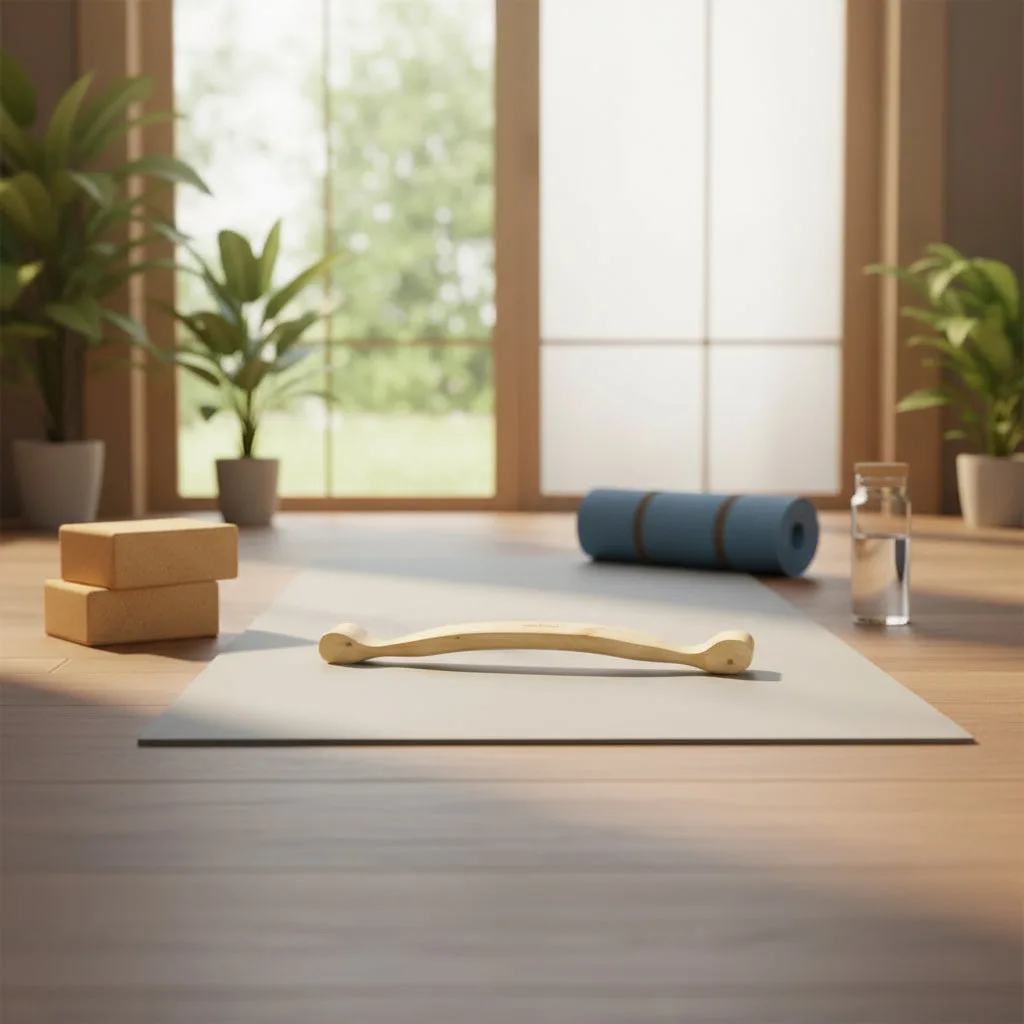
Curvature Plank
-
Curvature Plank: Primary purpose is posture correction and alignment of the spine and shoulders. This directly supports backbend practice by encouraging a safe, supported extension of the upper back.
Getting Started: Setup and Safety
Place the curvature plank on a non-slip yoga mat. The curved side should face upward. Before using it in a backbend, check that the plank is stable and will not slide. Beginners should have a spotter or experienced instructor nearby.
- Dust the surface: Use a clean, dry cloth or soft-bristle brush to remove any dust before each use. This keeps the surface clean and prevents slipping.
- Position the plank: Lie on your back with the plank placed horizontally under your mid-back or upper back, depending on the pose. The curve should support your spine naturally.
Supported Backbend Poses with the Curvature Plank
The curvature plank can be used in several poses to enhance backbends. Two common asanas mentioned in the product details are Tadasana (Mountain Pose) and Adho Mukha Svanasana (Downward-Facing Dog). In Tadasana, you can place the plank vertically behind your back and lean into it to open the chest. In Downward-Facing Dog, the plank can be placed under your chest to provide a gentle lift and support.
For a restorative backbend, lie on your back with the plank under your shoulder blades. Allow your arms to rest overhead or by your sides. Breathe deeply and let the curve gently open your chest and upper back. This is a safe way to work on spinal extension without forcing the pose.
Who Can Benefit from This Prop
The curvature plank is suitable for anyone from beginners to advanced practitioners. Beginners can use it to learn safe backbend alignment, while advanced yogis can use it to deepen their chest opening. It is also commonly used in restorative and therapeutic yoga classes for gentle stretching and soothing the back.
Honest Trade-Offs to Consider
The curvature plank is a single-purpose prop, unlike a yoga wheel or block that offers multiple functions. Its curved shape is excellent for backbends but less versatile for other poses. Additionally, the wood surface may feel firm compared to padded props. If you prefer a softer support, a yoga bolster might be more comfortable. However, for targeted spinal extension and posture correction, the curvature plank is a reliable choice.