Quick answer
Use a hundreds number board to help children count to 100, recognize numbers, and understand place value through hands-on activities.
Why a Hundreds Number Board Works for Early Math
A hundreds board gives children a visual and tactile way to see number patterns. The double-sided feature of the Hundreds Number Board (product ID 566690) adds versatility: one side has numbered squares for counting, and the reverse has a plain grid for patterning and graphing. This design supports both structured lessons and open-ended exploration.
Using physical tiles helps kinesthetic learners who struggle with worksheets. The act of placing numbered tiles in sequence reinforces number order and one-to-one correspondence.
Common Mistakes to Avoid
Don't skip the plain grid side. Many teachers only use the numbered side, but the reverse is ideal for skip counting and patterning activities that build a deeper understanding of number relationships.
Avoid overwhelming children with all 100 tiles at once. Start with smaller ranges (1-10, 1-20) and gradually increase as confidence grows.
How to Use a Hundreds Number Board for Counting Practice
- Step 1: Start with Number Recognition (1-10): Place the board with the numbered side up. Give the child the numbered tiles for 1-10. Ask them to match each tile to the corresponding square on the board. Say each number aloud as they place it. Common mistake: Children may skip numbers. Have them point to each square in order before placing tiles.
- Step 2: Count to 20 and 50: Once 1-10 is mastered, add tiles for 11-20. Emphasize the pattern of teen numbers (one-teen, two-teen). Then expand to 1-50, encouraging the child to count aloud as they fill in each row. Checkpoint: If the child struggles with 11-20, practice those numbers separately before adding more.
- Step 3: Count to 100: Fill the entire board with all 100 tiles. Have the child count from 1 to 100, touching each tile as they go. For variety, remove 5-10 tiles and ask the child to identify which numbers are missing. Common mistake: Children may lose track at decade boundaries (29→30, 39→40). Practice counting by tens first to reinforce the pattern.
- Step 4: Skip Counting on the Plain Grid: Flip the board to the plain grid side. Use the transparent red and blue tiles to mark every 2nd, 5th, or 10th square. Ask the child to count by twos, fives, or tens as they place the tiles. Checkpoint: Start with counting by tens (easiest) before moving to fives and twos.
- Step 5: Introduce Place Value: Point to a number like 42. Explain that the '4' means 4 tens and the '2' means 2 ones. Use the transparent tiles to cover groups of ten squares, helping the child visualize the concept of tens and ones. Common mistake: Children may think the digit in the tens place represents the number of tens, not the value. Emphasize that 40 is 4 tens.
Product facts
-
Hundreds Number Board: The Hundreds Number Board has recessed squares with numbers printed on the front and a plain grid for patterning and graphing on the reverse. This two-in-one design means you can use the same board for counting practice and for more advanced activities like skip counting or creating number patterns.
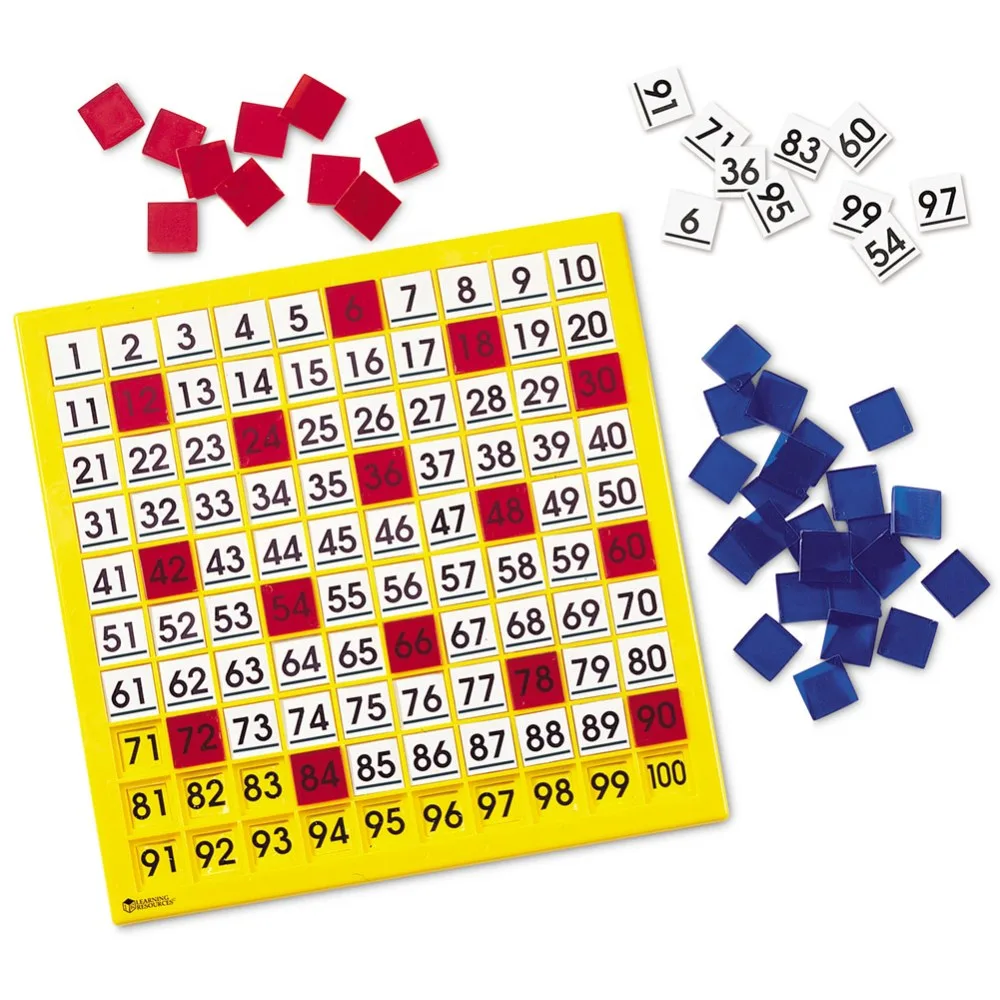
Hundreds Number Board