Quick answer
Attach a macro extension tube between your camera body and lens to reduce minimum focus distance, enabling closer shots without sacrificing image quality.
Why use extension tubes instead of a dedicated macro lens?
Extension tubes are hollow spacers that move the lens farther from the sensor, increasing magnification. They preserve your existing lens's optical quality because no extra glass is added, making them a budget-friendly way to try macro photography. The trade-off is reduced light reaching the sensor (especially with longer tubes) and loss of infinity focus—you can only shoot close subjects.
Choosing the right tube length for your shot
Most extension tube sets come with multiple lengths (e.g., 11mm and 16mm) that can be used individually or stacked. A shorter tube gives moderate magnification with less light loss, ideal for flowers or small objects. Stacking both tubes yields extreme close-ups but may require a tripod due to dimmer viewfinder and shallower depth of field.
Step-by-step guide to using macro extension tubes
- 1. Mount the extension tube: Remove the lens from your camera. Attach the extension tube to the camera body, then attach your lens to the tube. Ensure a firm click on both connections to avoid light leaks. Don't force the mount—if it doesn't align easily, check the tube orientation.
- 2. Set the lens to manual focus: Switch your lens to manual focus mode. Extension tubes reduce the focus range, so autofocus may hunt or fail. Manual focus gives you precise control over the critical sharpness plane. Use live view or focus peaking if available to confirm sharpness.
- 3. Adjust aperture for depth of field: Start with an aperture around f/8 to f/11 for a balance of sharpness and depth of field. Wider apertures create very shallow focus; narrower apertures reduce light further and may cause diffraction. Check your exposure meter—you may need to increase ISO or use a flash.
- 4. Move the camera, not the focus ring: With extension tubes, the focus distance is very tight. Instead of turning the focus ring, gently move the entire camera forward or backward until your subject appears sharp. This is called 'focus by rocking'. Use a tripod with a focusing rail for repeatable adjustments.
- 5. Use a flash or continuous light: Extension tubes reduce light reaching the sensor, making handheld shots difficult. Attach a small flash with a diffuser or use a bright LED panel to avoid camera shake at slow shutter speeds. A ring flash or twin flash works well for even illumination.
Product facts
-
Promaster Macro Extension Tube Set for Nikon Z: The ProMaster Macro Extension Tube Set for Nikon Z includes two tubes (11mm and 16mm) that can be used individually or in combination. This lets you adjust magnification and working distance for different subjects, from coins to insects.
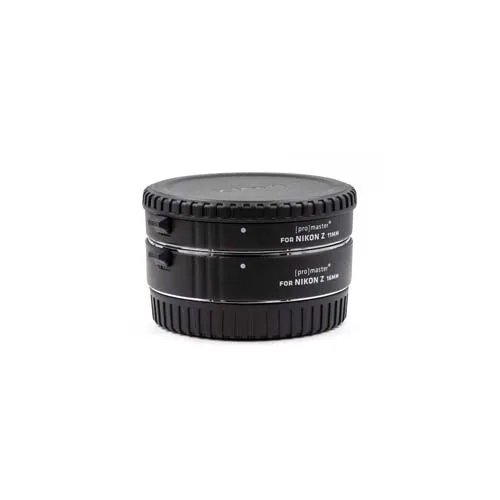
Promaster Macro Extension Tube Set for Nikon Z
-
Promaster Macro Extension Tube Set for Canon RF: The ProMaster Macro Extension Tube Set for Canon RF is engineered for precise fit and proper electronic communication between lens and body. Automatic extension tubes maintain autofocus and aperture control, so you can shoot without manual adjustments.
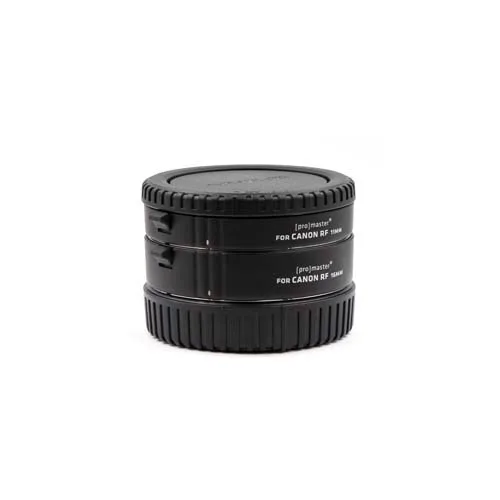
Promaster Macro Extension Tube Set for Canon RF