Quick answer
To use a pasta chitarra, roll a firm egg dough to about 2–3 mm thick, lay it over the strings, and press with a rolling pin so the strings cut square strands. Work in small batches and dust with semolina to keep the strands separate.
Why the dough needs to be firmer than for hand-cut noodles
A chitarra cuts by pressing the sheet through taut iron strings, so a soft or sticky dough will squash between the strings instead of falling through as clean strands. Mix 200 g fine semolina or 00 flour with 2 eggs (about 100 g) and a pinch of salt until the dough is stiff but workable. If it feels tacky, add flour a tablespoon at a time; if it crumbles, add water a teaspoon at a time. Rest the wrapped dough for 30 minutes so the gluten relaxes and the sheet rolls evenly.
Rolling thickness and sheet size
Roll the dough to roughly 2–3 mm—thin enough to cut cleanly but thick enough to hold its square shape. A sheet wider than the chitarra’s string bed will drape over the sides and cut unevenly, so trim it to fit within the frame before pressing. Keep the sheet lightly dusted with semolina or rice flour; too much flour can clog the strings, while too little causes the sheet to stick and tear.
When the chitarra is not the right tool
A chitarra is designed for square spaghetti and similar straight strands, not for wide ribbons, filled shapes, or very soft doughs. If you want fettuccine or ravioli, use a rolling pin and knife instead. Also skip the chitarra if your dough contains a lot of oil or extra egg yolks, which can make the sheet too soft to cut cleanly through the strings.
Step-by-step: cutting square spaghetti on a chitarra
- Mix and rest the dough: Combine 200 g fine semolina or 00 flour, 2 eggs, and a pinch of salt. Knead until smooth and firm, wrap, and rest for 30 minutes at room temperature. Checkpoint: the dough should spring back slowly when pressed; if it stays indented, knead in more flour.
- Roll a sheet to fit the string bed: Roll the dough on a lightly floured surface to about 2–3 mm thick. Trim the sheet so it is slightly narrower than the chitarra’s frame. Mistake to avoid: rolling too thin—the strands will break when pressed; too thick and they won’t cut through.
- Dust and drape: Dust both sides of the sheet with semolina or rice flour, then lay it flat across the chitarra strings without stretching it. Checkpoint: the sheet should sit loosely on the strings; if it sags heavily, it is too thin or too wet.
- Press with a rolling pin: Run a rolling pin firmly across the sheet from one end to the other in one smooth motion, pressing down as you go. Lift the chitarra and let the strands fall onto a floured tray. Mistake to avoid: pressing back and forth—this can tear the strands; use one steady pass per section.
- Separate and dry: Toss the cut strands with a little semolina and spread them in a single layer. Cook within 30 minutes or dry for a few hours before storing. Checkpoint: strands should be distinct and firm; if they clump, dust with more semolina before cooking.
Product facts
-
Verve Culture Italian Pasta Chitarra with Rolling Pin - Small: Handcrafted with beechwood and featuring iron strings. The taut iron strings are what cut the dough into square strands, so the wood frame needs to stay dry and the strings free of sticky dough.
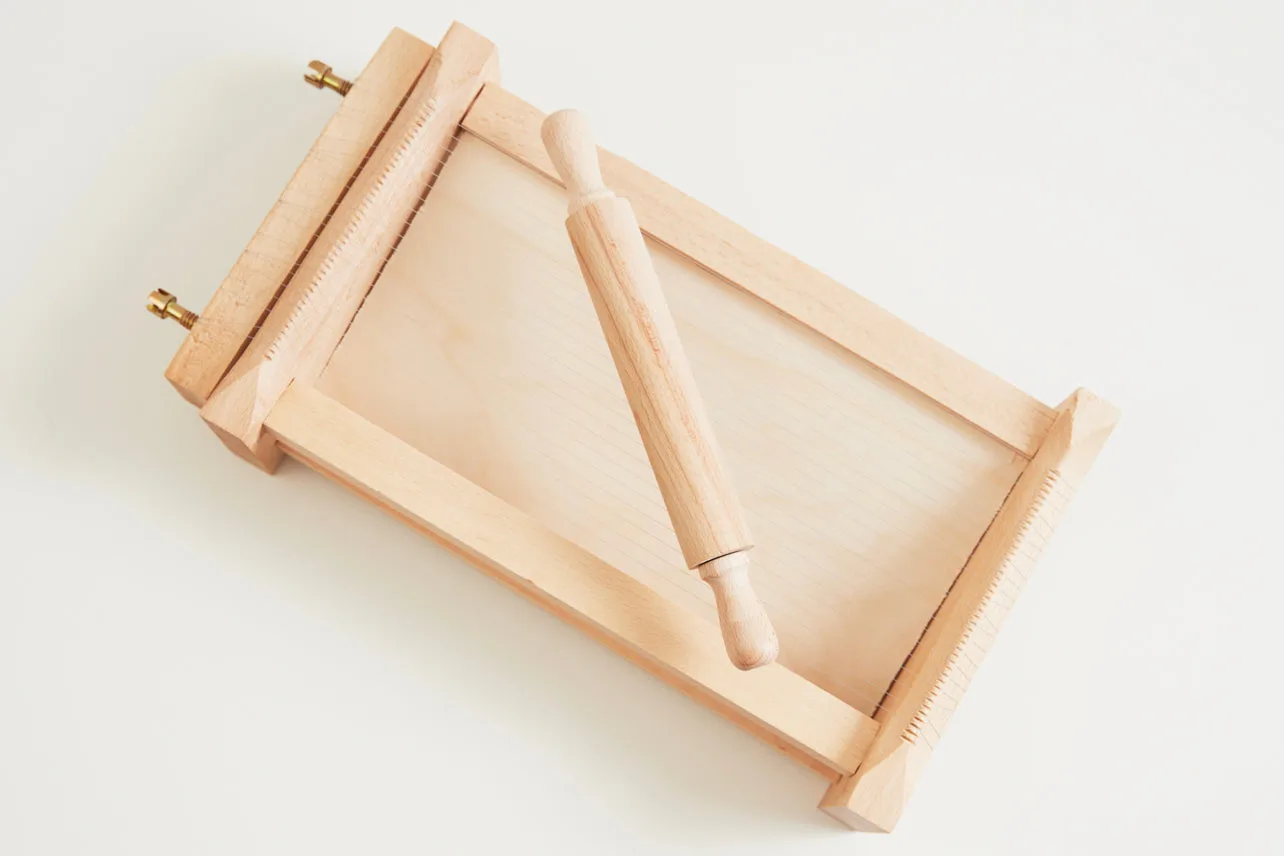
Verve Culture Italian Pasta Chitarra with Rolling Pin - Small