Quick answer
Use the Revolve Roller by rearranging its Adaptive Massage Rings to target specific muscle tightness, then roll slowly over the area, pausing on knots for deep tissue release.
Why the Revolve Roller Works Differently
Unlike a standard foam roller that provides uniform pressure, the Revolve Roller lets you customize the massage by swapping rings of different sizes and ridge patterns. This means you can adjust from a gentle surface massage to focused deep tissue compression without switching tools.
Know Your Pressure Zones
The nine rings come in three sizes, each with variable raised ridges. Larger rings with more prominent ridges deliver deeper pressure, while smaller rings are better for lighter, broader contact. Avoid using only the largest rings on bony areas like the shins or spine.
How to Use the Revolve Roller for Muscle Release
- 1. Assemble the rings for your target area: Choose ring sizes based on the muscle group. For large muscles like quads, use larger rings for deeper pressure. For smaller or sensitive areas like forearms, use smaller rings. Arrange them on the roller core in any order. A common mistake is using all large rings on a sensitive area, which can cause bruising. Start with a mixed setup.
- 2. Position the roller under the muscle: Lie on the roller so the rings contact the muscle belly, not the joint. For calves, place the roller under your shin or calf and support your weight with your arms. Checkpoint: Keep your core engaged to avoid dropping your full weight onto the roller too quickly.
- 3. Roll slowly and pause on tight spots: Move your body over the roller at a slow, controlled pace—about one inch per second. When you feel a knot or tender point, stop and take three deep breaths while applying light pressure. Do not bounce or roll rapidly; that can irritate the muscle instead of releasing it.
- 4. Adjust rings for different intensities mid-session: If a spot feels too sharp or not deep enough, sit up and swap a ring for a different size. You can also rotate the roller to use a different ridge pattern on the same ring. The ability to change rings mid-session is unique to this tool—take advantage of it rather than pushing through discomfort.
- 5. Finish with a lighter pass: After working knots, replace any larger rings with smaller ones and do one final slow roll over the entire muscle to promote blood flow and relaxation. Skipping this cooldown pass can leave the muscle feeling worked rather than released.
Product details
-
Revolve Roller: The Revolve Roller is the first adaptive massage roller with nine interchangeable rings in three sizes, each featuring variable raised ridges. You can tailor the intensity from superficial to deep tissue by simply swapping the ring arrangement, making it a versatile alternative to a standard foam roller.
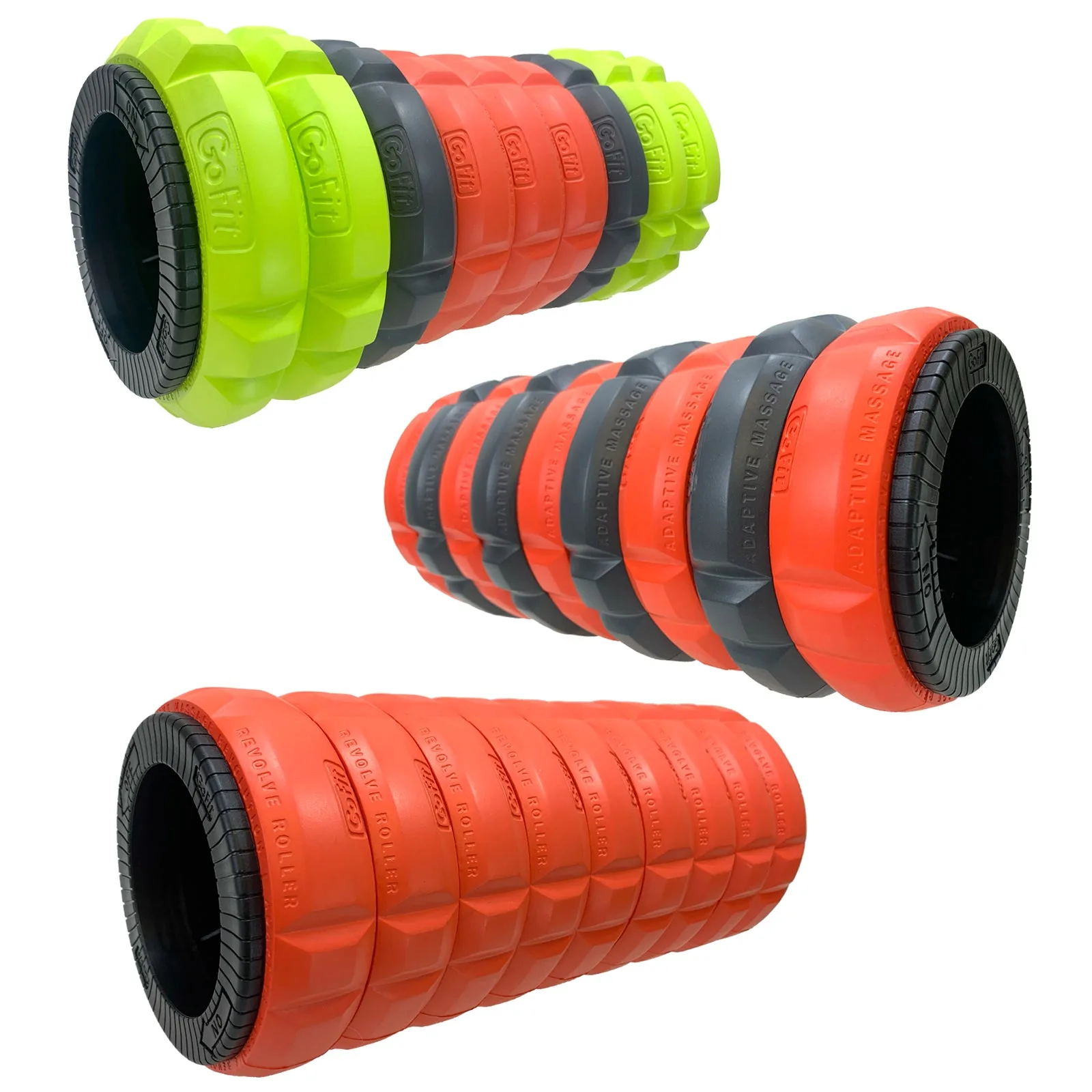
Revolve Roller