Quick answer
To use the Sunwayfoto MFR-150S, mount it between your tripod and camera, then turn the knob to move the camera fore-and-aft in precise increments for sharp macro focus stacking.
Why a focusing rail matters for macro
At high magnification, depth of field is razor-thin. Moving the entire camera instead of turning the lens focus ring keeps perspective and magnification consistent, which is essential for focus stacking.
The MFR-150S gives you smooth fore-and-aft control, so you can capture a series of images with slightly different focus points and merge them later for a fully sharp result.
Trade-off: manual vs. automatic rails
Manual rails like the MFR-150S require you to turn the knob yourself, but they are lighter, simpler, and more affordable than motorized rails. The trade-off is that you need to be consistent with your increments.
For static subjects (flowers, coins, insects), a manual rail is ideal. For moving subjects, even a motorized rail won't help—focus stacking only works with stationary scenes.
Step-by-step setup and shooting guide
- Mount the rail to your tripod: Slide the rail's double-dovetail base into your tripod head's Arca-type clamp and tighten the clamp knob securely. Ensure the rail is level and pointing in the same direction as your subject. A loose clamp can cause the rail to shift during shooting—double-check before attaching your camera.
- Attach your camera to the top clamp: Place your camera with its Arca-type plate onto the top clamp, then tighten the screw-knob until the camera is firmly locked. Orient the camera so the rail's movement is along your desired focus direction (usually toward and away from the subject). If the camera rotates or slides, the plate may not be fully seated—release and re-seat it.
- Set your focus and compose: Use the rail's knob to move the camera to the nearest focus point of your subject. Compose your shot, set your aperture for optimal sharpness (often around f/8 for macro), and turn off autofocus to prevent focus changes during the stack. Always start at the closest point to the subject so your stack covers the entire depth.
- Take a series of shots: Turn the knob in small, consistent increments to move the camera backward, taking a photo at each position. The smaller the increment, the more images you'll need, but the smoother the focus transition. A common mistake is turning too far between shots—use a marker on the rail or count clicks to keep increments even.
- Merge the images in post-processing: Import your focus-stacked images into software like Helicon Focus, Zerene Stacker, or Photoshop and align/merge them. Review the result and retake if any gaps or blurry areas appear. If you notice soft areas, you may have missed a focus point—reshoot with smaller increments.
Product spotlight
-
Sunwayfoto MFR-150S Macro Focusing Rail: The MFR-150S has an Arca-type compatible top clamp that locks with a screw-knob. You can attach your camera or a quick-release plate directly without needing extra adapters.
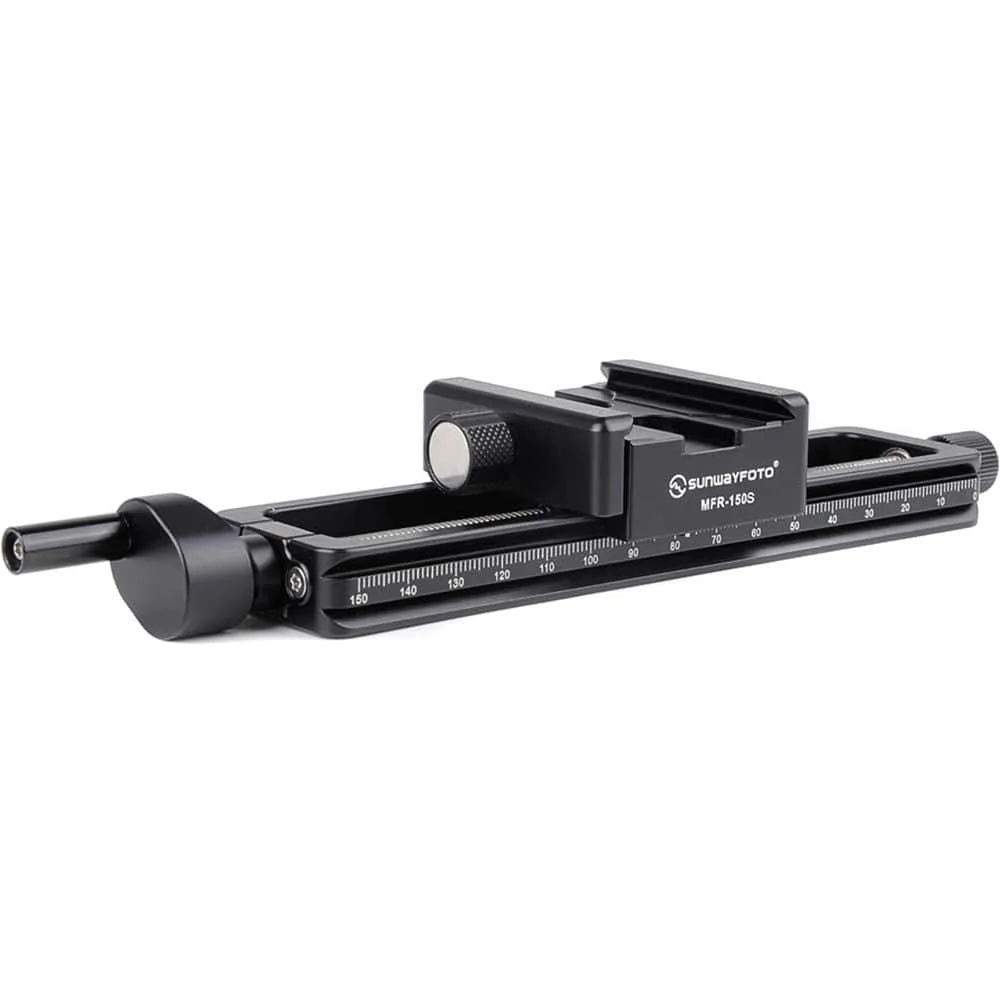
Sunwayfoto MFR-150S Macro Focusing Rail
-
Sunwayfoto MFR-150S Macro Focusing Rail: The rail features a double-dovetail mount that fits most Arca-type clamps on the market. It mounts securely on your existing tripod head, so you don't need a special base plate.